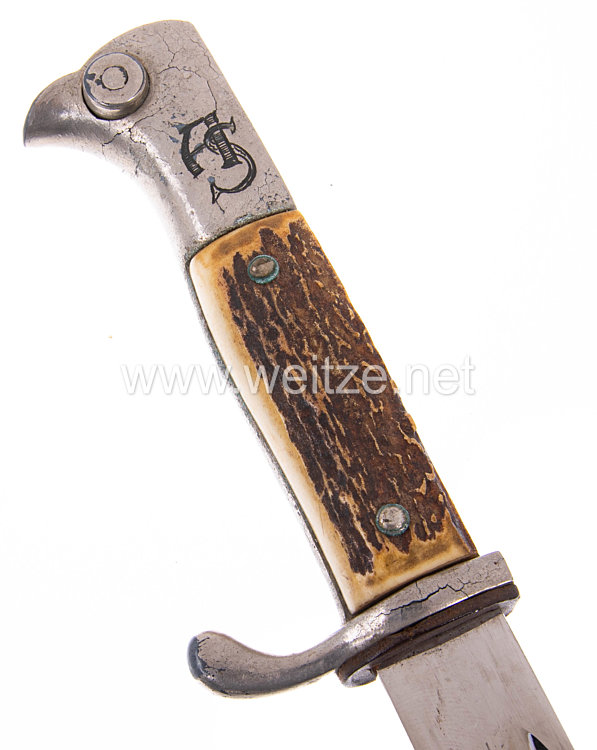
Wehrmacht Luftwaffe (WL) Dress Bayonet. Personalized!!!

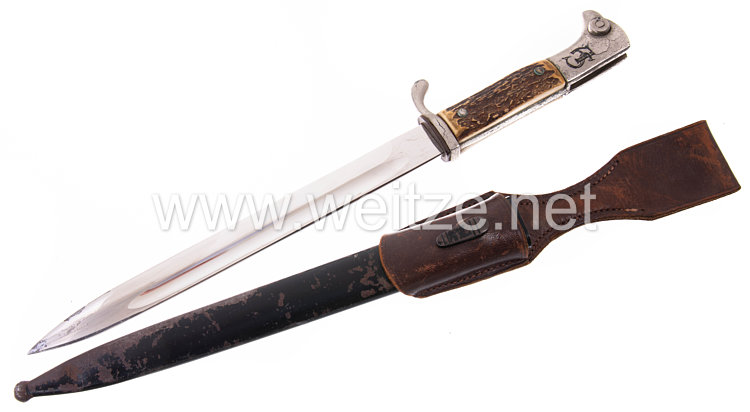
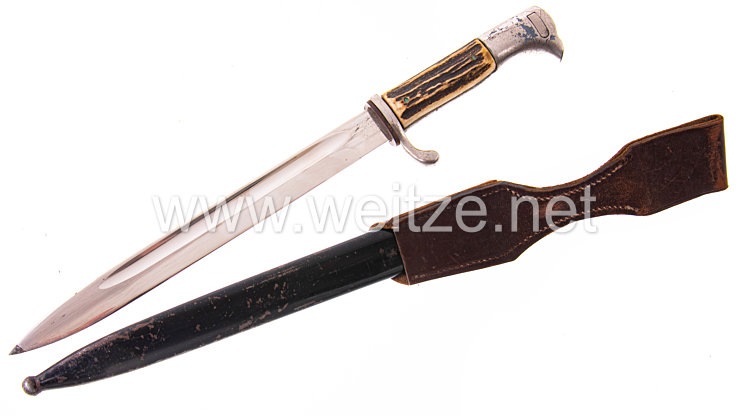
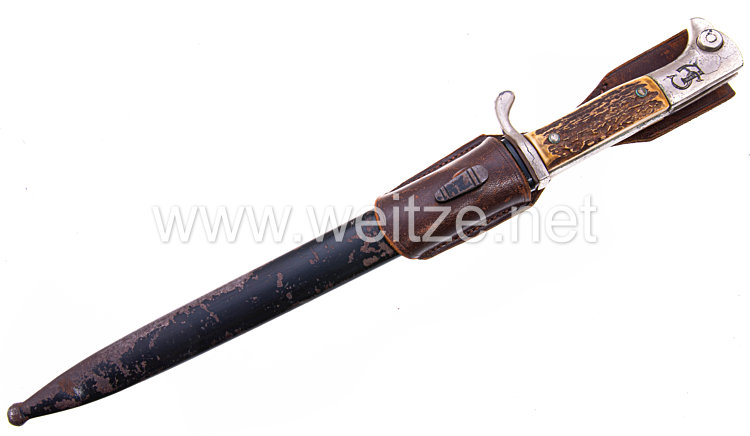
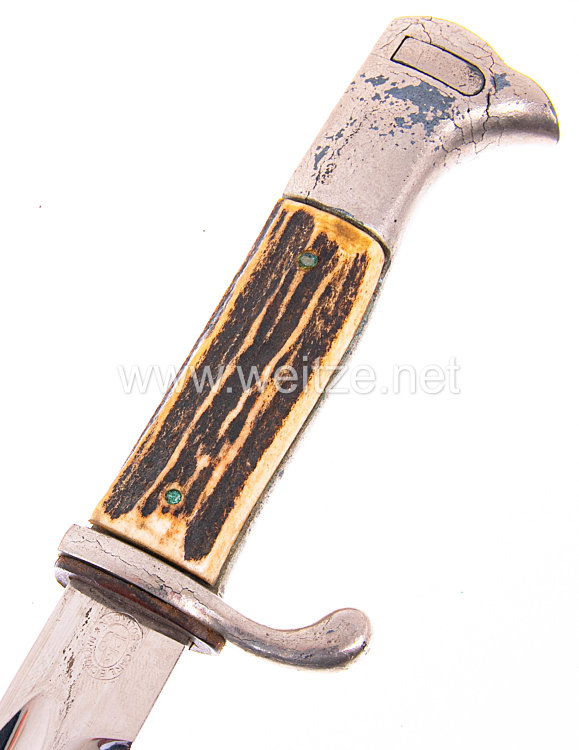
Model with long blade and wide fullers, clean blade with manufacturer marking “Carl Eickhorn Solingen”, nickel plating chipped at the tip, stag grip scales with double rivets, finely serrated crossguard, nickel plating with hairline cracks, pommel personalized on front with “AS”, black lacquered steel scabbard retaining approximately 85% of original finish, minor dent visible at chape, complete with brown leather frog. A well-preserved bayonet. Condition 2-
442234
480,00

Wehrmacht Luftwaffe (WL) Dress Bayonet. Personalized!!!

The Luftwaffe dress bayonet of the German Wehrmacht represents a significant collector's item from the Second World War era. This particular specimen bearing the manufacturer's mark Carl Eickhorn Solingen exemplifies the high quality of German edged weapon production during the Nazi period.

The firm of Carl Eickhorn in Solingen was among the most important manufacturers of edged weapons for the Wehrmacht. The company, founded in the 19th century, produced various models of bayonets for all branches of the Wehrmacht during World War II. The Solingen blade industry had enjoyed an excellent reputation for centuries, and Eickhorn was one of the leading producers of military edged weapons.

This dress bayonet is distinguished by several characteristic features. The long blade with wide fullers corresponds to the typical construction of this weapon type. The fullers served not only to reduce weight but also to strengthen the blade structure. The staghorn grip scales, double-riveted, were a typical feature of high-quality German bayonets of this era. Staghorn was valued for its durability and non-slip surface.

The finely cast crossguard with its nickel plating demonstrates the elaborate manufacturing process of these weapons. The personalization of the pommel with the initials “AS” indicates that this weapon was assigned to a specific bearer. Such personalizations were not uncommon among officers and non-commissioned officers and served to individually identify personal equipment.

The Luftwaffe, established in 1935 as the youngest branch of the Wehrmacht, had its own uniform and equipment regulations. Bayonets were part of the standard equipment for certain ranks and duties. While pilots generally did not carry bayonets, they were part of regular equipment for ground personnel, anti-aircraft troops, and Luftwaffe field divisions.

The black steel scabbard with its characteristic lacquer finish was standard for Luftwaffe bayonets. The brown leather frog enabled wearing on the belt and was part of the regular carrying system. The fact that approximately 85% of the original lacquer remains testifies to relatively good preservation, which is remarkable for objects over 75 years old.

Historically, bayonets became increasingly symbolic weapons during World War II. Their practical military significance had already declined significantly during World War I. Nevertheless, they remained in use as part of military tradition and as status symbols. In the Luftwaffe, they were primarily worn for guard duty, parades, and ceremonial occasions.

The preservation of such historical objects raises important questions regarding military historical research and commemorative culture. As material witnesses to a dark epoch of German history, they serve scientific documentation and education. The collector value of such pieces lies in their historical significance as primary sources for 20th-century military history.

The designation “Condition 2-” in the collector's world indicates a well-preserved condition with minor signs of use, which is considered remarkable for an object from the period 1935-1945. The preserved manufacturer's marking, the largely intact nickel plating, and the originally preserved components make this specimen a valuable object of study for military historical research.