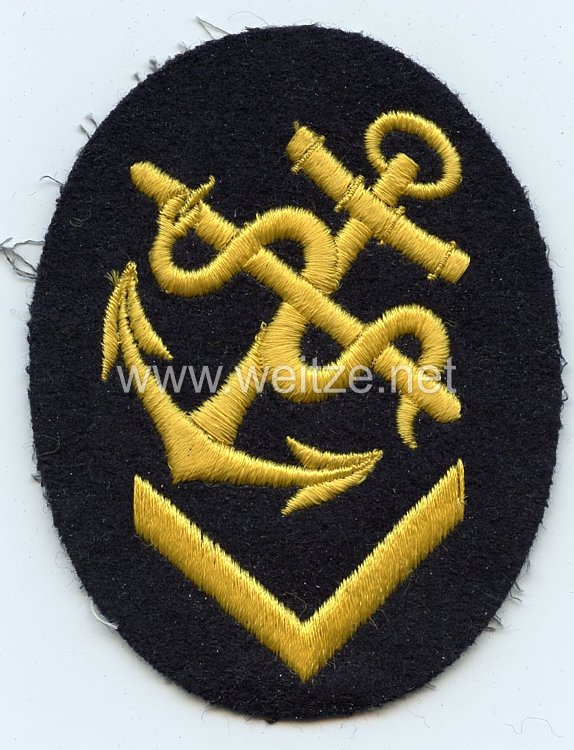
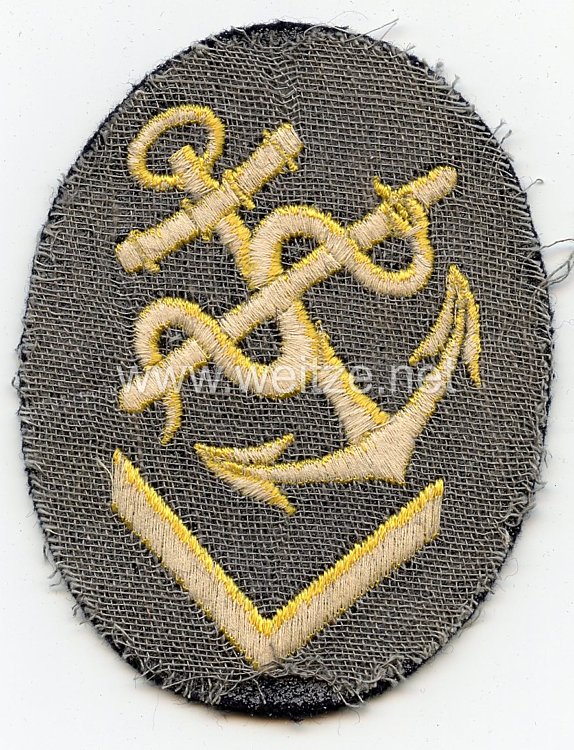
Kriegsmarine Sleeve Insignia Medical Chief Petty Officer (Sanitätsobermaat)

machine embroidered, for the blue jumper. Condition 2
376834
25,00

Kriegsmarine Sleeve Insignia Medical Chief Petty Officer (Sanitätsobermaat)

The Kriegsmarine sleeve badge for Sanitätsobermaat (Senior Medical Petty Officer) represents an important aspect of German naval uniform identification during World War II. This machine-embroidered career insignia for the blue blouse documents the complex rank system and specialized functions within the Kriegsmarine from 1935 to 1945.

The Kriegsmarine was officially established on May 21, 1935, as Nazi Germany advanced rearmament and ignored the restrictions of the Treaty of Versailles. With the Anglo-German Naval Agreement of June 18, 1935, Germany received permission to build a navy corresponding to 35 percent of the Royal Navy's tonnage. This marked the beginning of a comprehensive reorganization of German naval forces.

The rank of Sanitätsobermaat belonged to the petty officer corps with sword knot (Portepee) of the Kriegsmarine. The three-tier Maat system comprised Maat, Obermaat, and Stabsobermaat. The Sanitätsobermaat was a specialized petty officer in the medical service responsible for medical care aboard warships or in shore establishments. This position required both military discipline and medical expertise.

The career insignia of the Kriegsmarine were regulated by various uniform regulations, particularly the “Anzugordnung für die Kriegsmarine” (Dress Regulations for the Navy) and its supplements. Machine embroidery was the standard production method for sleeve badges worn on the blue working blouse. The blue blouse, also referred to as working uniform, was the daily service dress for enlisted men and petty officers.

The medical corps of the Kriegsmarine had a long tradition dating back to the Imperial Navy. Medical care at sea presented special challenges, as ships often operated for extended periods without connection to shore hospitals. The Sanitätsobermaat was frequently the highest-ranking medical specialist on smaller vessels such as U-boats, fast attack craft, or minesweepers, where no medical officer was assigned.

The sleeve badges were worn on the left upper arm and indicated the wearer's career branch through their specific design. Medical personnel were identified by special symbols that differed from badges of other branches such as artillery, torpedo service, or navigation. Machine production enabled standardized manufacturing, with various contractors producing these badges for the navy.

During the war, the Kriegsmarine served under extreme conditions in all the world's oceans. The U-boat service in particular suffered appalling losses – of approximately 40,000 U-boat personnel, only about 10,000 survived the war. In this context, the work of medical personnel was of crucial importance, not only for treating combat injuries but also for managing diseases that occurred on often overcrowded and unsanitary ships.

Training to become a Sanitätsobermaat took place at special medical schools of the Kriegsmarine. After basic training as a sailor and promotion to Sanitätsmatrose (medical seaman), candidates underwent intensive medical instruction. They learned the fundamentals of surgery, internal medicine, dentistry, and epidemiology relevant to service at sea.

Following the unconditional surrender on May 8, 1945, the Kriegsmarine was dissolved. Its ships were divided as reparations or scrapped. Uniform parts and badges became historical witnesses to a defunct military organization. Today, such sleeve badges are important study objects for military historians and collectors concerned with the uniform traditions and organization of German armed forces during World War II.

The preservation and documentation of such objects is of great significance for historical understanding. They enable the reconstruction of hierarchies, specializations, and daily life of Kriegsmarine members and contribute to the scholarly examination of this era.

r