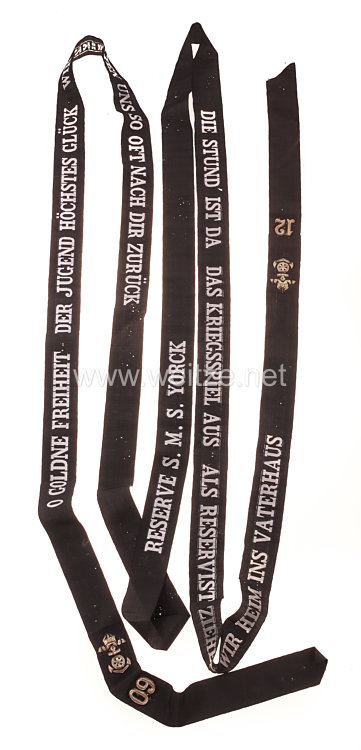
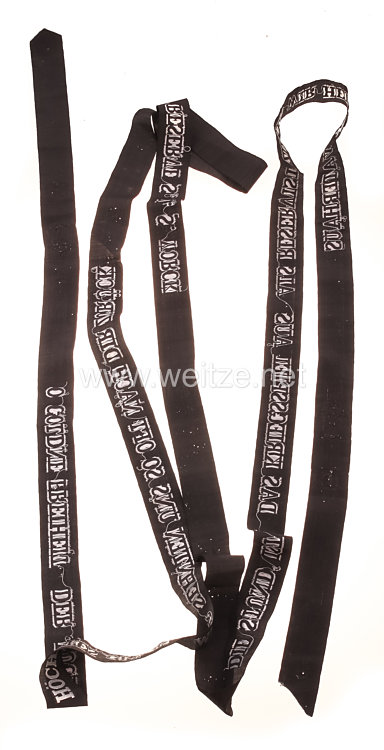
Imperial German Navy Long Reservist Cap Tally "Reserve S.M.S. Yorck"

Circa 1914. Black silk with woven silver metal thread for technical personnel. Length 188 cm. Condition 2.

SMS Yorck was the second and last ship of the Roon-class of the Imperial German Navy. The armored cruiser, officially classified as a large cruiser, built by Blohm & Voss in Hamburg, served in the active fleet of the German Navy from 1905 to 1913. Reactivated at the beginning of World War I, the cruiser sank on November 4, 1914 in the Jade estuary after striking two mines.


438634
250,00

Imperial German Navy Long Reservist Cap Tally "Reserve S.M.S. Yorck"

The reservist cap ribbon of the Imperial German Navy represents a fascinating testament to the maritime tradition of the German Empire. These ribbons, worn on the uniform caps of naval personnel, served not only to identify ship affiliation but also expressed pride and camaraderie among sailors.

The SMS Yorck was the second and final armored cruiser of the Roon-class, built by the renowned shipyard Blohm & Voss in Hamburg. The ship was commissioned in 1905 and embodied the technological and strategic ambitions of the Imperial Navy at the beginning of the 20th century. With a displacement of approximately 9,350 tons and armament consisting of four 21-cm guns and ten 15-cm guns, the Yorck was among the significant warships of her time.

The present cap ribbon is distinguished by its execution in black silk with silver metal thread, indicating affiliation with the technical personnel. In the hierarchically structured Imperial Navy, there were clear distinctions between different ranks and specializations. While deck personnel wore gold lettering on their ribbons, the silver version identified machinists, stokers, and other technical specialists responsible for the ship's propulsion and mechanical systems.

The designation “Reserve” on the ribbon indicates that this band belonged to a reservist who had already completed his active service. The reserve system played a central role in the German military structure. After completing active service, former soldiers and sailors remained in the reserve and could be called up in case of war. Many reservists had special cap ribbons made as mementos of their service time, which they wore at veteran gatherings and other ceremonial occasions.

The SMS Yorck had a relatively short but eventful career. From 1905 to 1913, she was part of the active fleet and participated in various fleet exercises and representational voyages. In 1913, the ship was decommissioned as newer and more capable cruisers became available. With the outbreak of World War I in August 1914, the Yorck was reactivated to reinforce the German High Seas Fleet.

The fate of SMS Yorck met a tragic end on November 4, 1914. During a night training exercise in the Jade estuary, one of the main bases of the Imperial Navy, the cruiser entered a German minefield. Two mines exploded under the ship, causing severe damage. Despite all rescue attempts, the Yorck sank within a short time. Of the crew, 336 men lost their lives, while only 127 sailors were rescued. This catastrophe was one of the first severe losses of the German Navy in World War I and a bitter blow to fleet morale.

Cap ribbons like the present example were manufactured according to strict naval regulations. The length of approximately 188 cm was standardized, allowing the ribbon to be wrapped around the cap with both ends hanging down at the back. The weaving quality and materials were subject to precise specifications to ensure durability and uniform appearance. The lettering had to conform to specific typographic guidelines, with the inscription indicating the ship's name and, where applicable, fleet affiliation.

For collectors and historians, such cap ribbons are of particular value as they establish direct connections to specific ships and their history. They document not only maritime tradition but also the personal fates of the men who served on these vessels. In the case of SMS Yorck, such a ribbon commemorates a ship lost through a tragic accident and the men who went down with her.

The preservation of such historical artifacts is of great importance for understanding German naval history and the social structures of the Imperial era. They offer insights into technical development, organizational structures, and the human aspects of naval service in the early 20th century. These ribbons serve as tangible links to a bygone era when the Imperial German Navy sought to establish itself as a world-class maritime power.

r