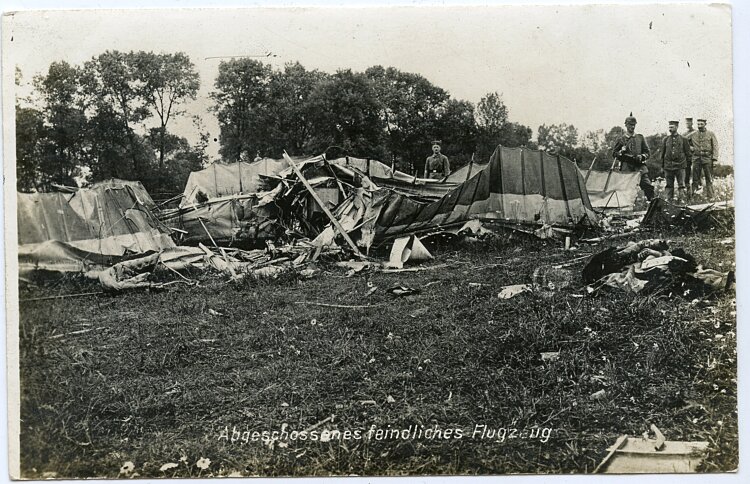
Photograph of Aviation World War I: a Shot Down Enemy Aircraft

Postcard size, condition 2
178834
12,00

Photograph of Aviation World War I: a Shot Down Enemy Aircraft

This object is a historical photograph in postcard format documenting a shot-down enemy aircraft from World War I. Such photographic documents represent important testimonies of early military aviation history and were widespread between 1914 and 1918.

World War I marked a turning point in the history of military aviation. What began as a reconnaissance tool quickly developed into an independent theater of war. The first aircraft were primarily used from 1914 onwards for observing enemy positions, but by 1915 specialized fighter aircraft began to develop. Pioneers such as Oswald Boelcke, Max Immelmann, and later Manfred von Richthofen became legends of the skies.

Photographs of shot-down aircraft served multiple purposes: they documented military successes, were used for propaganda purposes, and served intelligence analysis. The identification of aircraft type, armament, and technical equipment provided valuable information about the technological status of the opponent. German, British, French, and later American forces maintained their own photographic units that systematically produced such images.

The production of such photographs in postcard format was typical for the era. The format corresponded to the then-common standards of approximately 9 x 14 cm and allowed for easy reproduction and distribution. Soldiers collected these images as mementos, sent them to the home front, or exchanged them among themselves. Some photographs were officially published by military authorities, while others were created through private initiative by soldiers or war correspondents.

The air combat of World War I was characterized by enormous brutality. Without parachutes (German fighter pilots only received parachutes in 1918, while among the Allies they were considered “cowardly” for even longer), a hit often meant certain death. The average life expectancy of a fighter pilot on the Western Front was sometimes only a few weeks. Nevertheless, a special code of honor developed among airmen that treated fallen opponents with respect.

Shot-down aircraft were meticulously examined by both sides. Technical development progressed rapidly: from the initial Fokker Monoplanes and Nieuport Scouts in 1915, through the Albatros D-series and SPAD XIII in 1916/17, to the highly developed Fokker D.VII and Sopwith Camel in 1918, only a few years passed. Each captured aircraft offered the opportunity to identify weaknesses and improve one's own technology.

The verification of victories was a complex process. An aerial victory had to be confirmed by witnesses, ideally by the wreckage itself. Photographs played a crucial role as evidence. The various air forces developed different confirmation procedures, leading to considerable discrepancies in official victory tallies.

From today's perspective, such photographs are of inestimable historical value. They document not only the technical development of aviation but also the human dimension of this war. Each shot-down aircraft represents one or more human lives, shattered hopes, and families in mourning. The sober documentation of this destruction gives us insight today into the mentality and perception of that time.

Collectors and historians particularly value such original documents as they represent authentic period testimonies. The indicated condition 2 suggests good preservation with minor signs of use, which is remarkable for photographs over a hundred years old. The preservation of such objects helps keep alive the memory of the horrors of war and the sacrifices made.

These images also provide important information for aviation historians and researchers studying the development of aerial warfare tactics, aircraft recognition, and the evolution of military photography. They serve as primary sources for understanding how the war in the air was perceived, documented, and communicated to both military authorities and the civilian population.