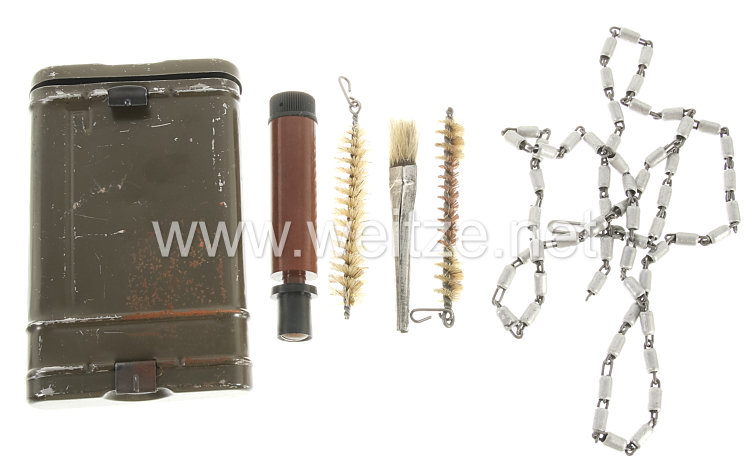
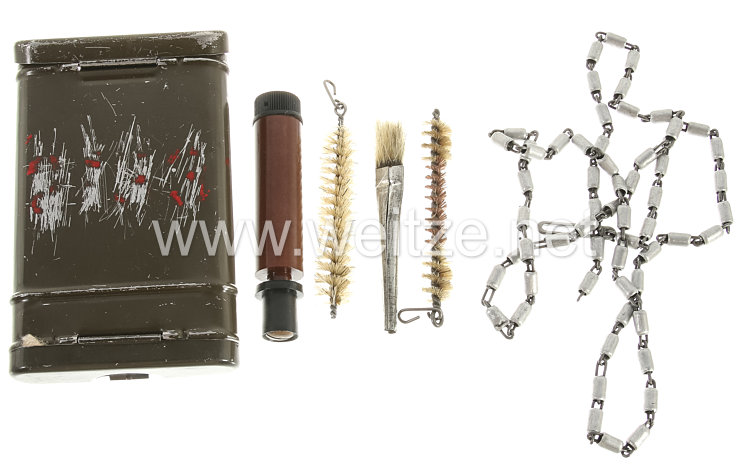
Federal Republic of Germany (FRG) Bundeswehr Rifle Cleaning Kit

complete with contents, dated 1962, condition 2
360134
25,00

Federal Republic of Germany (FRG) Bundeswehr Rifle Cleaning Kit

The rifle cleaning kit of the Bundeswehr, dated 1962, represents an important aspect of military equipment and weapon maintenance during the early years of West German armed forces. When the Federal Republic of Germany regained its sovereignty in 1955 and established the Bundeswehr, it marked the beginning of an intensive phase of reorganization and equipment of German military forces in the context of the Cold War.

In the early 1960s, the Bundeswehr was still in its formative period. The standard rifle of this time was the Gewehr 1 (G1), a licensed version of the Belgian FN FAL, which was procured from 1956 to 1961. Starting in 1959, the introduction of the Gewehr 3 (G3) began, produced by Heckler & Koch, which would remain the main infantry weapon of the Bundeswehr until the 1990s. The year 1962 thus marks a transitional period during which both weapon systems were in service simultaneously.

The proper care and maintenance of small arms was and remains a fundamental component of military training and discipline. The Heeresdienstvorschrift (HDv) and other military regulations prescribed in detail how weapons were to be cleaned and maintained. A typical cleaning kit of this era contained various standardized components specifically designed for the needs of the weapon systems in use.

A complete cleaning kit typically consisted of several essential elements: a metal cleaning rod, or later one made of modern materials, which could be divided into multiple segments; various brush attachments for different calibers and cleaning purposes; cleaning patches or cleaning wool; a bore mop for the barrel; a small bottle of gun oil; and often a combination tool for minor maintenance work. These components were packaged in a durable pouch or case made of artificial leather or textile material, which was typically marked with military nomenclature and date stamps.

The dating of 1962 on the cleaning kit followed the military practice of material dating, which was important for both logistical purposes and quality control. These dates enabled the Bundeswehr to track inventory, replace worn parts in a timely manner, and monitor the service life of equipment. Typically, these sets were produced in large quantities by various suppliers, with strict quality standards being maintained.

In the context of the Cold War and the integration of the Bundeswehr into NATO structures, the standardization of equipment and materials was of great importance. The Bundeswehr oriented itself in many areas toward American and other NATO standards, but also developed its own specifications that met the particular requirements of the German armed forces.

Military training strongly emphasized the importance of weapon care. Soldiers were systematically trained to thoroughly clean their weapons after every deployment, exercise, or shooting training. This served not only the functional reliability of the weapon but was also part of military discipline and responsible handling of equipment. The inspection of weapons and their state of cleanliness was a regular component of service operations.

The present set in condition 2 indicates well-preserved equipment that may not have been intensively used in the field or was carefully maintained. Collectors of military equipment particularly value such early Bundeswehr items because they document the history of German rearmament and bear witness to the technical and organizational development of the armed forces.

From a material culture perspective, these cleaning kits reveal much about the practical realities of military service. The design reflected both functional requirements and the economic constraints of the early Bundeswehr. Every component had to be robust enough to withstand field conditions while remaining portable and easy to use under various circumstances.

Today, such historical cleaning kits are important objects of study for military historians and sought-after collectibles. They tell the story of the practical aspects of military service beyond strategy and tactics, and remind us of the daily routines and duties of soldiers during one of the most tense periods in German and European history.