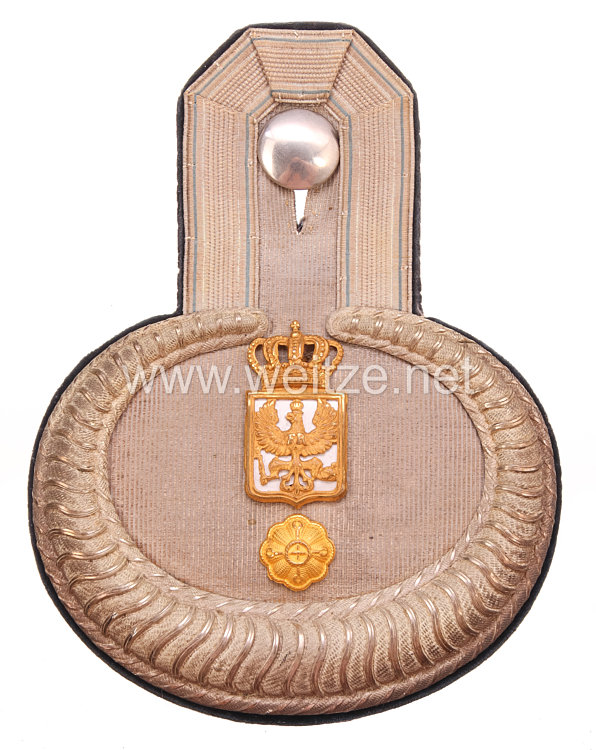
Prussia Military Intendantur Single Epaulette for a Secretary

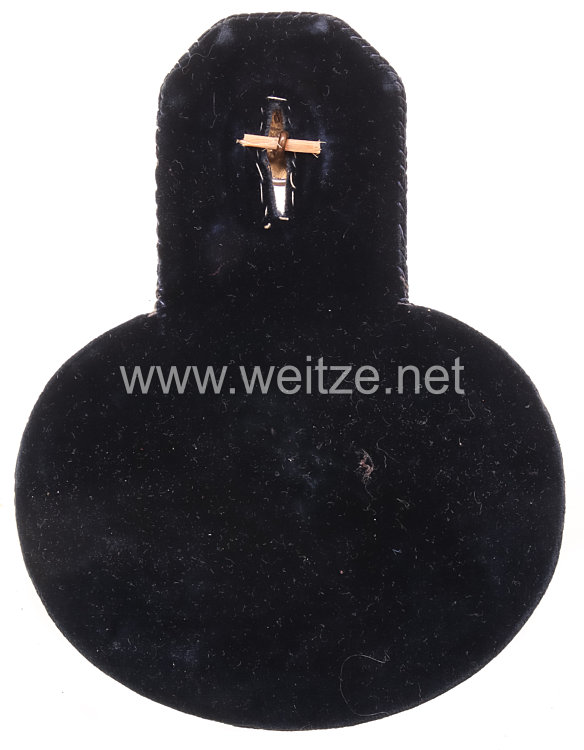
Circa 1900. Silver field, silver braids with blue stripes, silver crescent, gold rank star and civil service insignia, dark blue velvet backing. Condition 2+.
414633
220,00

Prussia Military Intendantur Single Epaulette for a Secretary

This single epaulette represents a fascinating artifact of the Prussian military administration around 1900. As a rank insignia of a Secretary of the Military Intendantur, this piece embodies the complex hierarchy and careful differentiation that characterized the Prussian military system, even in its administrative branches.

The Militär-Intendantur formed the backbone of the logistical and administrative organization of the Prussian army. This institution was responsible for the procurement, storage, and distribution of equipment, provisions, and all material resources required for the operation of a modern army. During the military reforms of the 19th century and the increasing professionalization of military affairs, the Intendantur gained considerable importance. The Prussian army recognized early that military success was achieved not only on the battlefield but also through efficient administration and logistics.

The epaulette described here displays the characteristic features of civil service rank insignia in the Prussian army. The silver field with silver braids and blue interwoven threads corresponds to the color scheme prescribed for Intendantur officials. Blue was traditionally the branch color of the Intendantur and appears both in the interwoven threads of the epaulette and in the dark blue velvet backing. This color coding enabled immediate identification of a wearer's branch or administrative unit.

Particularly noteworthy is the combination of the silver crescent, golden rank star, and the civil service emblem. These elements precisely defined the wearer's status within the military hierarchy. While officers wore epaulettes as pairs, civil servants and non-commissioned officers frequently used single epaulettes or wore different insignia on their two shoulders. The golden rank star indicates a middle position in the civil service hierarchy, while the civil service emblem identifies membership in the civilian branch of military service.

The position of a Secretary in the Militär-Intendantur was not insignificant. Secretaries were responsible for extensive correspondence, maintaining registries, managing documents, and often drafting reports and statistics. In an era before digitization, these officials formed the nervous system of military administration. They needed not only excellent writing skills but also familiarity with military regulations, administrative procedures, and often multiple languages.

The craftsmanship involved in such epaulettes was remarkably elaborate. The braids were made from genuine precious metal threads, with silver wire wrapped around silk threads. The crescent – the half-moon-shaped element – was manufactured separately and sewn on. The rank star and civil service emblem were often produced by specialized military effects manufacturers who worked under strict quality control to ensure compliance with military regulations.

Around 1900, the Prussian military was in a phase of modernization and expansion. Under Kaiser Wilhelm II, the army was not only numerically strengthened but also organizationally developed. Administrative structures were professionalized, and the importance of well-trained officials was increasingly recognized. The precise uniforming and identification of these officials through rank insignia like the present epaulette reflects this professionalization process.

The uniform regulations of the Prussian army were extraordinarily detailed and precisely regulated which uniform parts and rank insignia were to be worn by which ranks. These regulations were regularly updated and published in official gazettes. Compliance with these regulations was not optional but strictly monitored. Incorrect or unauthorized rank insignia could lead to disciplinary measures.

After the end of World War I and the collapse of the monarchy in 1918, these rank insignia lost their official significance. Many were kept by their wearers as mementos or entered the trade. Today they are important sources for uniform studies and research into Prussian military history. They document not only external appearance but also the social structure and organizational complexity of one of Europe's most significant armies.

For collectors and historians, such epaulettes offer valuable insights into the everyday reality of Prussian military life beyond the great battles. They remind us that an army consisted not only of fighting troops but also of an extensive administrative apparatus whose members had their own rank insignia, traditions, and professional identities.