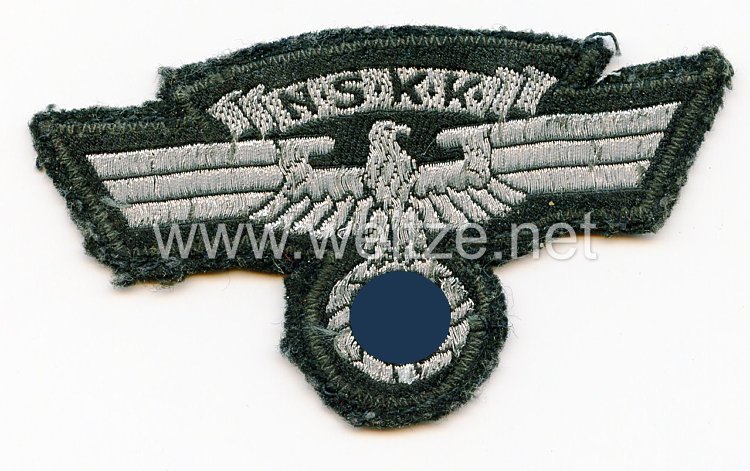
NSKK-Transportbrigade Speer Sleeve Eagle of the French Volunteers

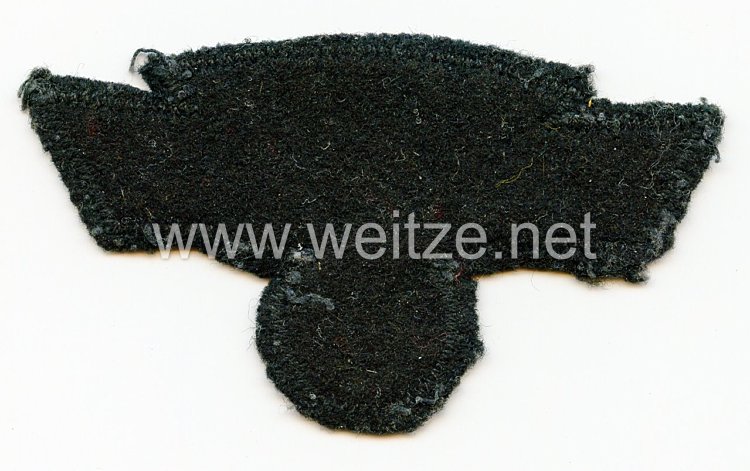
Version for the service tunic, circa 1942. The sleeve eagle in metal thread woven construction on black wool backing. Worn condition, Condition 2.
383333
250,00

NSKK-Transportbrigade Speer Sleeve Eagle of the French Volunteers

The NSKK Sleeve Eagle of the Transport Brigade Speer for French volunteers represents a remarkable testimony to a little-known facet of German occupation policy during World War II. This badge, manufactured around 1942, documents the integration of French civilians into the German war economy and logistics organization under the leadership of Albert Speer.

The National Socialist Motor Corps (NSKK) was founded in 1931 as a paramilitary organization of the NSDAP and developed into an important pillar of German war logistics. With Albert Speer's appointment as Reich Minister for Armaments and Munitions in February 1942, the need for transport capacity increased dramatically. The Transport Brigade Speer, also known as the NSKK Transport Group Todt, was created to manage the enormous logistical challenges on all fronts.

The recruitment of French volunteers for German services occurred in several waves. After France's defeat in 1940 and the establishment of the Vichy Regime, the German occupation authorities sought ways to mobilize French labor for the war economy. The Relève of 1942 and later the Service du Travail Obligatoire (STO) of 1943 forced hundreds of thousands of French citizens to work in Germany. In parallel, the Germans also specifically recruited volunteers for various organizations, including the Transport Brigade Speer.

The sleeve eagle described here shows the characteristic design for members of this formation. The badge was manufactured in metal-thread woven execution on black cloth backing, which corresponded to the standard quality for service tunics. The eagle itself followed the standardized forms of NSKK badges, but with specific markings for French volunteer units. The black backing corresponded to the NSKK colors and distinguished these badges from those of other organizations.

French volunteers in the Transport Brigade Speer were primarily deployed in occupied France, Belgium, and on the Eastern Front. Their duties included transporting material, ammunition, and supplies for the Wehrmacht and Organization Todt. The motivation for volunteering was diverse: economic hardship, ideological conviction, thirst for adventure, or attempts to avoid STO forced service by “voluntarily” enrolling in a specific formation.

The uniforming of these units largely followed NSKK regulations, with special badges identifying membership in the Transport Brigade Speer and national origin. The sleeve eagle was worn on the left upper arm and was a central identifying feature. The quality of execution varied depending on the time and place of manufacture. Early badges from around 1942, like the one described here, often showed higher-quality workmanship than later wartime productions.

The organization of the Transport Brigade Speer was strictly hierarchical. The formation was directly subordinate to the Reich Ministry for Armaments and Munitions and worked closely with Organization Todt. On the Eastern Front, these transport units played a critical role in maintaining supply lines over enormous distances and under the harshest climatic conditions.

After the liberation of France in 1944, French collaborators who had served in German formations were prosecuted. Many attempted to hide or minimize their participation. Uniform parts and badges were frequently destroyed, which explains why well-preserved examples are rare today. The wearing of such badges, as evidenced by the worn condition of this specimen, confirms actual service use.

From a military-historical perspective, such badges document the complex reality of German occupation rule and collaboration. They shed light on the organization of the German war economy and the role of foreign volunteers and forced laborers. The Transport Brigade Speer is an example of the fusion of civilian and military structures in total war.

Research on these formations is not yet complete. Archives in Germany, France, and Russia continue to contain unevaluated material on the composition, deployments, and fate of these units. Such material remains as the described sleeve eagle are important sources for historical research and museum work, as they make abstract history concrete and tangible.