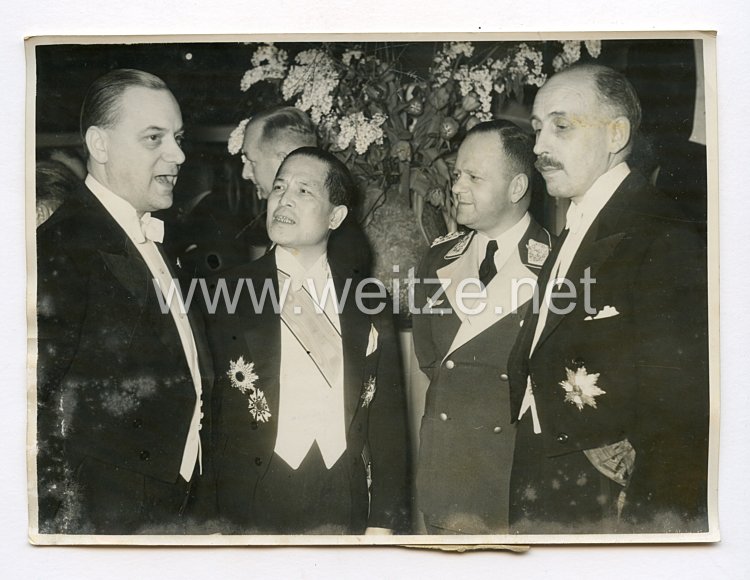
Third Reich Press Photograph. Reception of the Reich Press Chief at the Hotel Kaiserhof in Berlin. January 24, 1939.

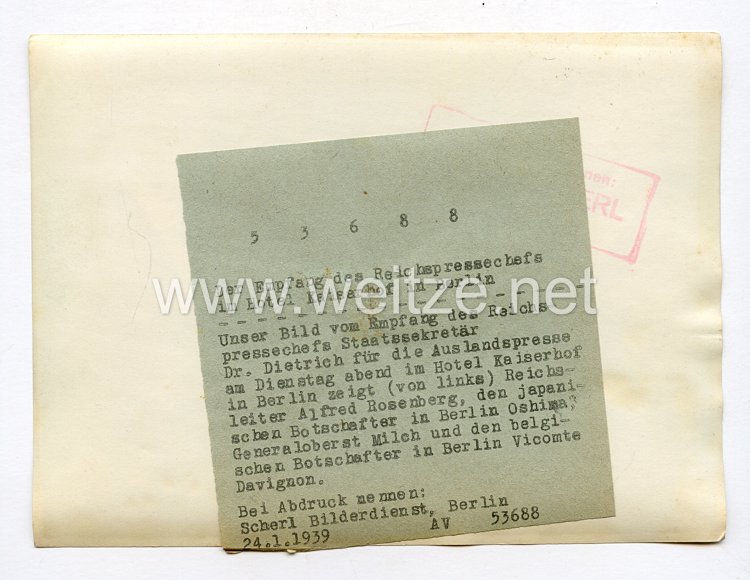
Dimensions approx. 13 x 18 cm, with description on reverse, used condition. 
313233
20,00

Third Reich Press Photograph. Reception of the Reich Press Chief at the Hotel Kaiserhof in Berlin. January 24, 1939.

This Third Reich press photograph documents a reception for the Reich Press Chief at the legendary Hotel Kaiserhof in Berlin on January 24, 1939. Such photographs constitute important contemporary historical sources that provide insight into the propaganda and media machinery of the National Socialist regime.

The Hotel Kaiserhof was located at Wilhelmplatz in immediate proximity to the Reich Chancellery and played a central role in the history of the NSDAP. Even before the seizure of power in 1933, it served as a preferred meeting place and quasi-unofficial headquarters for Adolf Hitler and other high-ranking National Socialists. After 1933, the hotel retained its significance as a venue for official receptions, press conferences, and diplomatic meetings.

The position of Reich Press Chief was a key function in the National Socialist power structure. Since 1937, Dr. Otto Dietrich had held this office. Dietrich simultaneously served as Reich Press Chief of the NSDAP and Press Chief of the Reich Government, thereby exercising central control over the entire German press. His task was to direct reporting, issue press directives, and ensure that the media disseminated National Socialist ideology.

Press photographs of this type were an essential component of National Socialist propaganda. They were centrally controlled by the Reich Ministry for Public Enlightenment and Propaganda under Joseph Goebbels and distributed to newspapers, magazines, and photo agencies domestically and abroad. The photographs were intended to convey a specific image of the regime - one of order, power, and modernity. Each image was carefully selected and often staged to convey the desired political message.

The year 1939 marked a decisive turning point in the history of the Third Reich. January 1939 was characterized by increasing international tensions. On January 30, 1939, one week after the reception documented in the photograph, Hitler delivered his infamous Reichstag speech in which he prophesied the “annihilation of the Jewish race in Europe” in the event of war. This threat would materialize in terrible ways in the coming years.

The technical characteristics of the photograph - approximately 13 x 18 cm format with description on the reverse - correspond to the standard for press photographs of that era. These dimensions were ideal for reproduction in newspapers and allowed for easy archiving. The reverse inscription was customary and typically contained information about the event, the date, possibly the names of depicted persons, and often a stamp from the distributing agency or the Propaganda Ministry.

Such press photographs were produced and distributed by various organizations, including Presse-Hoffmann-Archiv (Heinrich Hoffmann's photo agency, who served as Hitler's personal photographer), Scherl Bilderdienst, the Wehrmacht's Propaganda Companies, and other state-controlled photo agencies. After being taken, the photographs were developed, captioned, and distributed to media outlets that were obligated to use them when ordered to do so by the propaganda authorities.

From today's perspective, these press photographs are significant historical documents that must be viewed critically. They are not objective documentation but deliberately staged propaganda tools. Nevertheless, they offer valuable insights into the regime's self-representation, the visual strategies of National Socialist propaganda, and the events of that time. They are part of the material legacy of a dictatorial rule and serve today as illustrative material for historical research and education.

The Hotel Kaiserhof itself was severely damaged during Allied bombing raids in World War II and was not rebuilt after 1945. In its place today stands part of the modern Berlin cityscape. However, the hotel remains a symbol of the close interweaving of power, propaganda, and public sphere in National Socialist Germany.

r