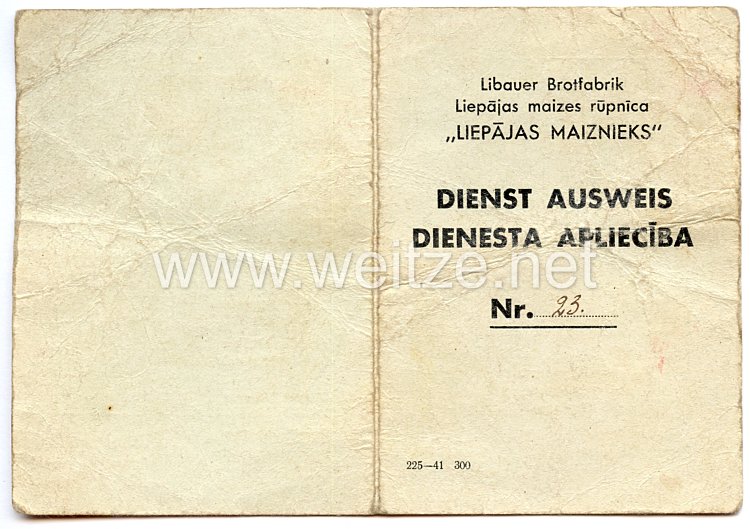
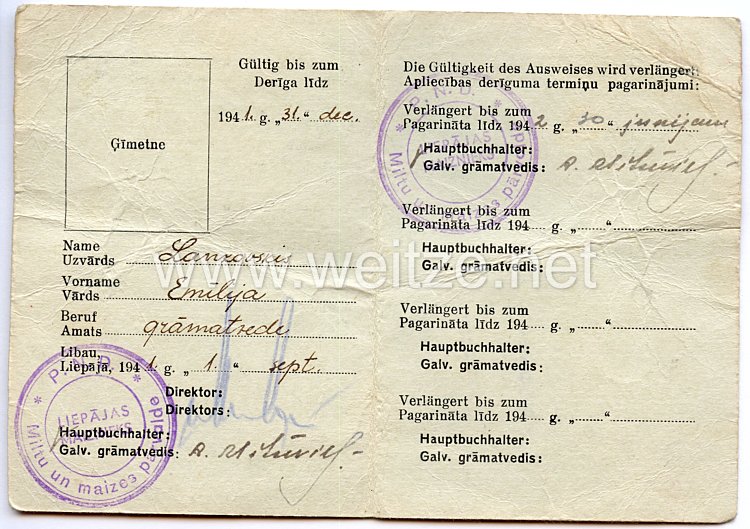
Third Reich / Latvia - Libau Bread Factory - Service Identification Card for a Woman

issued on September 1, 1941, without photograph; bilingual form in German-Latvian, used condition.
339233
100,00

Third Reich / Latvia - Libau Bread Factory - Service Identification Card for a Woman

This service identification card from the Libau Bread Factory dated 1941 represents a remarkable artifact from the German occupation of Latvia during World War II. Issued on September 1, 1941, only weeks after the beginning of the German invasion of the Soviet Union as part of Operation Barbarossa, this document demonstrates the rapid establishment of German administrative structures in newly occupied territories.

Liepāja (German: Libau) was a significant port city on Latvia's Baltic coast with approximately 57,000 inhabitants in 1941. The Wehrmacht captured the city on June 29, 1941, just one week after the launch of the attack on the Soviet Union. The city held great strategic importance due to its ice-free harbor and quickly became a major base for the German Navy (Kriegsmarine).

The bilingual format of the identification card in German and Latvian reflects the Third Reich's occupation policy in the Baltic states. Unlike other occupied territories, the German administration initially attempted to win over the local population through a degree of integration into economic structures. The Reichskommissariat Ostland, to which Latvia was administratively assigned, officially began operations on September 1, 1941 – precisely the date of this identification card.

The bread factory in Libau was part of the essential food supply system for both the civilian population and German occupation forces. Food production was under strict German control, as occupied territories were exploited to supply the Wehrmacht and the German Reich. Bakeries and bread factories received special importance since bread was the staple food.

The fact that this card was issued for a woman is historically significant. During the war, women increasingly took on roles in production and administration as men were conscripted into the Wehrmacht. In the occupied Baltic territories, both German and Latvian women worked in war-essential enterprises. The issuance of service identification cards served multiple purposes: they regulated access to facilities, permitted freedom of movement despite curfews, and often entitled holders to additional food rations.

The absence of a photograph on this document is noteworthy, as most identification cards of this period were photographically documented. This could have various reasons: photo shortages in the first weeks of occupation, haste in issuance, or different requirements depending on the type of card. It is also possible that the photo was to be added later or was lost over time.

The situation in Libau during German occupation was particularly dramatic. The city housed a significant Jewish community of approximately 7,000 people. Already in the first weeks after German conquest, systematic massacres began, carried out by Einsatzgruppen and local collaborators. By the end of 1941, the Jewish population had been almost entirely murdered. The city also became a naval base and experienced intense military activity.

The used condition of the identification card indicates that it was actually used over an extended period. This gives the document a personal character and suggests the fate of a woman, whose name remains unknown, who had to navigate daily life during one of the darkest periods in European history.

Such documents are today important historical sources for researching German occupation rule, working conditions during the war, and everyday history. They document the bureaucratic penetration of all aspects of life by the National Socialist regime and show how quickly administrative structures were established in newly occupied territories. For Latvia, this period marks a deep rupture between Soviet occupation (1940-1941), German occupation (1941-1944), and renewed Soviet rule (1944-1991).

The Reichskommissariat Ostland, established under Hinrich Lohse, administered the Baltic states and Belarus. The administration attempted to exploit the economic resources of these territories while implementing racial policies. Documents like this identification card were part of an extensive system of control and registration that characterized Nazi occupation policy throughout Europe.