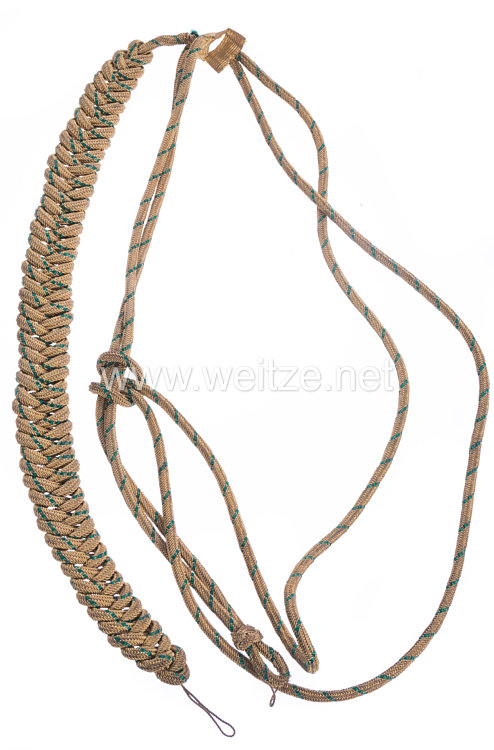
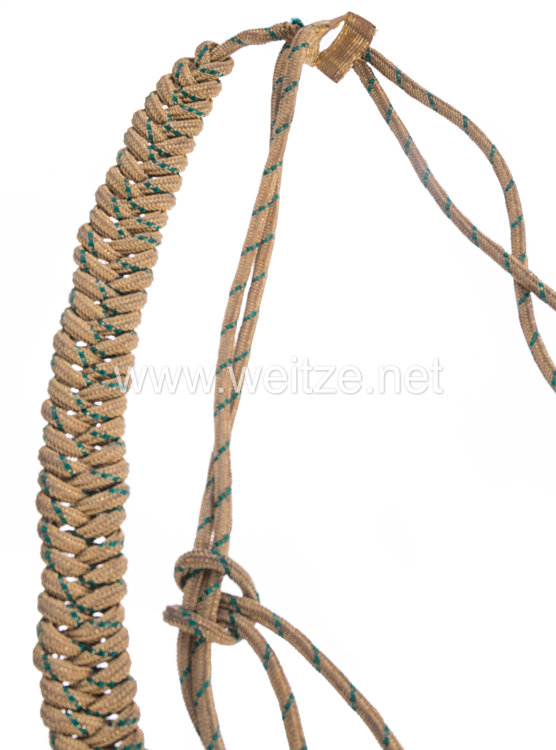
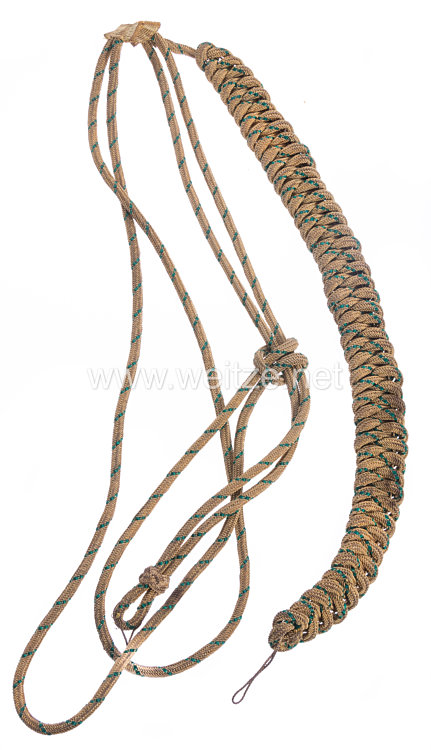
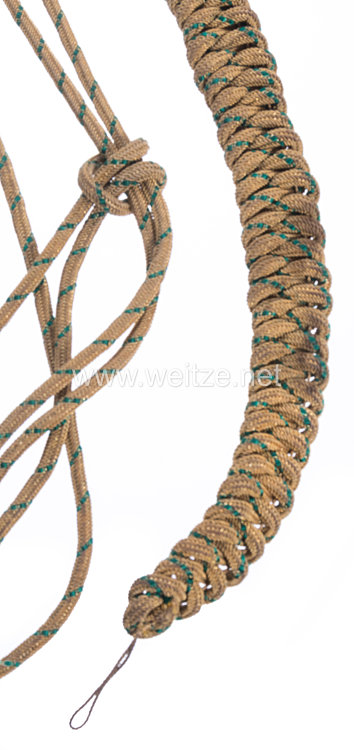
Third Reich Forestry Service Parade Aiguillette for an Oberforstmeister or Oberlandforstmeister
See: Aiguillettes of the III.Reich by Wilhelm Saris, page 505
The parade aiguillette for an Oberforstmeister (Senior Forest Master) or Oberlandforstmeister (Senior State Forest Master) of the Third Reich represents a remarkable example of the ceremonial equipment of the German forestry service during the National Socialist era. This particular aiguillette, manufactured from metal thread in gold with characteristic green strands, embodies the close connection between state forest administration and military traditions during this historical period.
The forestry service in the Third Reich experienced significant reorganization and elevation in status. After the seizure of power in 1933, forestry was increasingly integrated into the state administrative structure. Hermann Göring, as Reichsforstmeister (Reich Forest Master) and Reichsjägermeister (Reich Hunt Master) from 1934, played a central role in the reorganization of German forestry. The Reich Forest Law of 1934 created a unified framework for forestry and established a clear hierarchy within the forestry service.
The ranks of Oberforstmeister and Oberlandforstmeister were positioned in the upper hierarchy of forest administration. The Oberforstmeister was typically responsible for larger forest districts, while the Oberlandforstmeister held an even higher position in the state forest administration. These officials bore considerable responsibility for the management of German forests, which were of great economic and ideological significance.
The aiguillette has its roots in military traditions dating back to the 18th century. Originally intended as a practical aid, it evolved into a purely ceremonial rank insignia. In the Third Reich, aiguillettes were used not only in the military but also in paramilitary organizations and state services such as the forestry office to denote rank and status.
The gold execution with green strands of this parade aiguillette is particularly significant. Gold traditionally symbolized high rank and authority, while the green color clearly indicated the connection to forestry. Green was the traditional color of hunters and foresters and was consistently used in the uniform and insignia design of the forestry service. The combination of gold and green made these aiguillettes immediately recognizable at parades and official occasions.
The manufacture from metal thread testifies to the high quality and representative character of these equipment pieces. The production of such aiguillettes required specialized craftsmanship. Traditional passementerie makers and specialized military effects companies produced these pieces according to precise regulations. The use of metal threads ensured not only a brilliant, impressive appearance but also durability.
The parade aiguillette was worn at ceremonial occasions, not in daily service. These included state receptions, parades, oath ceremonies, and other official events. It was attached to the right shoulder of the parade uniform and ran across the chest, with the exact manner of wearing regulated by service regulations.
Documentation of such equipment items can be found in Wilhelm Saris' standard work “Aiguillettes of the III. Reich,” which serves as the authoritative reference for aiguillettes of this period. Such reference works are indispensable for collectors and historians, as they provide detailed information about manufacture, wearing, and attribution of these objects.
In the context of National Socialist Blood and Soil ideology, forestry received particular symbolic significance. The German forest was portrayed as an expression of national identity and racial connection with nature. Senior forestry officials were thus not merely administrators of natural resources but also bearers of ideological messages.
After 1945, these rank insignia disappeared from official use with the end of the Third Reich. The forestry administrations in both German states developed new uniform regulations and rank insignia. Today, such objects are historical artifacts that provide insight into the administrative structure and ceremonial practice of the NS era.
For collectors and historians, such parade aiguillettes are important testimonies of a specific historical epoch. They document the connection between state institutions and military traditions and demonstrate how rank insignia were employed to display hierarchy and authority. The preservation and scientific documentation of such objects contributes to understanding this complex historical period.