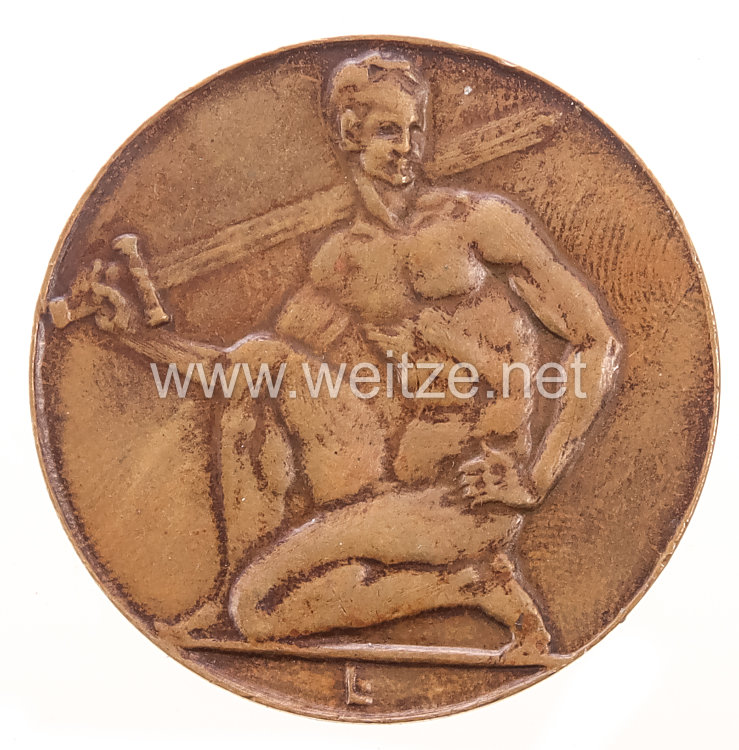
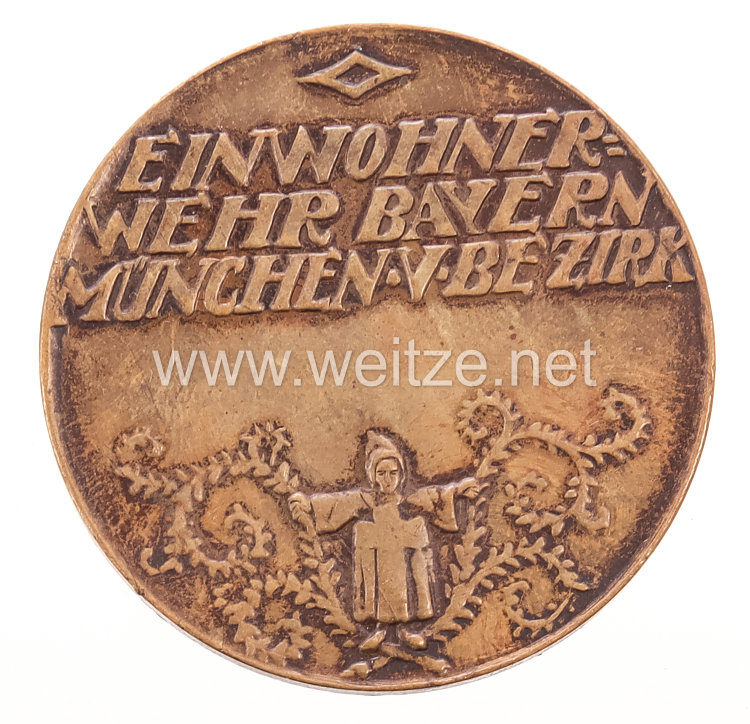
Freikorps München Einwohnerwehr - Bronze Marksmanship Medal

Bronze, “Einwohnerwehr Bayern München V. Bezirk”, diameter 38 mm.
423333
150,00

Freikorps München Einwohnerwehr - Bronze Marksmanship Medal

This bronze shooting medal from the Einwohnerwehr Munich, District V, represents a significant artifact from the turbulent post-war period in Bavaria. With a diameter of 38mm, it exemplifies the paramilitary organizations that played a crucial role in Bavarian history between 1918 and 1921.

The Einwohnerwehr (Citizens' Defense Force) was established in spring 1919 as a response to the revolutionary upheavals that shook Bavaria following the end of World War I. After the proclamation of the Bavarian Soviet Republic on April 7, 1919, and the subsequent communist uprisings, bourgeois circles increasingly felt threatened. The Einwohnerwehr emerged as a civic-military self-defense organization, primarily composed of middle-class citizens, academics, civil servants, and former officers.

In Munich, the organization was divided into various districts, with District V covering a specific area of the city. Each district maintained its own structures, commanders, and training facilities. Members of the Einwohnerwehr received military drill and shooting instruction to ensure readiness in case of emergency. Regular shooting practice was not merely a military necessity but also served to strengthen esprit de corps and paramilitary identity.

Shooting medals like this specimen were awarded as decorations for exceptional performance in shooting competitions. These contests were held regularly and served multiple purposes: they promoted members' marksmanship, strengthened cohesion within the district, and simultaneously provided a public demonstration of military readiness. The awarding of such medals followed the traditional German associational practices that had been widespread among shooting clubs during the Imperial era.

At its peak in 1920, the Bavarian Einwohnerwehr reached a strength of approximately 300,000 to 400,000 men, making it one of the largest paramilitary organizations of the Weimar Republic. It was formally subordinated to the Bavarian state government but often operated with considerable autonomy. The organization possessed weapons, uniforms, and military structures, making it effectively a parallel army.

The political orientation of the Einwohnerwehr was distinctly anti-socialist and anti-revolutionary. Many members sympathized with monarchist and nationalist positions. The organization played an important role in suppressing the Soviet Republic and maintaining bourgeois order in Bavaria. Simultaneously, it was increasingly perceived by the Reich government in Berlin as a threat to democratic order.

Following the Kapp Putsch in March 1920 and due to pressure from the Allied Control Commission, which viewed the Einwohnerwehr as a violation of the provisions of the Treaty of Versailles, the organization became increasingly problematic. The Treaty of Versailles had imposed strict armament restrictions on Germany, and paramilitary associations were fundamentally unwelcome. In summer 1921, the Reich government, under Allied pressure, ordered the dissolution of the Einwohnerwehr, which met with considerable resistance in Bavaria. On June 13, 1921, the Bavarian Einwohnerwehr was officially dissolved, which was perceived as a humiliation in conservative and nationalist circles.

The significance of such medals extends beyond their material value. They document the existence of local organizational structures and the self-perception of members who viewed themselves as defenders of order and property. The use of bronze as a material indicates a medium level of distinction – higher-value awards were often made in silver or gold.

For collectors and historians today, Einwohnerwehr medals are important sources for researching the Freikorps period and paramilitary movements of the early Weimar Republic. They illustrate the militarization of society after World War I and the deep political divisions that characterized Germany during this period. The history of the Einwohnerwehr is inextricably linked to the rise of National Socialism, as many former members later joined the SA or NSDAP.

r