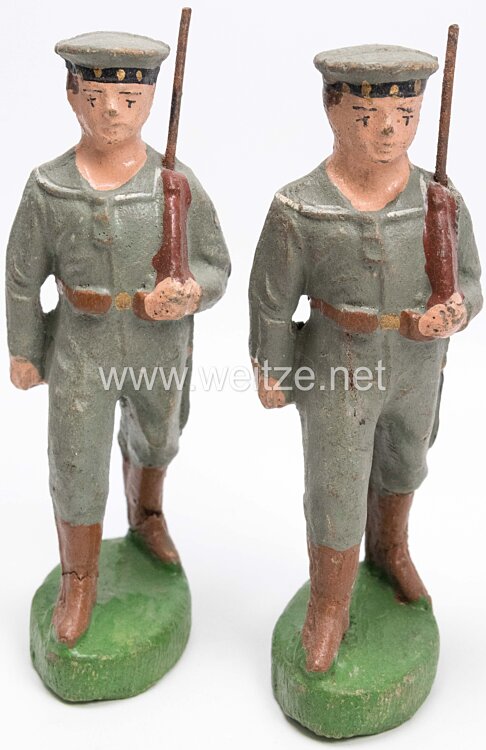
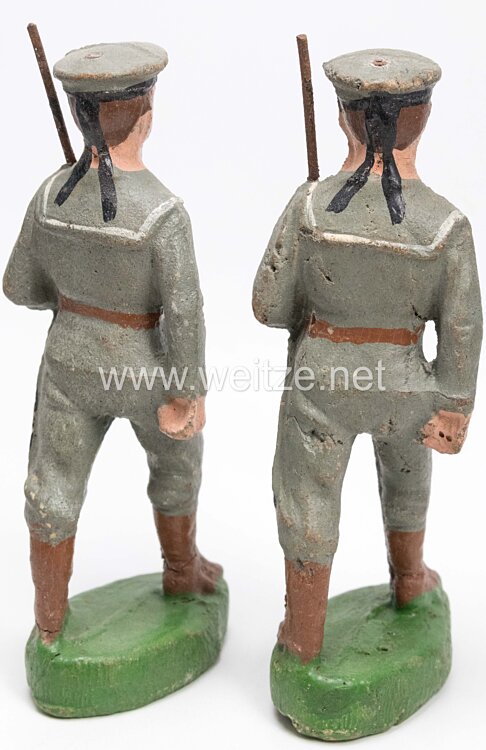
Elastolin - World War I Imperial German Navy 2 Sailors Marching
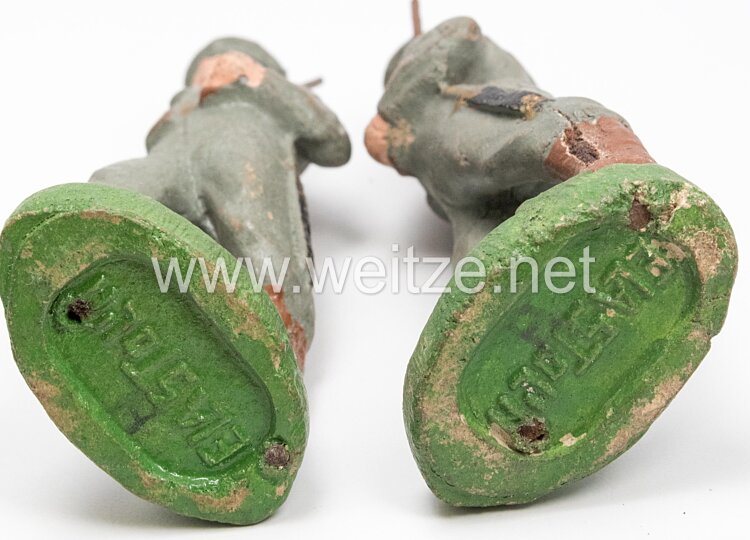
These Elastolin figures depicting two marching sailors of the Imperial German Navy (Kaiserliche Marine) from World War I represent a fascinating chapter in both toy history and the maritime military history of the German Empire. These composition figures, measuring 9.5 cm in height, were manufactured by the renowned firm O. & M. Hausser in Ludwigsburg, which under the brand name Elastolin became one of Germany's leading manufacturers of composition figures from the 1920s onward.
The Imperial German Navy developed after its founding in 1871 under the driving force of Grand Admiral Alfred von Tirpitz into one of the world's most significant naval forces. The Fleet Act of 1898 and subsequent naval bills laid the foundation for a massive expansion of the German war navy, which permanently strained Anglo-German relations and contributed to the naval arms race before World War I. By 1914, the Imperial Navy possessed an impressive fleet of dreadnoughts, cruisers, and torpedo boats.
The sailors represented by these figures wore the characteristic dark blue uniform of the Imperial Navy with its iconic sailor's collar and sailor cap with a cap ribbon that frequently displayed the ship's name or the designation “Kaiserliche Marine.” The uniform was based on the Dress Regulations for the Imperial Navy and was strictly regulated in its details. The blue sailor suit with its white collar became the symbol of German sea power and shaped the public perception of the navy.
The Hausser company began producing figures from Elastolin in the 1920s, a material composed primarily of casein, chalk, glycerin, and other additives, which established itself as an alternative to traditional lead figures. This material was lighter, non-toxic, and offered greater design possibilities. Elastolin figures were manufactured through elaborate processes: first cast in molds, then painted, and frequently fitted with wire armatures for greater stability.
The production of military figures from World War I held particular significance during the interwar period. For the generation that had experienced the war, these figures represented both a form of remembrance and processing. For children, they served as toys that simultaneously had an educational component and were intended to convey military values. The Imperial Navy enjoyed special popularity, as despite its limited role in World War I – with the exception of the Battle of Jutland in 1916 – it was regarded as a modern and technologically advanced branch of service.
The depiction of marching sailors reflects military everyday reality. Sailors did not spend all their time aboard ships but were also stationed at land bases such as Wilhelmshaven, Kiel, or Cuxhaven, where military drill and exercises were part of daily routine. The Imperial Navy also maintained naval infantry units and sailor divisions that participated in land combat during World War I, particularly in Flanders and during the German colonial wars.
From a collector's perspective, Elastolin figures of the Imperial Navy are highly sought-after objects today. The indicated condition 2 suggests a well-preserved figure with possibly minor signs of use, which is remarkable for objects of this age. Typical aging characteristics of Elastolin figures include paint wear, cracks in the material, or deformations, as the casein-based material is sensitive to moisture and temperature fluctuations.
The historical significance of such figures extends beyond their value as collectibles. They document the memory culture of the interwar period, the role of the military in German society, and the development of the toy industry. After World War II, Hausser continued production, with focus increasingly shifting to historical and civilian themes. The company existed until 1983, when production ceased.
Today, these figures are important witnesses to military and cultural history, offering insights into the material culture of the early 20th century and keeping alive the memory of the Imperial German Navy. They represent a time when military toys were commonplace and reflect both the militarization of society and the technical craftsmanship of German toy manufacturers.