Luftwaffe - Document Estate of a Later Missing Obergefreiter with Combat Missions over Crete and Russia

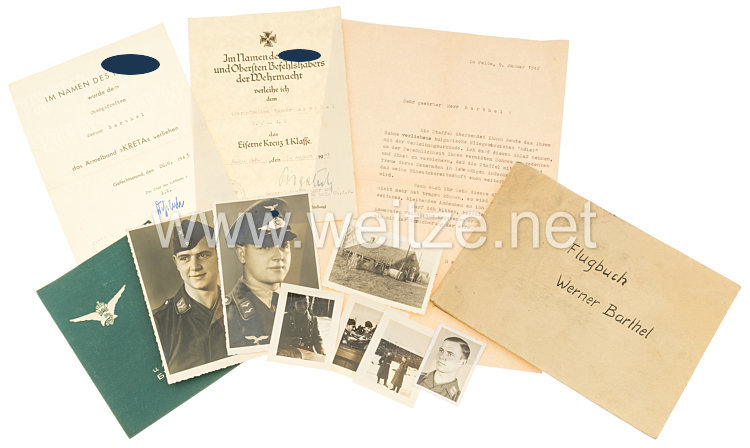
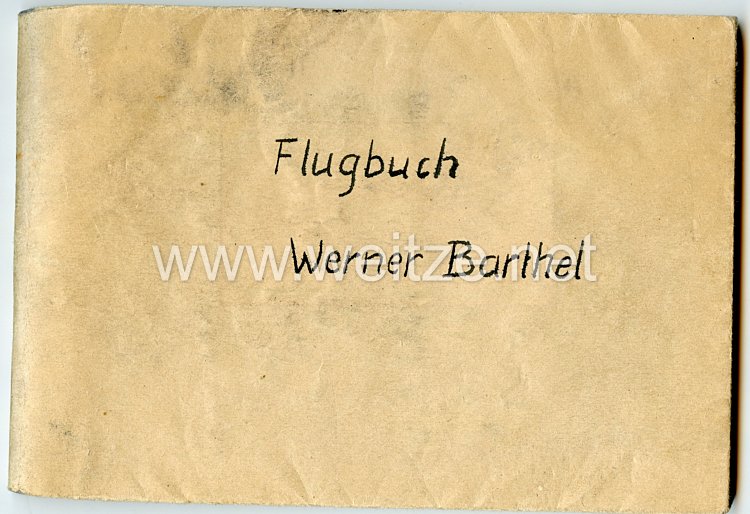
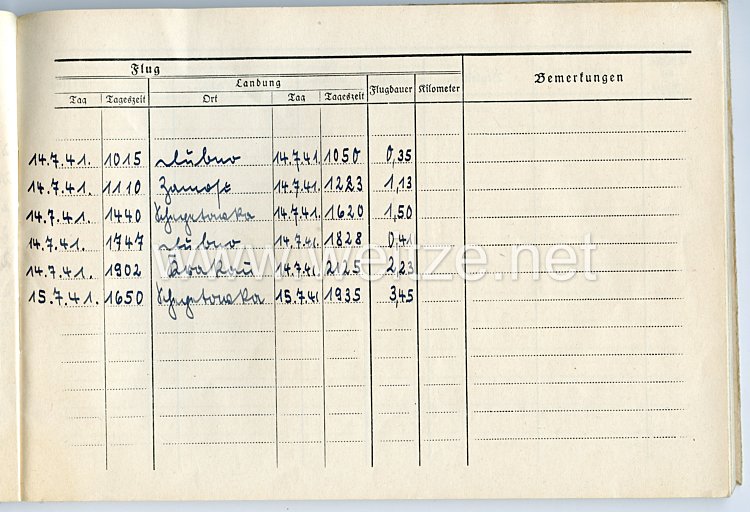
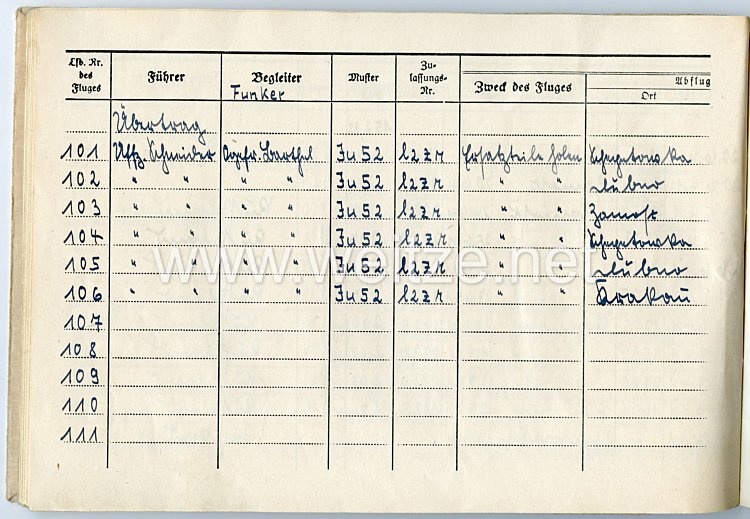
Logbook begun on July 7, 1939 and completed on July 15, 1941 with 106 recorded flights including 26 combat missions. Starting with the obligatory training and further practice flights, 1st combat mission on April 30, 1941 over Greece to Crete and 9 additional combat missions in the Crete area, from April 26, 1941 the first combat missions over Russia. The combat missions predominantly on Me 110, plus several flights on Ju 52
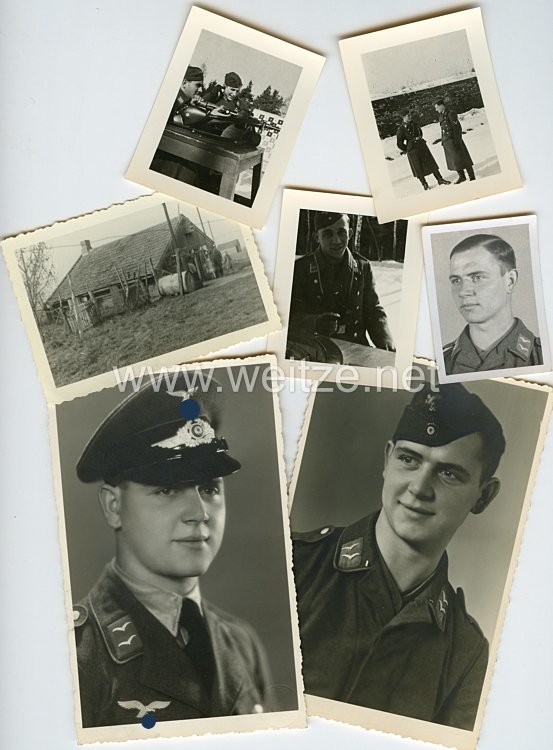
Included are two postcard-sized portrait photographs of the man; and 5 additional small-format photographs, used condition.
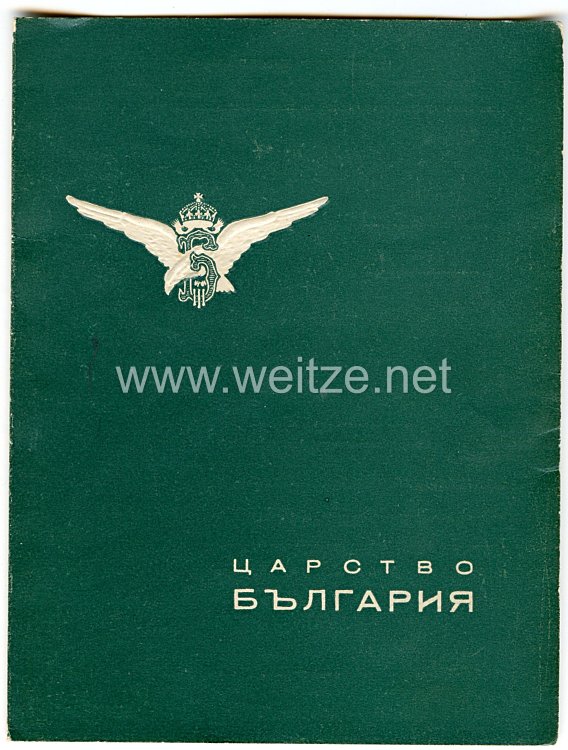
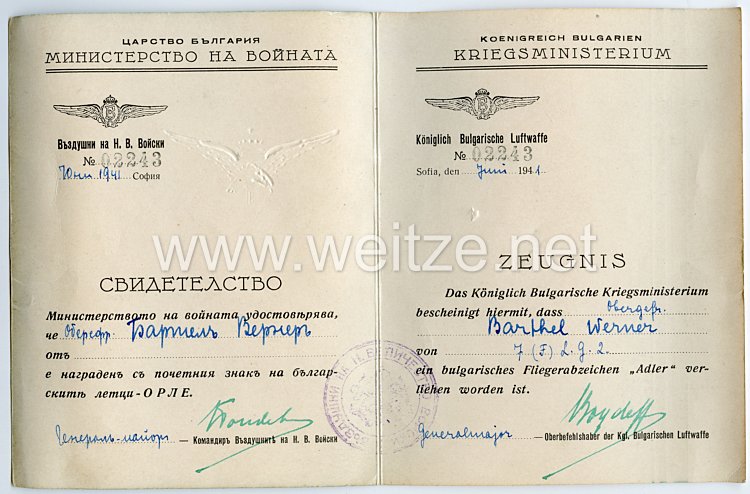
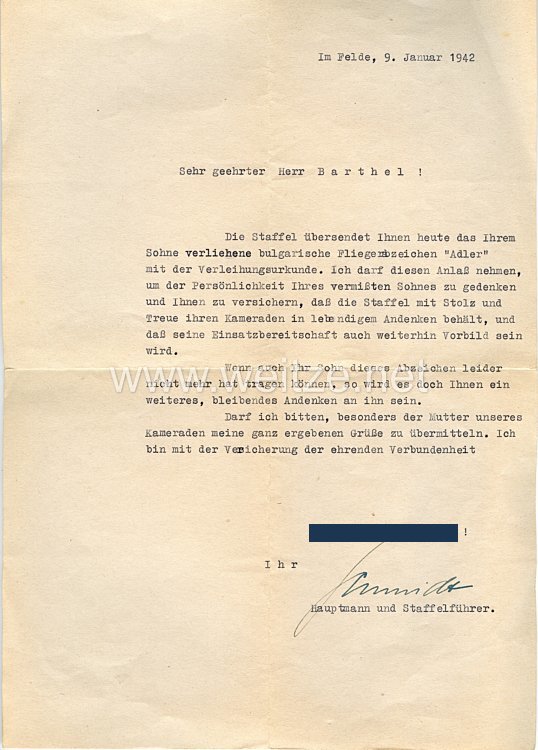
Also included is the bilingual award booklet for the Bulgarian Pilot’s Badge, with award number 02243, issued in June 1941 in Sofia (included is a letter from the Staffel regarding the transmission of the Pilot’s Badge, dated January 9, 1942).
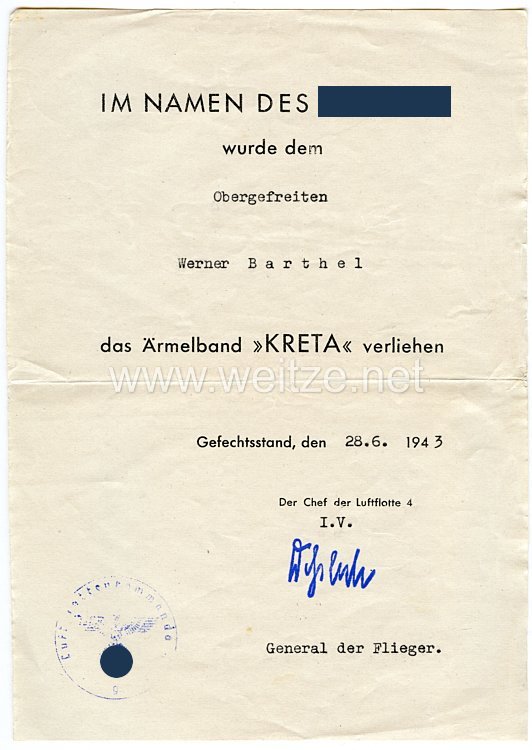
Award certificate for the Kreta cuff title, dated June 28, 1943 with facsimile signature of Generaloberst Deßloch.
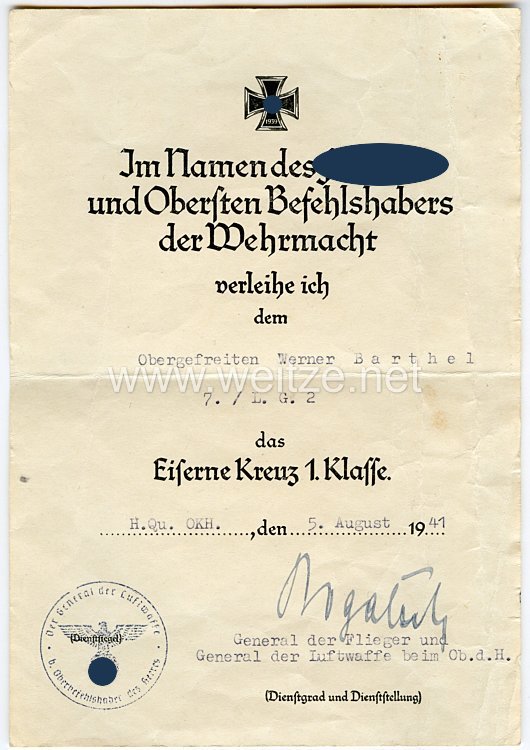
Certificate for the Iron Cross 1st Class, awarded on August 5, 1941, with signature of General der Flieger Bogatsch. Various documents from his apprenticeship, slides as well as field post letters. Condition 2-
424932
990,00

Luftwaffe - Document Estate of a Later Missing Obergefreiter with Combat Missions over Crete and Russia

This documentary estate of a Luftwaffe Obergefreiter (Senior Aircraftman) offers a rare and authentic insight into the life and operations of a German airman during World War II. The collection comprises personal documents, photographs, and official material documenting the military career of a man who was later reported missing in action – a fate shared by thousands of Luftwaffe personnel.

The centerpiece of the collection is the Flugbuch (flight logbook), maintained from July 7, 1939, to July 15, 1941. Flight logbooks were mandatory for all Luftwaffe pilots and crew members and served as the official record of all flights completed. In this case, the logbook documents 106 flights, of which 26 are classified as enemy operations. The records begin with typical training and practice flights that were standard for new crew members. The Luftwaffe placed great emphasis on thorough training, and flight students had to complete numerous practice hours before being cleared for combat missions.

The first Feindflug (enemy combat flight) took place on April 30, 1941, over Greece toward Crete. This falls within the context of the Balkans Campaign and the subsequent airborne operation on Crete, known as Operation Mercury (May 20 to June 1, 1941). This operation was the largest airborne operation by the German Wehrmacht and resulted in heavy casualties, particularly among the paratroopers. The Luftwaffe played a crucial role in supporting this operation, and the nine additional combat flights in the Crete area testify to the intense aerial combat activity during and after this battle.

Beginning June 26, 1941 – just days after the start of Operation Barbarossa on June 22, 1941 – the logbook records the first combat flights over Russia. The Eastern Front became the main theater of air warfare for the Luftwaffe, and losses were enormous. The combat flights predominantly flown in the Messerschmitt Bf 110 are particularly noteworthy. The Me 110 was a twin-engine heavy fighter aircraft deployed as a long-range escort fighter and fighter-bomber. Although it showed weaknesses in the Battle of Britain, it performed better on the Eastern Front, where it was used for reconnaissance, ground attack, and fighter operations.

The mentioned flights on the Junkers Ju 52 suggest transport or supply missions. The Ju 52, affectionately called “Tante Ju” (Auntie Ju), was the workhorse of the Luftwaffe for troop transport and supply deliveries.

Of particular interest is the Bulgarian pilot's badge, issued in Sofia in June 1941 with the award number 02243. Bulgaria joined the Tripartite Pact on March 1, 1941, and allowed German troops passage for the Balkans Campaign. The awarding of Bulgarian decorations to German soldiers was part of military cooperation between the Axis powers. The accompanying letter from the squadron dated January 9, 1942, regarding the transmission of the badge shows the bureaucratic delays common in wartime routine.

The Kreta cuff title, awarded on June 28, 1943, was a special decoration for participants in the Crete operation. It was instituted by Führer decree on October 16, 1942, and bore the inscription “KRETA”. The award certificate bears the facsimile signature of Generaloberst Otto Deßloch, who held various Luftwaffe commands.

The certificate for the Iron Cross 1st Class, awarded on August 5, 1941, is particularly significant. The Iron Cross 1st Class was awarded for repeated bravery or outstanding leadership and was considerably rarer than the 2nd Class. The award just weeks after the beginning of the Russian campaign suggests exceptional performance. The signature of General der Flieger Bogatsch lends additional authenticity to the document.

The mention that the Obergefreiter was later reported missing is tragic but representative of the fate of many Luftwaffe soldiers. On the Eastern Front, thousands of aircraft were lost, and many crews remained missing. The circumstances of his disappearance are not documented, but the heavy losses suffered by the Luftwaffe, especially from 1942 onward, make clear how dangerous these missions were.

This estate is not only of military-historical value but also a personal testimony of a young man who served from mandatory flight training through the dramatic battles over Crete to the brutal air battles over Russia. The combination of official documents, photographs, and personal letters makes this collection a valuable historical document that does not let us forget the human dimension of war.

r