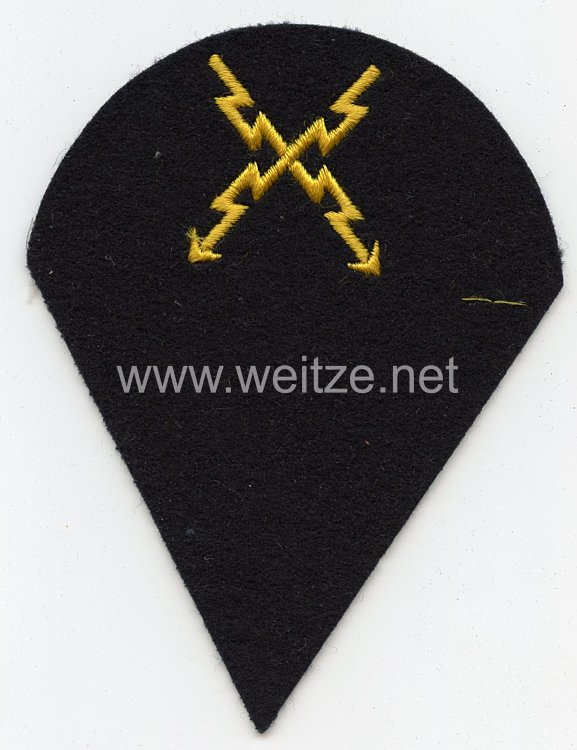
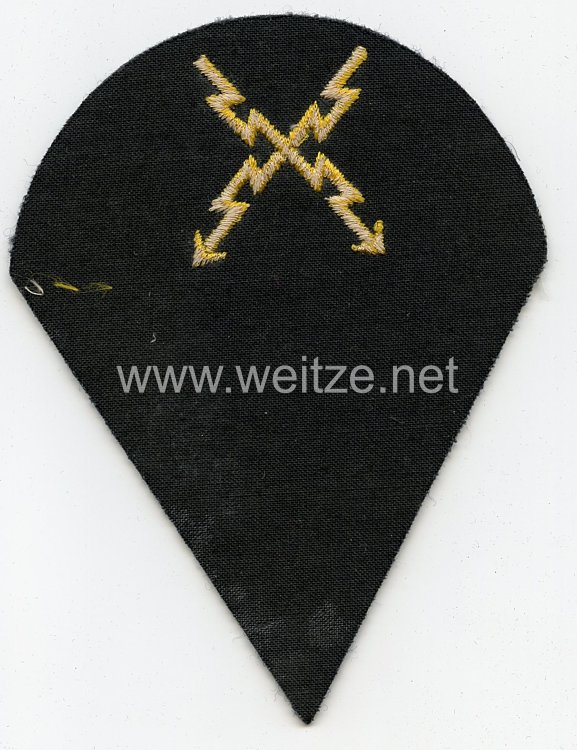
Kriegsmarine Enlisted Personnel Career Badge for Teleprinter Operators

Version for colani uniform, reverse with foxing, condition 2.
376632
25,00

Kriegsmarine Enlisted Personnel Career Badge for Teleprinter Operators

The Kriegsmarine Career Badge for Enlisted Personnel in the Teleprinter Service represents a specific aspect of the German naval hierarchy during World War II. These badges, also known as Tätigkeitsabzeichen (activity badges) or specialist badges, were introduced to make visible the various technical and administrative specializations within the Kriegsmarine.

The Kriegsmarine, as part of the Wehrmacht from 1935 to 1945, developed a complex system of rank insignia and career designations. The introduction of these badges occurred as part of the modernization and expansion of the German Navy under Grand Admiral Erich Raeder and later Karl Dönitz. The career badge system was regulated by various naval ordinances, particularly the Anzugordnung für die Kriegsmarine (Dress Regulations for the Navy), which was updated multiple times.

The teleprinter service gained central importance for military communications during World War II. The teleprinter operators, or Teletypistenmaaten, were responsible for the encrypted transmission of orders, situation reports, and operational messages. They worked with devices such as the famous Enigma machine and other cipher devices, as well as mechanical teleprinters that enabled faster message transmission than traditional Morse code telegraphy.

The designation für den Colani (for the Colani) refers to wear on the navy blue work or service uniform. The term “Colani” in the Kriegsmarine referred to a specific type of work suit or overall worn during practical duty. These badges were typically manufactured on dark blue cloth and worn on the left upper arm.

The enlisted career path in the Kriegsmarine encompassed various ranks, beginning with Matrose (seaman) through Matrosenobergefreiter (leading seaman), Maat (petty officer) to Obermaat (chief petty officer) and Stabsobermaat (senior chief petty officer). Career badges identified the specific technical or administrative assignment within this hierarchy. The teleprinter badge would typically display a stylized symbol representing the activity, possibly lightning bolts, radio waves, or stylized teleprinter devices.

The manufacture of these badges was carried out by various certified producers authorized by the Kriegsmarine. Quality and execution could vary, from hand-embroidered examples for officers to machine-woven or embroidered versions for enlisted personnel. The badges were manufactured on cloth or felt backing and attached to uniform pieces using various fastening methods.

The condition with foxing on the reverse is typical for textile militaria stored under less than ideal conditions over decades. Foxing occurs through moisture and microbial contamination and is commonly found on historical textiles. The stated condition grade 2 corresponds in the collector hierarchy to a well-preserved piece with light wear, which is considered very acceptable for an object over 75 years old.

The historical significance of these badges lies in their documentation of the highly specialized organization of the Kriegsmarine. The teleprinter service was essential for submarine warfare, the coordination of fleet units, and strategic communication between naval bases. Teleprinter operators on land and aboard larger vessels were integrated into the comprehensive communication network that was of central importance to German naval warfare.

Today, such career badges are important collectibles and historical documents. They provide historians and collectors with insights into the organizational structure and technical specialization of the Kriegsmarine. For military-historical research, they offer valuable information about the hierarchy, training, and operational organization of the German Navy during World War II.

r