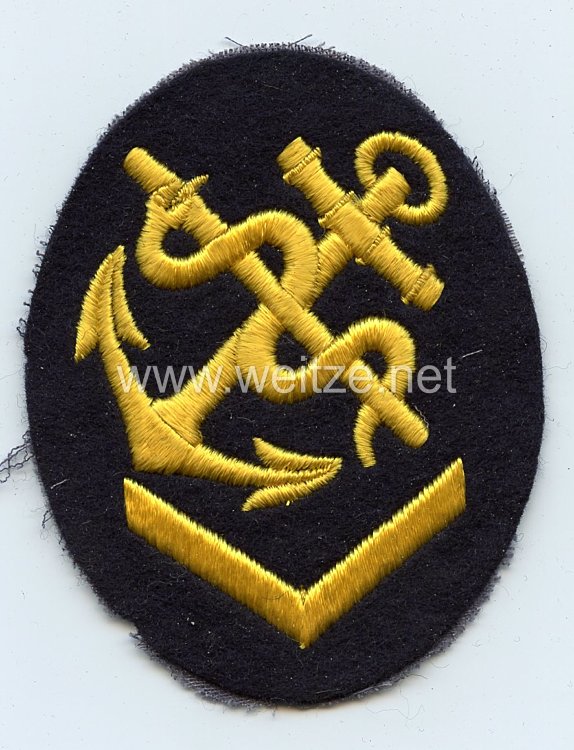
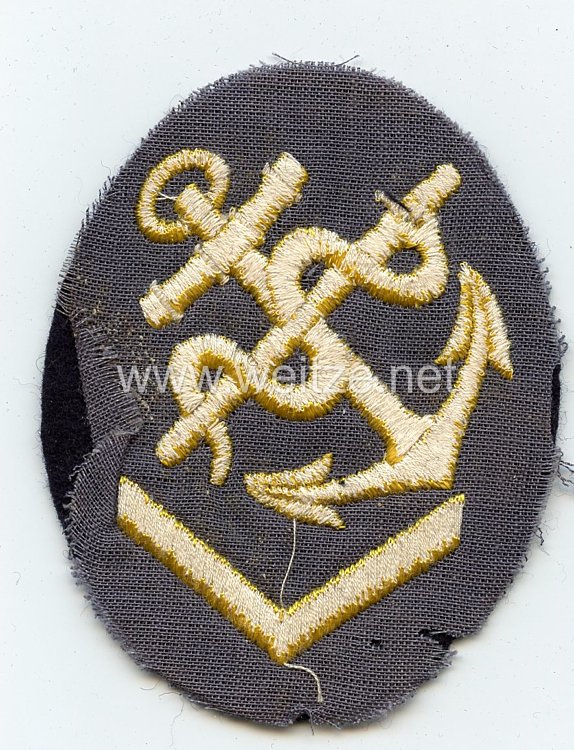
Kriegsmarine Sleeve Insignia Medical Chief Petty Officer (Sanitätsobermaat)
The sleeve insignia of the Kriegsmarine Sanitätsobermaat (Medical Petty Officer First Class) represents an important component of the German Navy's uniform identification system during World War II. These machine-embroidered badges were worn on the blue service blouse and indicated both the rank and specialization of the wearer within the Kriegsmarine.
The Kriegsmarine, which existed as the official war navy of the German Reich from 1935 to 1945, developed a complex system of rank insignia and specialization markings. The rank of Obermaat (Petty Officer First Class) represented a non-commissioned officer grade positioned between Maat (Petty Officer Second Class) and Bootsmann (Boatswain). The prefix “Sanitäts-” denoted membership in the naval medical service.
The medical personnel of the Kriegsmarine played an indispensable role aboard German warships. On every vessel, from small fast attack craft to large battleships, medical staff were stationed to care for the crew. The Sanitätsobermaat held a middle leadership position and was often responsible for practical medical care as well as supervising subordinate medical personnel.
The uniform regulations of the Kriegsmarine were detailed in the “Anzugordnung für die Kriegsmarine” (Dress Regulations for the Navy). These regulations precisely specified which insignia were to be worn at which locations on the uniform. Sleeve badges for specialists such as medical personnel were typically worn on the left upper arm and were designed to be clearly visible against the dark blue fabric of working and service blouses.
The machine embroidery of these badges was standard during the war years. Unlike hand-embroidered variants, which were often of higher quality and used for parade uniforms, machine embroidery enabled faster and more cost-effective production. This was particularly important given the enormous demand during the war, as the Kriegsmarine rapidly expanded and required hundreds of thousands of uniform components.
The design of medical insignia was based on traditional medical symbols. Typically, these badges displayed an Aesculapius staff, the internationally recognized symbol of the medical profession, often in combination with navy-specific elements such as anchors. The coloring was usually in gold or yellow tones on a dark background to ensure maximum visibility.
The training path to become a Sanitätsobermaat was demanding and included both military and medical components. Candidates first had to complete basic naval training before receiving advanced education at specialized naval medical schools such as the Marineschule Mürwik. Training encompassed first aid, surgery under combat conditions, nursing, and shipboard hygiene.
The blue blouse on which this insignia was worn was part of the working and shipboard uniform of the Kriegsmarine. It was worn during daily service aboard ships and at naval bases, and differed from the white summer uniform and the dark parade uniform. The blue blouse was practically designed and made from durable material to withstand the harsh conditions of naval service.
The importance of the medical service at sea cannot be overstated. In naval battles and during accidents aboard ship, rapid medical care and competent treatment were often life-saving. Sanitätsobermaate had to be capable of working under extreme conditions – in heavy seas, under fire, or in burning ships. Their identification through special insignia enabled crew members to quickly identify them in emergencies.
After the war's end, many of these badges were preserved by collectors and militaria enthusiasts. Today they serve as historical evidence of the organization and structure of the Kriegsmarine and are important study objects for military historians researching the German Navy of World War II. The condition of such badges varies considerably, depending on storage and use over the decades.
These insignia represent more than mere uniform decoration; they are tangible links to the individuals who served in the medical branches of the Kriegsmarine. Each badge tells a story of the organizational complexity of naval warfare and the critical importance of medical personnel in maintaining fleet operations. For modern researchers and collectors, they provide valuable insights into the daily life, organization, and structure of one of history's most significant naval forces.