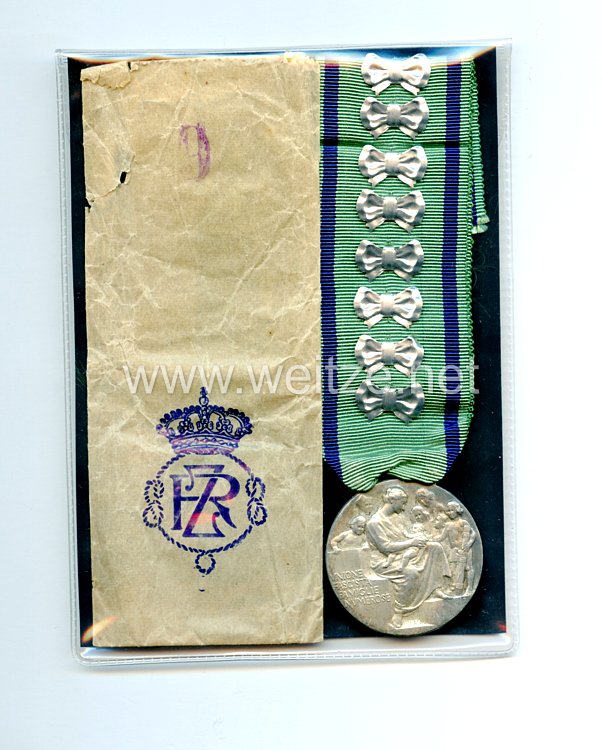
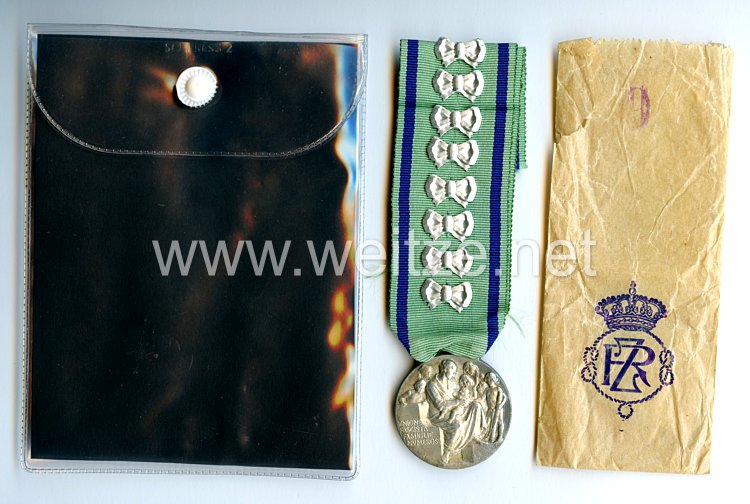
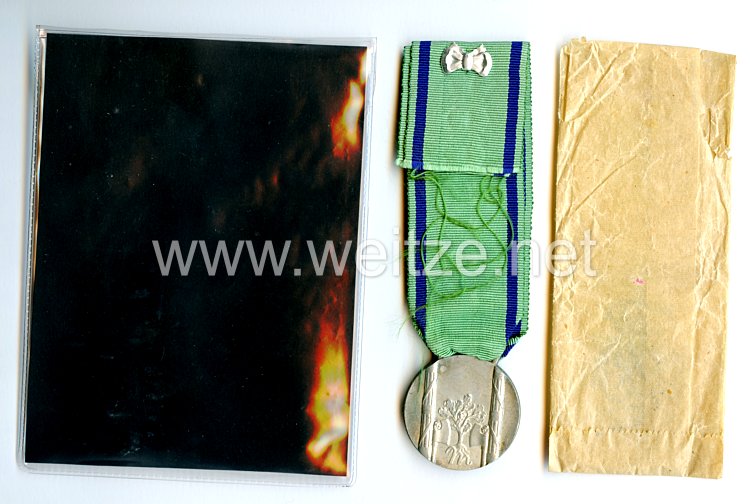
Kingdom of Italy World War II, Medal of Honor of the Italian Mother
The Medaglia della Madre Italiana (Medal of the Italian Mother) represents one of the most notable awards of Fascist Italy during World War II. This honor was conferred by the Unione Fascista Famiglie Numerose (Fascist Union of Large Families), an organization closely connected with the Fascist regime's population growth program.
The present specimen is distinguished by nine loops, indicating an exceptionally high number of children. In the system of Fascist family awards, each loop typically corresponded to one or more children, though the exact allocation varied over time. The nine loops thus represent a family with at least nine children, which in the context of Fascist population policy was considered a special service to the fatherland.
Historical Context and Population Policy
Benito Mussolini regarded population growth as crucial to Italy's status as a great power. From the 1920s onward, the Fascist regime initiated an aggressive population policy with the goal of increasing Italy's population to 60 million by the mid-20th century. The “Battaglia demografica” (Demographic Battle) became a central component of Fascist ideology.
The Unione Fascista Famiglie Numerose was founded as part of this initiative. It was designed to organize, support, and publicly honor large families. The organization conferred various awards on mothers who contributed to the nation's growth through their fertility. These honors were not merely symbolic but were often accompanied by practical benefits such as tax relief, preferential access to housing, and other state services.
Construction and Design of the Award
The medal was typically worn on a ribbon, as documented with this specimen. The badge bears the inscription “Unione Fascista Famiglie Numerose”, clearly identifying the issuing organization. The design followed the aesthetic principles of Italian Fascism, which valued classical Roman symbolism and monumental representations.
The loops on the ribbon served as a visible indicator of the number of children. This system allowed for immediate public recognition of the bearer's “merit.” Such decorations were worn at official occasions and served the regime's propaganda by presenting mothers of large families as role models for society.
Award Practices and Ceremonies
The presentation of the medal often took place within the framework of public ceremonies organized by local Fascist organizations or state agencies. The presentation envelope preserved with this specimen (though damaged) was an integral part of the award. It typically contained, in addition to the medal itself, official documents confirming the award and listing the recipient's special privileges.
Such ceremonies frequently occurred on December 24th, a date declared by Mussolini as the “Day of the Mother and Child.” These events were staged for propaganda purposes and extensively covered in the media to promote the regime's population policy and encourage other women to follow suit.
Significance During World War II
During World War II, demographic policy acquired an additional military dimension. Large families were viewed not only as an economic necessity but also as a military resource. The decoration of mothers with many children was intended to strengthen cohesion on the home front and increase the population's willingness to sacrifice.
However, reality increasingly diverged from ideological goals. The burdens of war, rationing, and growing losses at the front undermined the effectiveness of such propagandistic awards. Nevertheless, the conferral continued until the collapse of the Fascist regime in 1943.
Collector Value and Historical Significance
Today, such awards are important historical artifacts providing insight into the social and population policies of Fascist Italy. The presence of nine loops makes this specimen particularly noteworthy, as it represents an above-average number of children. The preserved presentation envelope, despite its damage, significantly enhances the historical value, as such original packaging has rarely survived.
The stated condition 2 indicates a well-preserved decoration that has survived the decades since its conferral relatively unscathed. Such objects today serve as important sources for research into the Fascist era and its impact on the daily lives of the Italian population.