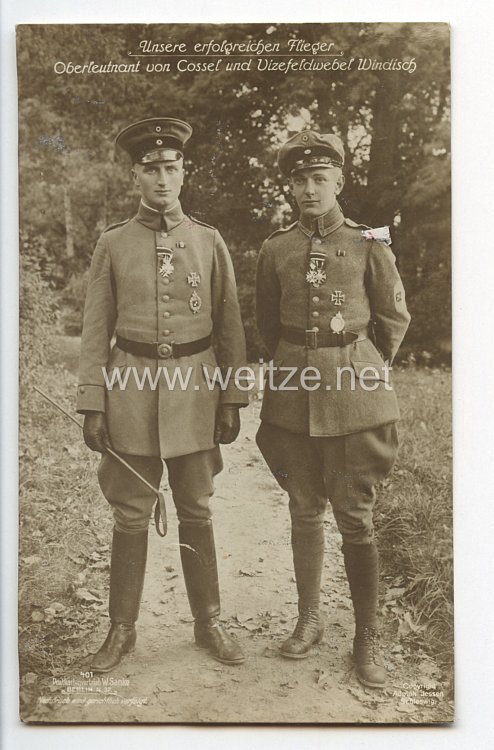
Aviation World War I - Photo Postcard - German Flying Aces "Oberleutnant von Cossel and Vizefeldwebel Windisch"
This Sanke postcard No. 401 documents two significant German aviators of the First World War: Oberleutnant von Cossel and Vizefeldwebel Windisch. The card belongs to an extensive series of propaganda postcards published between 1914 and 1918 by the Berlin publisher Gustav Liersch & Co. under the name of photographer Sanke.
The Sanke cards represented one of the most important visual documentations of German military aviation during World War I. The publisher produced over 600 different motifs, predominantly portraying successful fighter pilots, combat aviators, and reconnaissance pilots. These postcards served multiple functions: they were used for military propaganda, hero worship, and maintaining morale on the home front. Simultaneously, they were coveted collectibles, often sent by soldiers to their families or preserved in albums.
Air warfare in World War I evolved rapidly from initial reconnaissance flights to organized fighter and bomber units. The German Fliegertruppe (aviation corps), originally part of the transportation troops, became increasingly professionalized and specialized. Pilots and observers enjoyed high social status, which was further amplified by media such as the Sanke cards.
The card depicts two aviators of different ranks: an officer (Oberleutnant, first lieutenant) and a non-commissioned officer (Vizefeldwebel, vice sergeant major). This constellation was typical for crews of two-seater reconnaissance or combat aircraft, where the pilot was usually accompanied by an observer or gunner. Military hierarchy was also reflected in the air force, with officers typically bearing command responsibility.
The photographic quality of Sanke cards was remarkable for the time. The photographs were usually taken in professional photo studios, with aviators posing in their uniforms adorned with medals and decorations. They were often photographed against neutral backgrounds or with stylized military backdrops. These staged portraits were intended to convey the heroic image of the aviation corps and demonstrate Germany's technological superiority.
The condition rating of “2-” according to standard collector grading indicates a well-preserved card with minimal signs of wear. The fact that the card is unposted – never sent through the mail – increases its collector value, as it bears no stamps, addresses, or postal damage.
In the context of military history, such postcards document not only individual persons but also the development of military visual propaganda. The systematic commercialization of war heroes by commercial publishers was a novel phenomenon of World War I. The Sanke cards contributed significantly to the mythology surrounding the “knights of the air,” a romanticized image that obscured the brutal reality of aerial warfare.
The German Fliegertruppe suffered considerable losses during the war. The average life expectancy at the front was alarmingly short, especially for fighter pilots. Nevertheless, or perhaps because of this, successful aviators were stylized as national heroes whose images reached a broad public.
Today, Sanke cards are important sources for military historical research. They enable the identification of persons, units, and equipment. For collectors of military historical documents, they are among the most sought-after objects, with value depending on factors such as the fame of the depicted person, condition, and rarity of the specific card number.
The present card No. 401 is part of the middle number series, typically produced between 1916 and 1917, when air warfare reached its peak. This period was characterized by intense aerial combat, technological innovations in aircraft construction, and the increasing strategic importance of aerial reconnaissance and bombardment.
The documentation of these aviators on postcards reflects the broader cultural phenomenon of how modern warfare was mediated to civilian populations, creating both distance from and engagement with the realities of industrial conflict.