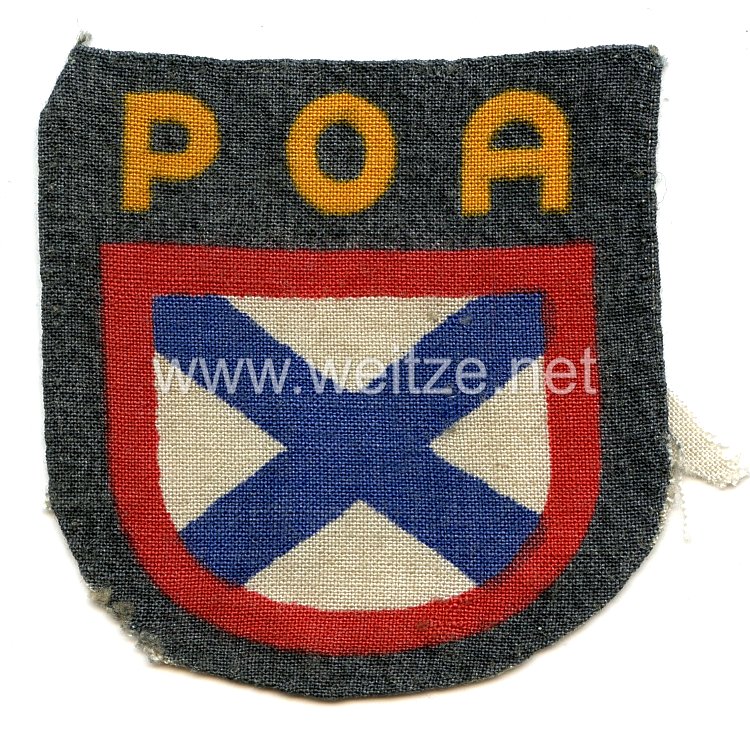
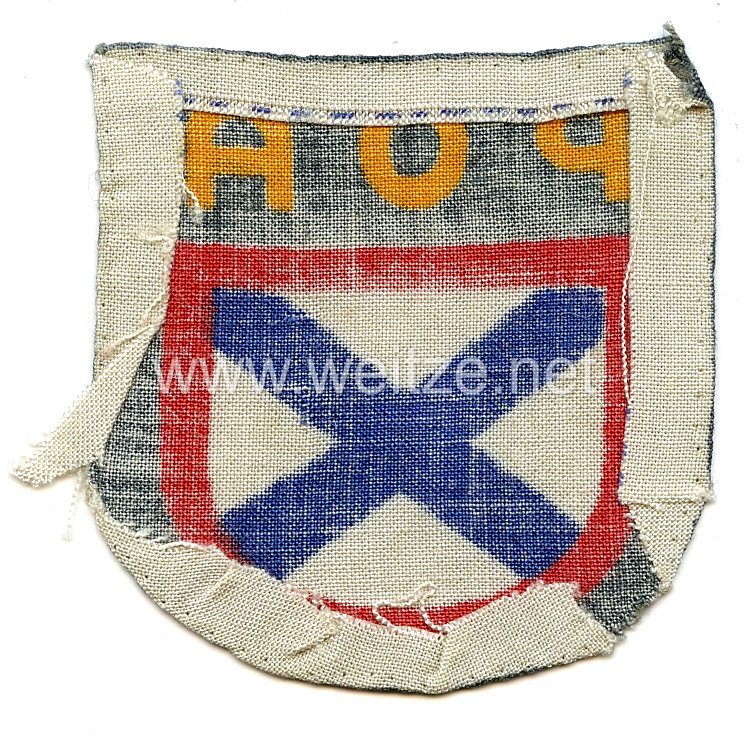
Wehrmacht Heer Sleeve Shield of the Russian Liberation Army POA

Printed variant. Worn, condition 2.

The Russian Liberation Army (Русская освободительная армия – РОА, Russkaja oswoboditel'naja armija – ROA), also called Vlasov Army after its first commander, was a Russian volunteer formation that fought on the German side in World War II. Its establishment was authorized by Adolf Hitler at the end of 1944, while volunteers from non-Russian peoples of the Soviet Union had already been organized three years earlier in the Eastern Legions.

The ROA was organized by former Lieutenant General of the Red Army Andrei Vlasov, who sought to unite all Russians in the fight against the Soviet Union. Among the volunteers were prisoners of war, forced laborers, and Russian emigres. The ROA received the status of an army of an allied state and was subordinated to the Wehrmacht in operational matters.
425631
95,00

Wehrmacht Heer Sleeve Shield of the Russian Liberation Army POA

Sleeve Shield of the Russian Liberation Army (ROA)

The sleeve shield of the Russian Liberation Army (Russkaja oswoboditel'naja armija – ROA) represents a significant artifact from one of the most controversial military formations of World War II. This unit, fighting on the German side, united Soviet defectors, prisoners of war, and émigrés under the banner of anti-communism.

Historical Background

The Russian Liberation Army was officially authorized by Adolf Hitler only in late 1944, although Russian volunteer units had been employed in limited capacity on the German side since 1941. The central organizer and commander was Lieutenant General Andrei Andreyevich Vlasov, a formerly highly decorated officer of the Red Army who fell into German captivity in July 1942.

Vlasov had distinguished himself during the defense of Moscow in 1941 and was considered one of the most capable Soviet commanders. After his capture, he agreed to lead an anti-communist Russian liberation movement. His motivation was complex: disillusionment with Stalin's regime, personal bitterness, and belief in the possibility of a non-communist Russia.

Organization and Structure

The ROA received the extraordinary status of an army of an “allied state,” though it remained operationally subordinate to the Wehrmacht. This status was largely symbolic, as the German leadership never fully trusted the Russian units and initially deployed them only in limited capacity. Only in 1944, as Germany's military situation became increasingly desperate, did Hitler authorize the full establishment of the ROA.

The force consisted of various elements: former Soviet prisoners of war seeking to escape German camps; Russian émigrés who had lived in exile since the October Revolution of 1917; and forced laborers seeking an alternative to their situation. Total strength is estimated at approximately 50,000 to 120,000 men, though precise figures are difficult to establish.

The Sleeve Badge

The ROA sleeve shield typically displayed the Russian national colors in the form of a heraldic shield with the Cross of St. Andrew – a white diagonal cross on a blue field. This symbol was historically associated with Russian military traditions and was intended to underscore the formation's legitimacy as a “genuine” Russian army.

The badges were manufactured in various versions: embroidered versions for officers and senior ranks, and printed versions for the mass of soldiers. The printed variant was more cost-effective to produce and could be manufactured more quickly in larger quantities, meeting the logistical demands of the late war years.

Combat History

The first fully equipped ROA division, the 1st Division of the ROA under Major General Sergei Bunyachenko, became operational only in January 1945. It was initially deployed on the Oder against the advancing Red Army. In April 1945, however, the division marched to Bohemia, where in a remarkable turn of events it participated in the Prague Uprising of May 5-8, 1945 – this time against the Germans and on the side of Czech insurgents.

Bunyachenko's decision was a desperate attempt to win Allied favor and escape Soviet retribution. The attempt failed: Czech communists refused to recognize the ROA, and the Western Allies handed over most ROA personnel to the Soviet Union in accordance with the Yalta agreements.

Post-War Fate

The fate of ROA personnel after the war was tragic. General Vlasov was captured by American troops in May 1945 and handed over to the Soviet Union. He was executed on August 1, 1946, after a show trial for high treason. Thousands of his soldiers were deported to Soviet labor camps or executed. Only a few managed to escape repatriation and found refuge in the West.

Historical Significance

The ROA remains a controversial subject in historiography. For Soviet and Russian historiography, Vlasov and his followers were traitors. In the West, the ROA was sometimes romanticized as an anti-communist resistance movement, a view that oversimplifies complex reality. Contemporary historical research views the ROA more nuancedly: as a product of the brutal circumstances of the Eastern Front, Stalinist terror, and the desperate hopes of people caught between two totalitarian systems.

The ROA sleeve shield thus stands symbolically for one of the most tragic episodes of World War II – a testament to betrayal, desperation, and the impossible choices people face in extreme situations.

r