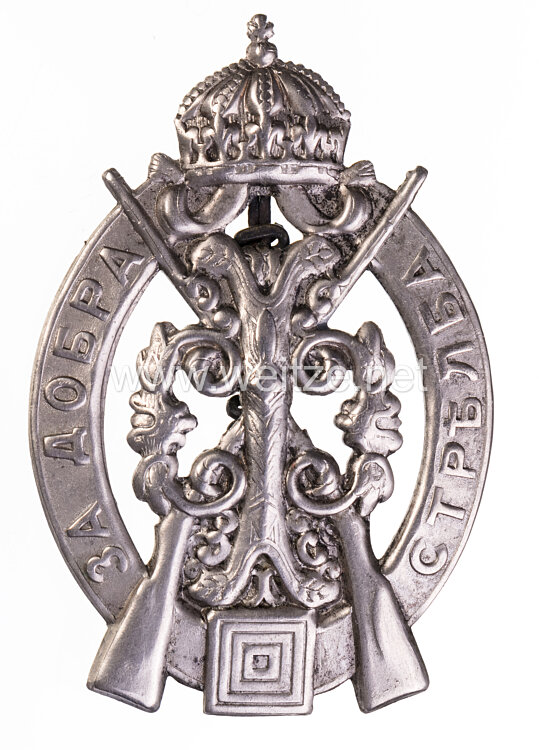
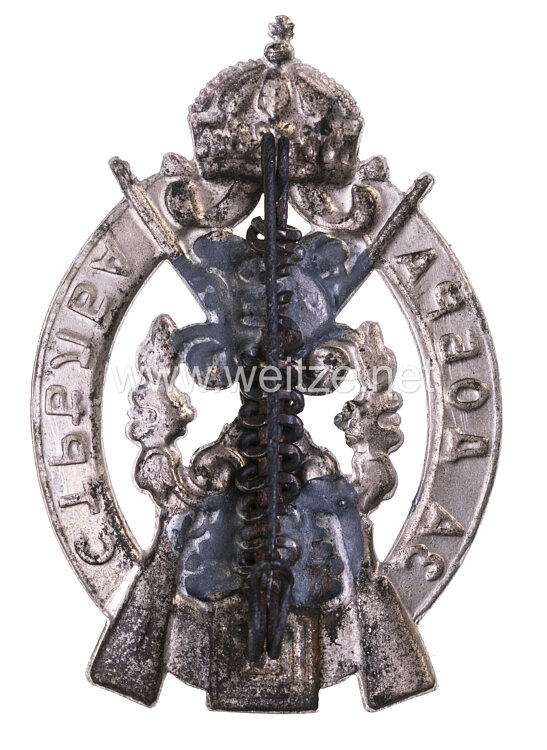
Kingdom of Bulgaria Infantry Marksmanship Badge
The Infantry Marksmanship Badge of the Kingdom of Bulgaria represents an important aspect of military training and recognition of achievement in the Southeastern European monarchy during the first decades of the 20th century. This award embodies the Bulgarian military's efforts to establish professional standards and promote marksmanship skills among its infantrymen.
Historical Context
The Kingdom of Bulgaria emerged in 1908 when Prince Ferdinand I proclaimed complete independence from the Ottoman Empire and elevated himself to Tsar. During this period of national consolidation and military modernization, the Bulgarian army was strongly influenced by German and Austro-Hungarian models. The introduction of marksmanship badges was part of a comprehensive reform program designed to increase the combat effectiveness of the armed forces.
The years around 1910 were characterized by intense military preparations. Bulgaria found itself in a geopolitically tense situation in the Balkans, surrounded by rival neighboring states and the weakening Ottoman Empire. The Balkan Wars of 1912-1913 would soon demonstrate the importance of well-trained and accurate infantry.
Technical Characteristics and Manufacturing
The described object is a tall oval pin badge made of tinplate, manufactured using the embossing process. This production method was typical for military decorations of lower ranks and enabled cost-effective mass production. Tinplate, a tin-coated steel sheet, provided sufficient corrosion protection and was easy to work with.
The embossing created a relief that gave the badge a certain dignity and recognizability despite the simple material. Such badges were typically worn attached to the uniform and identified the wearer as an above-average marksman within his unit.
Marksmanship Training in the Bulgarian Army
Marksmanship training held high importance in the Bulgarian army. Following German models, regular shooting exercises were conducted where soldiers had to demonstrate their accuracy under various conditions. The infantry was equipped with Mannlicher rifles, which had an effective range of several hundred meters.
Soldiers who achieved certain performance standards were honored with marksmanship badges. This practice served several purposes: it motivated troops to higher performance, created healthy competition, and identified the best marksmen who could undertake special tasks in combat situations.
Wearing Method and Military Significance
The pin badge was worn on the field uniform, typically on the chest or collar. The rear pin fastening allowed for easy attachment and removal. The mentioned old repair to the pin suggests that the badge was actually worn in military service and does not merely represent an unused depot specimen.
For the wearer, such an award was a source of pride and could have a positive impact on his military career. At a time when infantry formed the backbone of every army and battles were often fought at visual range, marksmanship was an essential combat skill.
Bulgaria in World War I
When Bulgaria entered World War I on the side of the Central Powers in 1915, the well-trained infantrymen proved themselves on various fronts. Years of peacetime training, including systematic promotion of marksmanship, paid off in battles against Serbia, Romania, and on the Salonika Front.
Collector Value and Historical Significance
Today, such marksmanship badges are sought-after collector's items that provide insight into the military history of the Kingdom of Bulgaria. They document the professionalization of Bulgarian armed forces and the adoption of Western European military traditions. The condition with signs of wear and repair emphasizes the authenticity and actual military use of the piece.
As a historical testimony, this inconspicuous tin badge connects the personal achievement of an individual soldier with the larger currents of European military history in the early 20th century.