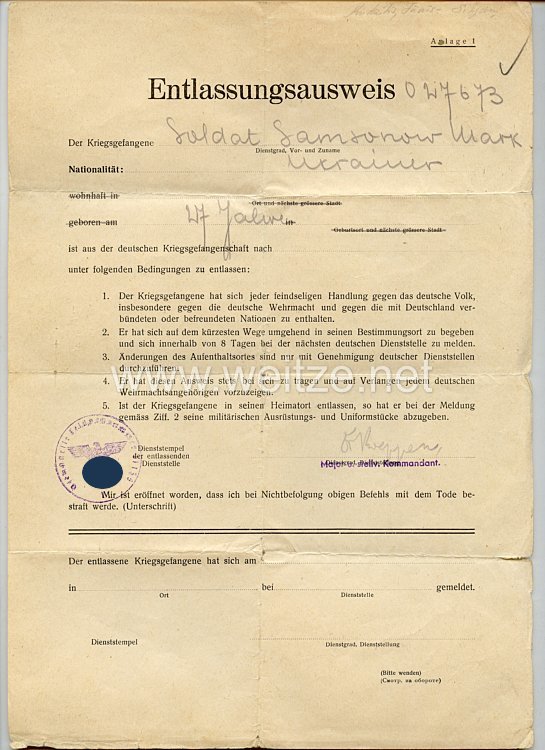
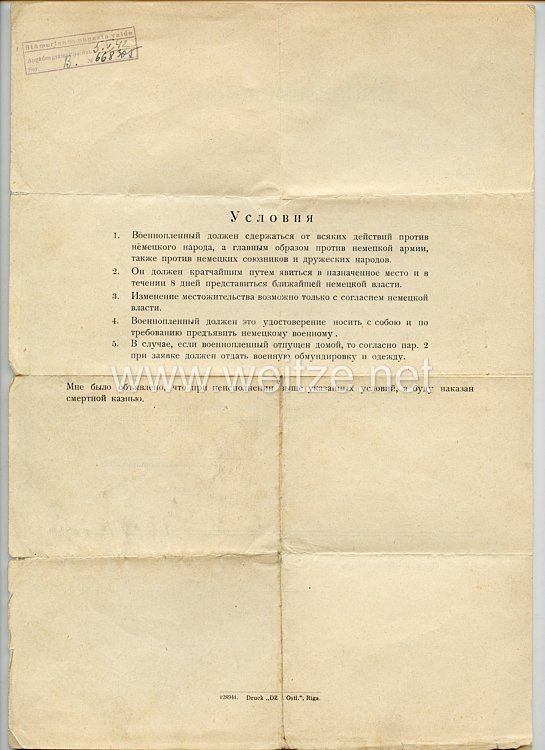
Third Reich - Discharge Certificate for a Ukrainian Prisoner of War from German Captivity

reverse stamped on May 5, 1942, folded multiple times, used condition.
398131
60,00

Third Reich - Discharge Certificate for a Ukrainian Prisoner of War from German Captivity

Release Certificates for Soviet Prisoners of War in the Third Reich

The present release certificate (Entlassungsausweis) from 1942 documents the release of a Ukrainian prisoner of war from German captivity and represents a significant historical testimony to the complex treatment of Soviet prisoners of war during World War II.

Historical Context of Operation Barbarossa

Following the launch of Operation Barbarossa on June 22, 1941, millions of Soviet soldiers fell into German captivity. By the end of 1941, over 3.3 million Red Army soldiers were already held in German camps. The Nazi leadership did not consider Soviet prisoners of war to be protected by the Geneva Convention, as the Soviet Union had not signed this agreement. This led to catastrophic conditions in the camps, with millions of prisoners perishing from starvation, disease, and mistreatment.

The Special Status of Ukrainian Prisoners of War

Within the framework of Nazi occupation policy, a differentiated treatment of various nationalities among Soviet prisoners of war developed. Ukrainians, Balts, and members of other non-Russian peoples were partially viewed as potential allies against Bolshevik rule. Nazi propaganda attempted to exploit ethnic tensions within the Soviet Union and presented the German campaign as a “liberation” of non-Russian peoples.

Beginning in 1942, the increasing labor shortage in the German Reich led to a reorientation of policy toward Soviet prisoners of war. Healthy and able-bodied prisoners, particularly from Ukraine, were increasingly employed in the war economy. This required their formal release from prisoner-of-war status and the issuance of corresponding documents.

The Release Certificate of May 1942

The date of the stamp - May 5, 1942 - falls within a transitional phase of German Eastern policy. In spring 1942, the Nazi regime intensified the recruitment of labor from the occupied Eastern territories. The General Plenipotentiary for Labor Deployment, Fritz Sauckel, was appointed in March 1942 and drove the mobilization of millions of forced laborers.

Such a release certificate served as an official document regulating the status of the former prisoner of war. It enabled the transformation of status from prisoner of war to Ostarbeiter (Eastern worker) or return to occupied home territories. These documents were designed in multiple languages and typically contained personal data, photographs, fingerprints, and stamps from various German authorities.

Legal and Administrative Framework

The administration of prisoners of war was under the authority of the Wehrmacht High Command (OKW), while their employment as laborers fell under the Reich Labor Ministry and later Sauckel's office. Release from prisoner-of-war status involved extensive bureaucratic procedures, including identity verification, medical examination, and assignment to work locations.

For Ukrainian prisoners of war, release did not necessarily mean freedom in the true sense. Many were obligated to perform forced labor in German armaments industry, agriculture, or other war-essential sectors. Their living and working conditions often remained harsh, even though they formally no longer held prisoner-of-war status.

Documentary Significance

Release certificates like the present specimen are today important historical sources for researching Nazi forced labor and the treatment of prisoners of war. The document's multiple folds and used condition indicate that it was actually carried by its holder - a silent witness to an individual fate within the mass deportations and forced displacements of those years.

The preservation of such documents enables historians to reconstruct the bureaucratic mechanisms of Nazi rule and trace individual life stories. They document both the systematic exploitation of millions of people and the complex categorizations and differentiations that the Nazi regime applied in treating various population groups.

Postwar Fate

For many Ukrainian former prisoners of war and forced laborers, the war's end had ambivalent consequences. Soviet leadership often viewed captivity as treason, and returnees were frequently treated as potential “collaborators.” Many underwent interrogations and camp internment in the Soviet Gulag system after their return. This aspect makes such documents testimonies to multiple persecutions and illustrates the tragic situation of many Eastern Europeans during and after World War II.

r