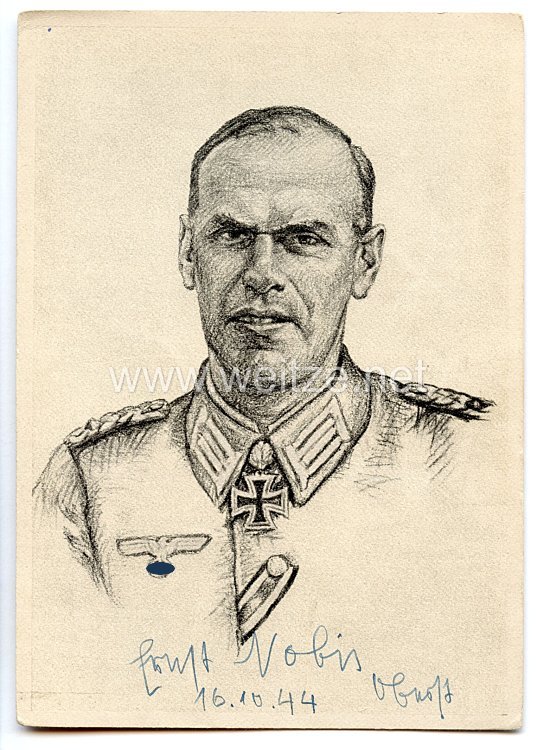
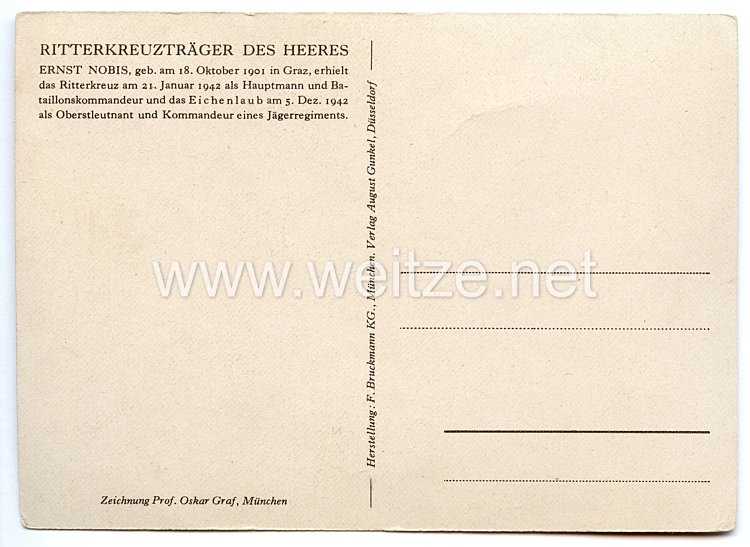
Army - Original Signature of Knight's Cross Recipient Oberst Ernst Nobis

on a postcard from the series “Knight's Cross Recipients of the Army”, with very fine ink signature “Ernst Nobis Oberst 16.10.44”, unmailed, condition 2.
334531
140,00

Army - Original Signature of Knight's Cross Recipient Oberst Ernst Nobis

This postcard bearing the original signature of Oberst Ernst Nobis dated October 16, 1944, belongs to a significant series of propaganda postcards depicting Knight's Cross recipients of the Army during World War II. Such documents with authentic signatures of highly decorated officers represent important historical testimonies today, documenting both the military decoration practices and the propaganda machinery of the Third Reich.

Ernst Nobis was born on April 8, 1895, in Wuppertal and pursued a remarkable military career. He entered the Imperial Army during World War I, serving in various capacities. After the war, he remained loyal to the Reichswehr and was later transferred to the Wehrmacht. During World War II, Nobis commanded Grenadier Regiment 232 of the 132nd Infantry Division on the Eastern Front. For his leadership achievements and personal courage during fierce battles in Russia, he was awarded the Knight's Cross of the Iron Cross on March 21, 1942, one of the highest military decorations of the German Reich.

The postcard series of Knight's Cross recipients was part of a comprehensive propaganda strategy aimed at glorifying military successes and strengthening civilian morale. These cards were produced in large editions and typically featured a portrait photograph of the decorated officer in uniform with visible medals and decorations. The cards served various purposes: they were distributed as collectibles, used for autograph hunting, and sent by soldiers to their families. The photographs were usually taken in professional studios and intended to convey an idealized image of the German soldier.

The signature dated October 16, 1944, falls during a period when the fortunes of war had long turned decisively against Germany. At this time, the Wehrmacht was fighting defensively on all fronts, and the Allies had already reached German Reich territory in both East and West. Nevertheless, propaganda continued, and the awarding and portrayal of Knight's Cross recipients remained an important element of perseverance propaganda. The fact that Nobis signed his card with rank and date corresponded to common practice of the time and increased the personal value for collectors and admirers.

The Knight's Cross of the Iron Cross was instituted on September 1, 1939, by Adolf Hitler as a renewal of the war decoration from World War I. It was the highest grade of the Iron Cross and was awarded for exceptional bravery in combat or outstanding military leadership achievements. By war's end, approximately 7,300 members of the Wehrmacht received this decoration, with the criteria undergoing various changes throughout the war. Knight's Cross recipients enjoyed high prestige and were intensively used for propaganda purposes, explaining the creation of such postcard collections.

After receiving his Knight's Cross, Oberst Nobis continued his service and was later promoted to the rank of Oberst (Colonel). He survived the war and passed away on March 20, 1960. His military career reflects the experiences of many professional officers who served through both world wars and whose lives were inextricably linked to German military history of the 20th century.

From a collecting historical perspective, such signed postcards are today sought-after objects for militaria collectors and historians. They document not only individual biographies but also the systematic use of military successes for propaganda purposes. The condition grade “2” indicates a well-preserved card, which is not self-evident for objects from this period. The ink signature is a particularly valuable element, as it establishes authenticity and direct connection to the historical person.

Today, such objects must be viewed in the context of their time of origin. They are testimonies of a criminal regime responsible for war and genocide. At the same time, as historical documents, they possess undeniable scientific and educational value. Engagement with such objects enables understanding and critical reflection on the mechanisms of propaganda and hero worship. In museums and scholarly collections, they contribute to comprehensively documenting the history of World War II and conveying it to future generations.