Grand Duke Friedrich Wilhelm - Tablecloth from His Personal Household
This exceptional tablecloth of white silk damask originates from the personal household of Grand Duke Friedrich Wilhelm of Mecklenburg-Strelitz and represents the highest quality of courtly textile art from the late 19th and early 20th centuries. It embodies not only craftsmanship perfection but also the complex dynastic and protocolar world of German high nobility during the Wilhelmine era.
Friedrich Wilhelm of Mecklenburg-Strelitz (1819-1904) ruled from 1860 until his death as Grand Duke over the small but tradition-rich North German territory. As a member of one of Germany's oldest princely families, he maintained close dynastic connections to other European royal houses, particularly to the British royal family. His sister Auguste was married to British Prince Frederick of Cambridge, which strengthened the family ties to the United Kingdom.
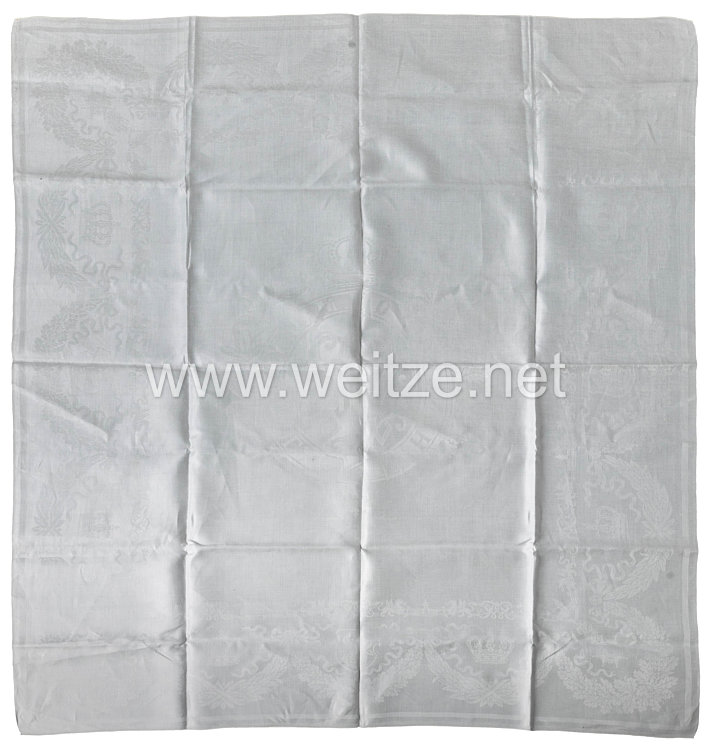
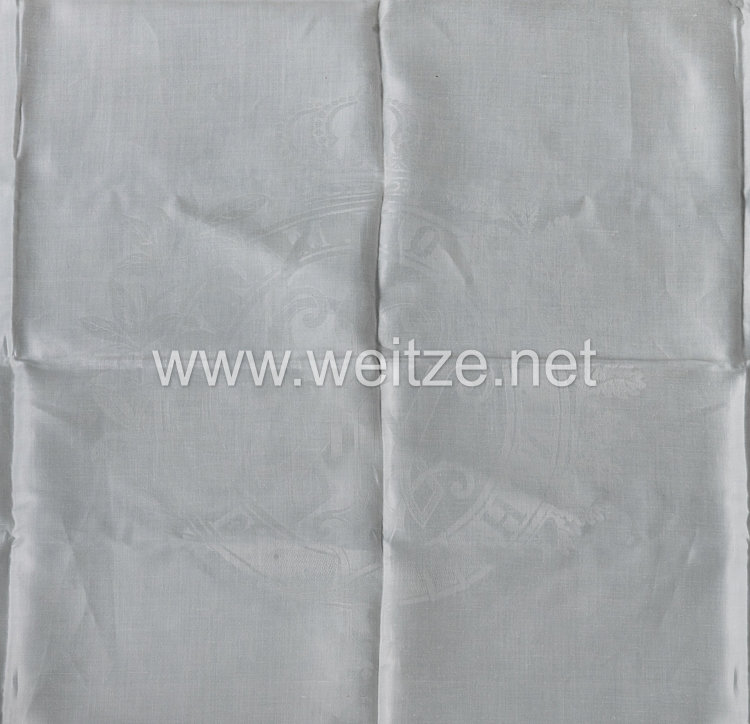
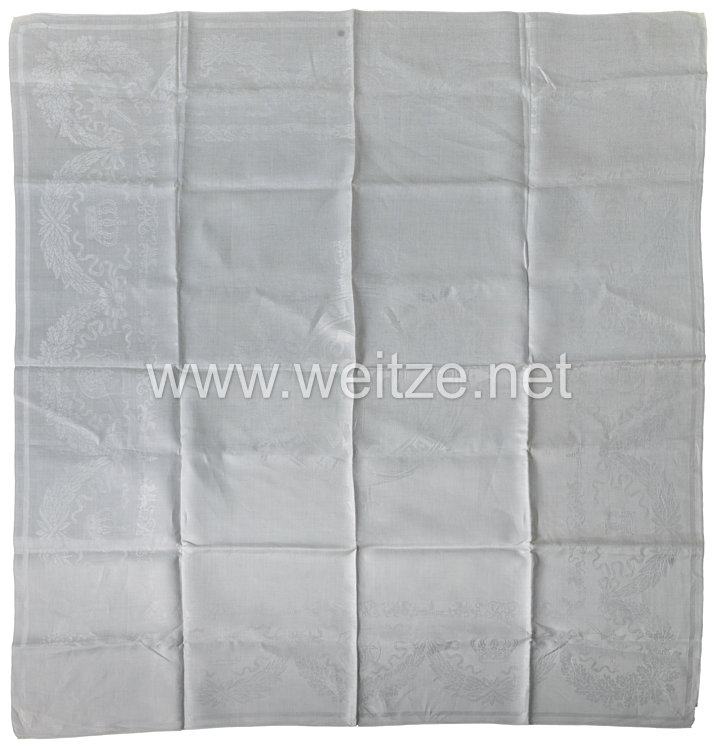
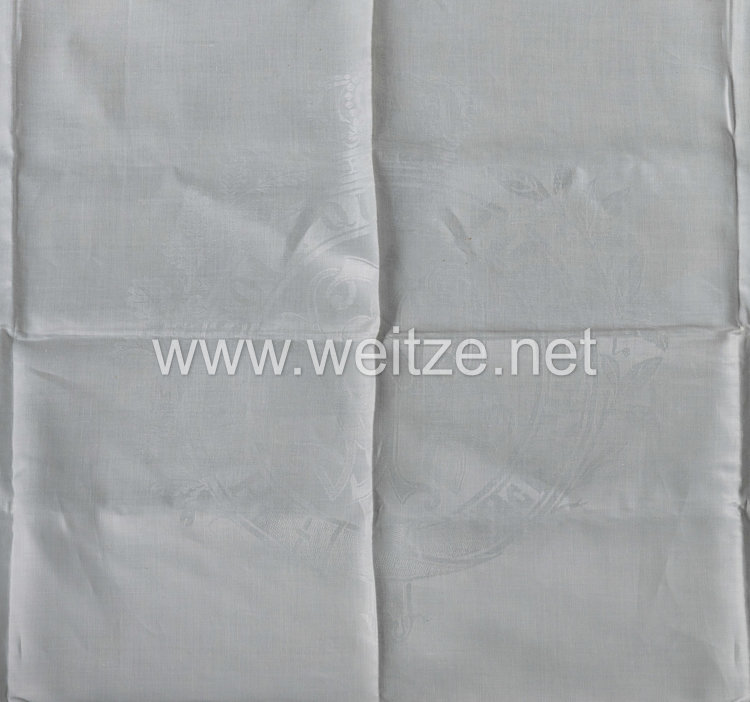
The design of the tablecloth reveals these Anglo-German connections in an impressive manner. At the center is the crowned mirror monogram “FW,” surrounded by the band of the English Order of the Garter with its characteristic motto “Honi soit qui mal y pense” (Shame on him who thinks evil of it). The Order of the Garter, founded in 1348 by King Edward III of England, is considered the highest British order of chivalry. Its bestowal upon foreign monarchs was a special honor and sign of closest diplomatic relations. The Mecklenburg-Strelitz dukes received this distinction due to their kinship ties with the British royal house.
The monogram is flanked by oak leaves and laurel branches, traditional symbols of strength, constancy, and glory. These heraldic elements were widespread in the German Empire and emphasized the authority and dignity of the ruling house.
Particularly noteworthy is the surrounding depiction of the Golden Chain of the House Order of the Wendish Crown. This order was established in 1864 by Grand Duke Friedrich Franz II of Mecklenburg-Schwerin and was common to both Mecklenburg lines – Schwerin and Strelitz. The name refers to the Wendish roots of the region, as Mecklenburg was once settled by Slavic tribes. The golden order chain with the pendant crosses in the four corners of the tablecloth symbolizes the highest rank of this order of merit.
The woven grand ducal crowns and the various heraldic components of the Mecklenburg-Strelitz coat of arms complete the heraldic composition. The arms of Mecklenburg-Strelitz united several historical territories: the bull's head for Mecklenburg, symbols for the County of Schwerin, the Lordship of Rostock, the Principalities of Ratzeburg and Stargard, as well as other historical possessions.
Such representative textiles were an integral part of court culture. They were used at official banquets, receptions, and ceremonial occasions and served to demonstrate rank, power, and dynastic continuity. The use of white silk damask was no accident: silk was considered the noblest fabric, and the damask weaving technique, in which patterns become visible through different light reflections, required the highest level of craftsmanship. White symbolized purity, elegance, and was the preferred color for festive tables.
The production of such textiles took place in specialized manufactories, often in traditional weaving centers such as Lyon, Krefeld, or Dresden. The designs were often created by court artists and had to observe strict heraldic rules. Technical implementation required Jacquard looms that enabled complex patterns.
In the context of German history, this tablecloth represents the world of German particularism before 1918, when numerous kingdoms, grand duchies, duchies, and principalities under the umbrella of the German Empire maintained their own identity and court culture. Mecklenburg-Strelitz, with approximately 2,900 square kilometers and around 100,000 inhabitants, was one of the smaller territories but proudly preserved its traditions and dynastic claims.
After the end of the monarchy in 1918 and the abdication of the last Grand Duke Adolf Friedrich VI, many of these courtly furnishings were dissolved, sold, or passed into private ownership. That this tablecloth has been preserved in excellent condition testifies to careful storage and makes it a valuable historical testimony to courtly representative culture.