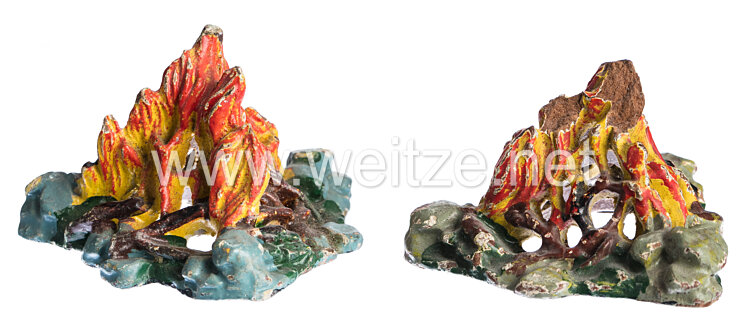
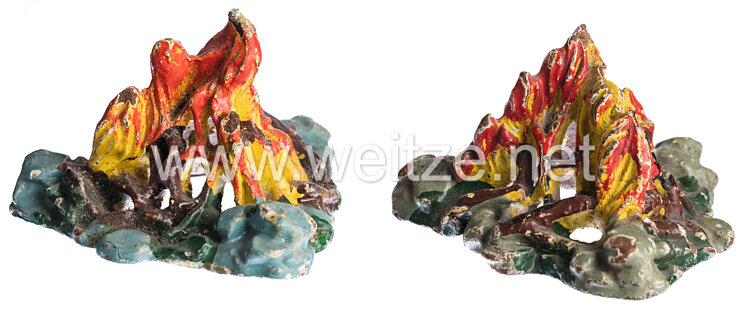
Elastolin - 2 Large Campfires

for 7.5 cm figures, condition 2.
277731
45,00

Elastolin - 2 Large Campfires

The Elastolin campfire pieces for 7.5 cm figures represent a fascinating aspect of German toy history in the 20th century. These accessories were manufactured by O. & M. Hausser in Ludwigsburg near Stuttgart, a company that was among the leading producers of composition and plastic figures in Germany from 1904 until the 1980s.

The Hausser company developed the patented material Elastolin around 1910, an innovative composition made from glue, chalk, sawdust, casein, and other additives. This material proved ideal for manufacturing detailed toy figures and accessories, as it was moldable, relatively stable, and more cost-effective to produce than wood or metal. The name “Elastolin” was intended to emphasize the material's elasticity and break resistance.

The 7.5 cm figures formed one of the standard sizes in Hausser's range and became particularly popular in the 1930s and 1940s. This size allowed for a good balance between detail and playability. The figure series included soldiers from various periods and nations, civilian figures, as well as an extensive range of accessories and terrain pieces.

The campfires were an essential component of military camp scenery and served to create realistic representations of field camps, bivouacs, or rest periods. In military reality, campfires were of central importance to soldiers in the field: they served for cooking, warmth, as a light source, and as the social center of the unit. This function was also replicated in the toy realm.

The production of these accessories followed a multi-stage process. First, the Elastolin composition was pressed into metal molds, then dried and subsequently hand-painted. The painting was often done by home workers in the Ludwigsburg region, which enabled the company to produce large quantities. The campfires were typically designed with realistic colors: black or gray logs, orange-red flames, and possibly details such as embers or smoke effects.

The historical context of these pieces' production is closely linked to German history in the 20th century. In the 1930s, the Hausser company experienced considerable growth as military toys became increasingly popular. During the Nazi era, production was partially oriented toward contemporary Wehrmacht representations, which today leads to ethical discussions among collectors. After World War II, production had to be restructured, with increased focus on historical and civilian themes.

The condition designation “Condition 2” follows the established collector's scale, where condition 1 means mint and condition 6 means heavily damaged. Condition 2 designates a piece with minimal signs of use, slight paint wear, or small imperfections, but generally well preserved. For Elastolin material, this is particularly significant, as the composition could be sensitive to moisture and mechanical stress.

For collectors today, such accessories are of particular interest because they have often survived less frequently than the figures themselves. While soldier figures formed the core of a collection and were accordingly carefully preserved, smaller accessories like campfires were more frequently lost or subjected to greater wear during play. Reconstructing complete camp scenery with appropriate accessories therefore presents a special challenge for collectors.

The cultural-historical significance of such toys lies in their function as historical witnesses. They reflect how military themes were present in the civilian sphere, particularly in children's education. At the same time, they document the craftsmanship and artistic design of German toy production. The Hausser company employed talented modelers who accurately recreated historical uniforms and equipment in detail.

After the discontinuation of Elastolin production in the 1980s, these pieces have become sought-after collectibles. The market for historical toy soldiers and accessories has become professionalized, with specialized dealers, auction houses, and collector associations. Evaluation is based on criteria such as rarity, condition, historical significance, and artistic quality.

These campfire accessories represent more than mere toys; they are artifacts of a specific period in toy manufacturing history and reflect changing social attitudes toward military themes in civilian life. They continue to fascinate collectors and historians alike, serving as tangible connections to the craftsmanship and cultural values of their era.