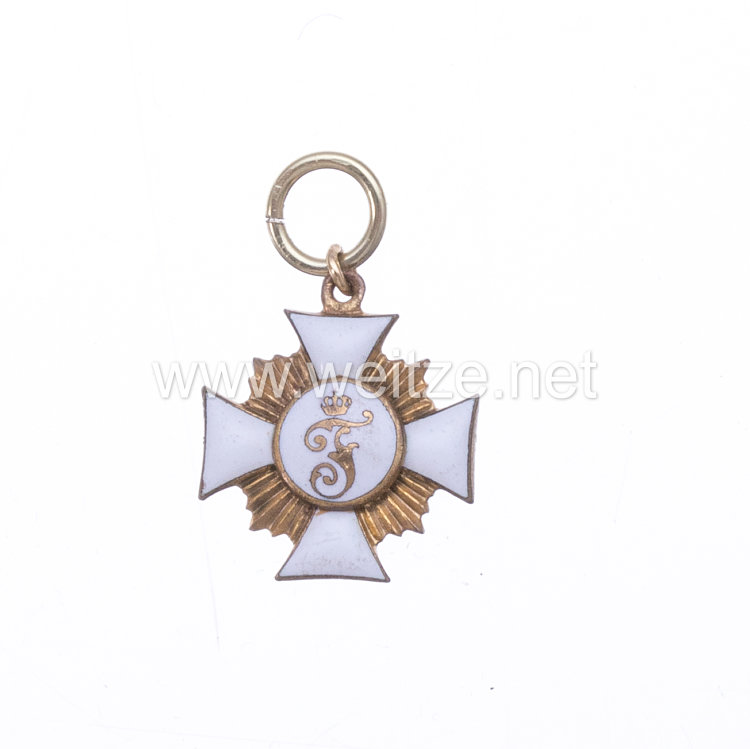
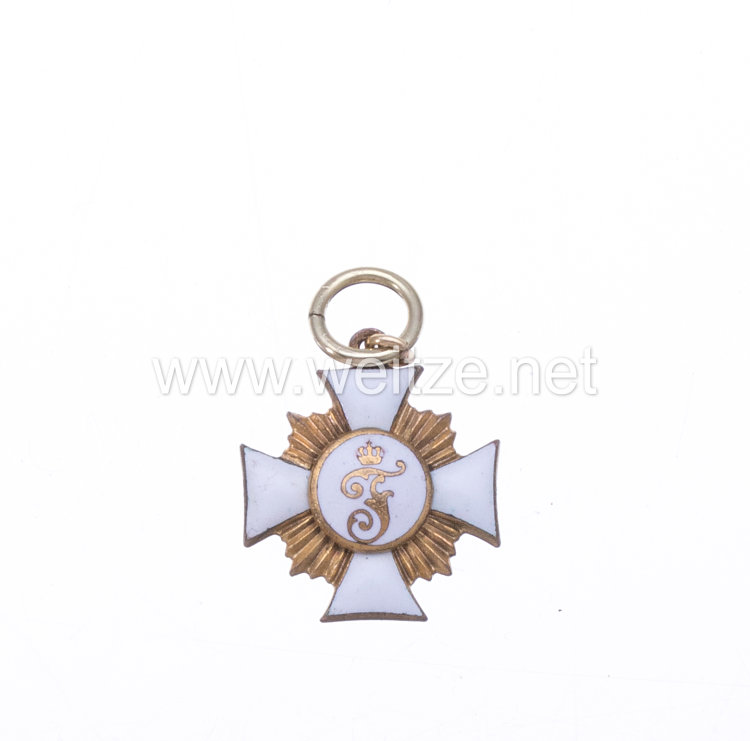
Württemberg Order of Friedrich Knight's Cross 1st Class
The Friedrich Order (Friedrichs-Orden) of the Kingdom of Württemberg ranked among the most prestigious orders of merit of the former South German kingdom and represented for over a century the highest recognition for exceptional services to the state and monarchy. The miniature of the Knight's Cross 1st Class described here represents a special form of order decoration specifically designed to be worn on an order chain.
King Friedrich I of Württemberg established the order on January 1, 1830, on his birthday, naming it after himself. The order's foundation occurred during a time of profound social changes in Europe, shortly before the July Revolution in France. The Friedrich Order was intended to reward outstanding civil and military merits and complemented the existing Württemberg order system with a high-ranking decoration.
The order classes were hierarchically structured: the Grand Cross formed the highest level, followed by the Commander's Cross with Star, the Commander's Cross, the Knight's Cross 1st Class, and finally the Knight's Cross 2nd Class. The Knight's Cross 1st Class was distinguished by its particular significance as a frequently awarded yet prestigious decoration granted to both officers and meritorious civil servants.
The order's design followed classical heraldic principles. The order cross was executed as a golden, red-enameled cross with broad arms, at whose center was the royal Württemberg monogram. The characteristic miniature version was considerably smaller than the regular decoration and specifically intended for wearing on the order chain or medal bar. These miniatures were worn at festive occasions with small uniform or formal dress when full-size order decorations seemed inappropriate.
The production of order miniatures required the highest level of craftsmanship. Specialized order manufacturers in Stuttgart and other Württemberg cities produced these pieces with utmost care. Firms such as Carl Dillenius in Stuttgart or later Friedrich Ortner were renowned for their quality work. Despite their reduced size, the miniatures had to preserve all characteristic features of the original, including the enameling and fine details.
Wearing order miniatures was subject to strict order statutes. Württemberg uniform regulations precisely specified when and how miniatures were to be worn. For grand gala uniforms, the complete order decoration with ribbon was worn, while for smaller uniforms or civilian evening dress, the miniature chain with corresponding miniatures was employed. This allowed bearers to display their decorations appropriately even at less formal occasions.
The awarding practice of the Friedrich Order was strictly regulated. For military merits, the order was frequently awarded after successful campaigns or for long-term exemplary service. In the civilian sphere, it honored state officials, scientists, artists, and industrialists who had rendered distinguished service to the kingdom. During the reigns of Kings Wilhelm I (1816-1864), Karl I (1864-1891), and Wilhelm II (1891-1918), the order experienced continuous awards.
During World War I, the Friedrich Order gained special significance once more. Numerous Württemberg officers and troop commanders were decorated with the order, with awarding practices adapted to the requirements of total war. The miniature enabled bearers to display their decoration even in the field on appropriate occasions.
After King Wilhelm II's abdication on November 30, 1918, and the end of the monarchy, the Friedrich Order lost its official status. The Weimar Republic and later the Nazi regime prohibited wearing monarchical decorations in certain contexts. Nevertheless, many bearers preserved their orders as personal mementos of their service and the Württemberg monarchy.
Today, miniatures of the Friedrich Order are valued collectors' items that provide insight into the order culture of the Kingdom of Württemberg. They document not only the craftsmanship of their era but also the complex hierarchy and ceremonial of monarchical society. The preserved condition of such miniatures varies considerably, with well-preserved examples featuring complete enameling being particularly sought after.