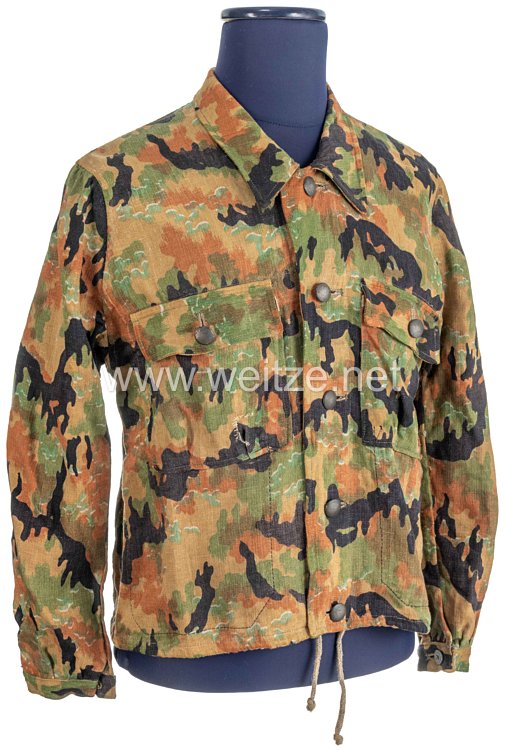
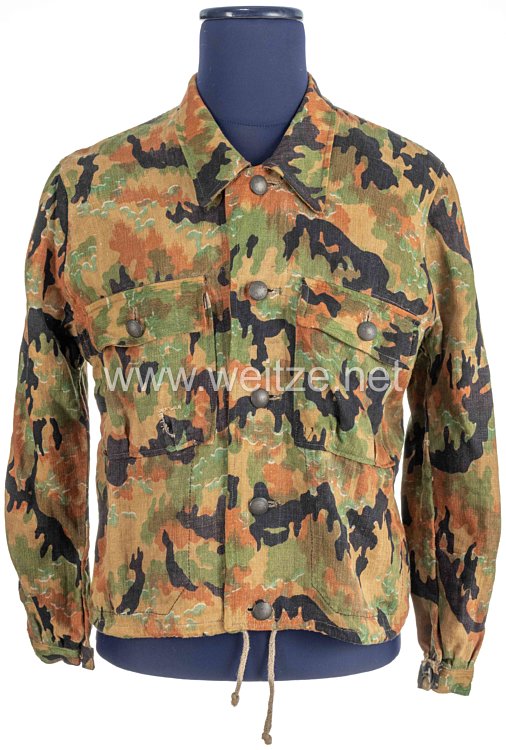
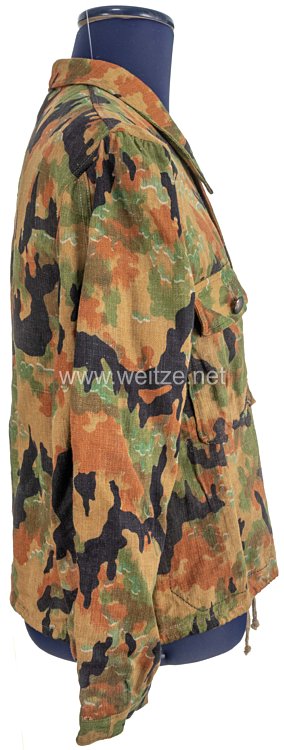
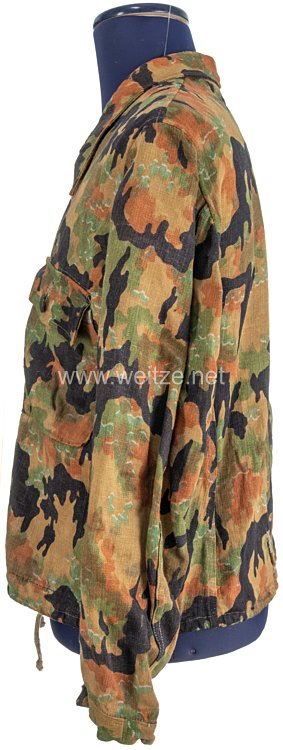
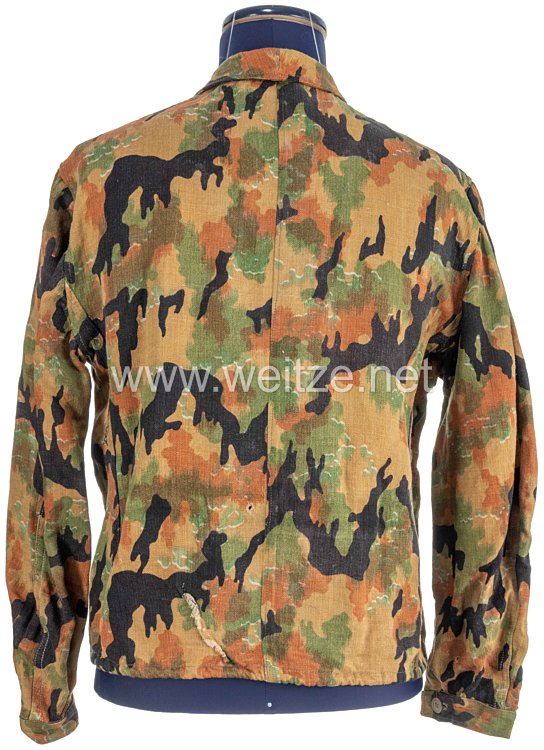
Waffen-SS Camouflage Field Blouse M 45 in Leibermuster Pattern

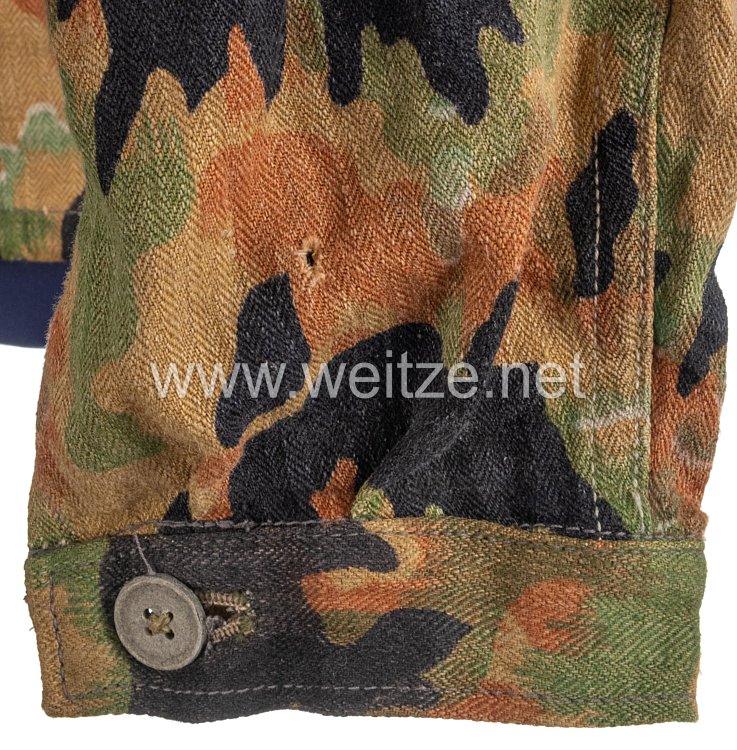
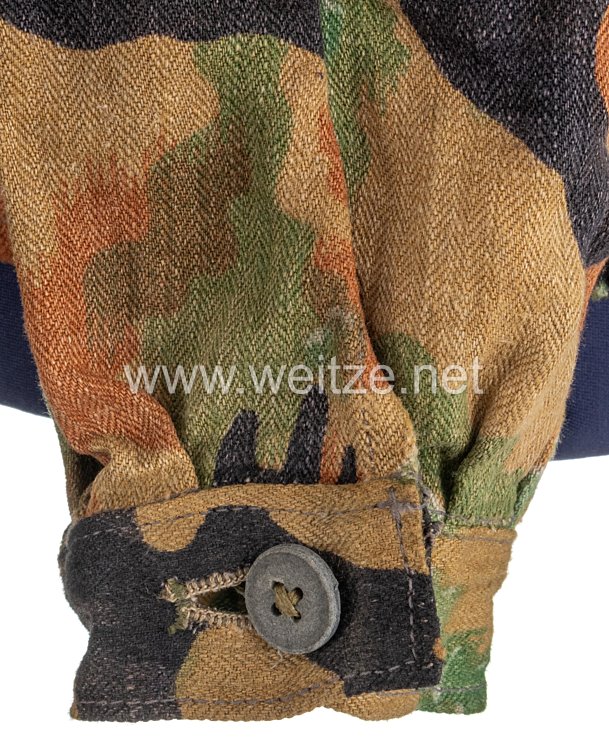
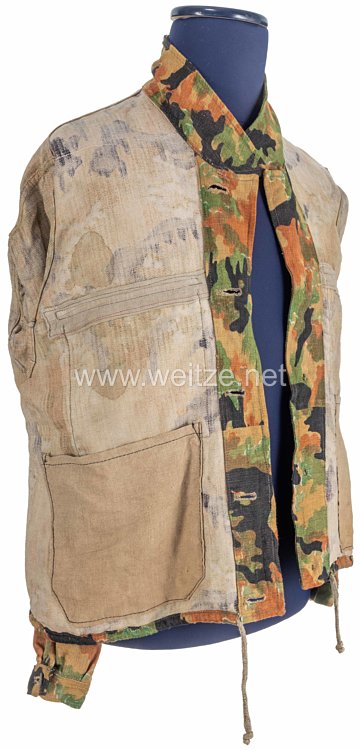
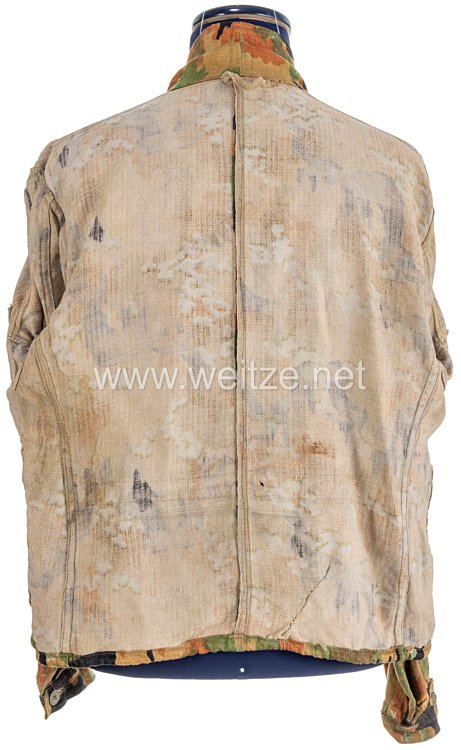
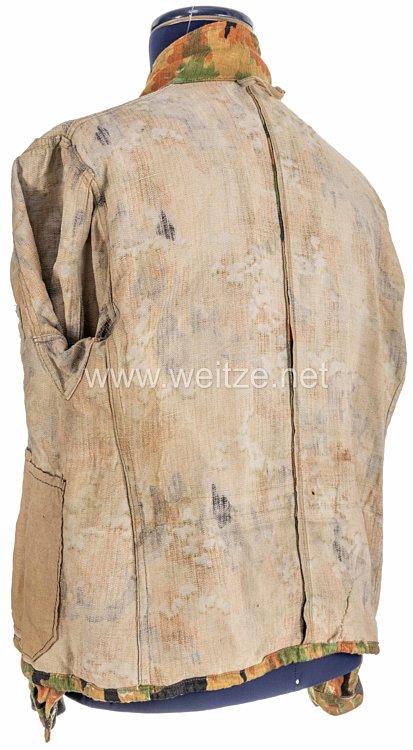
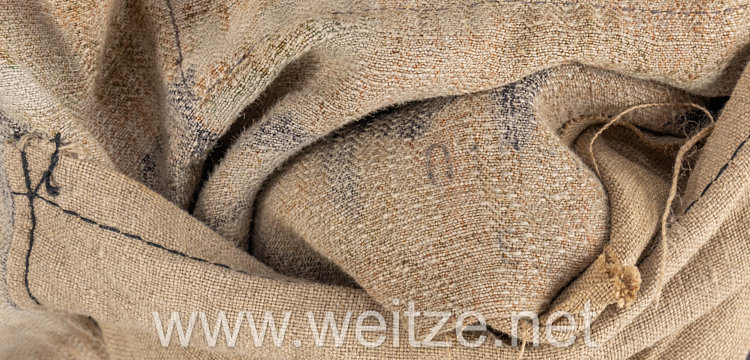
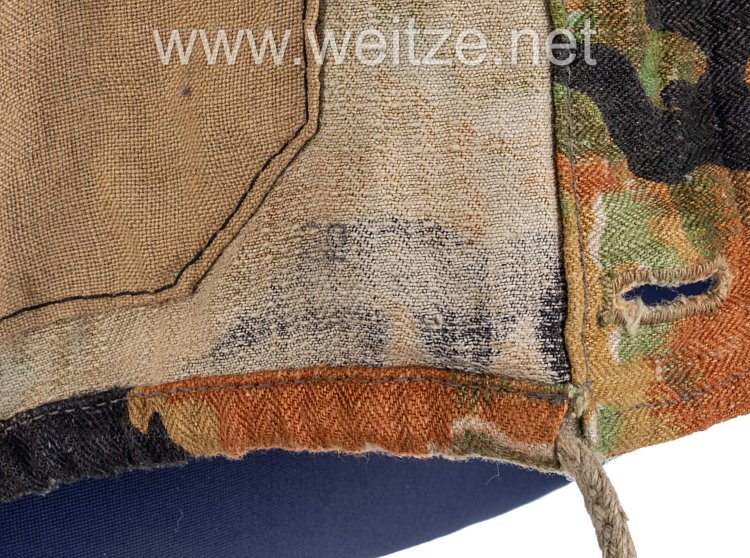
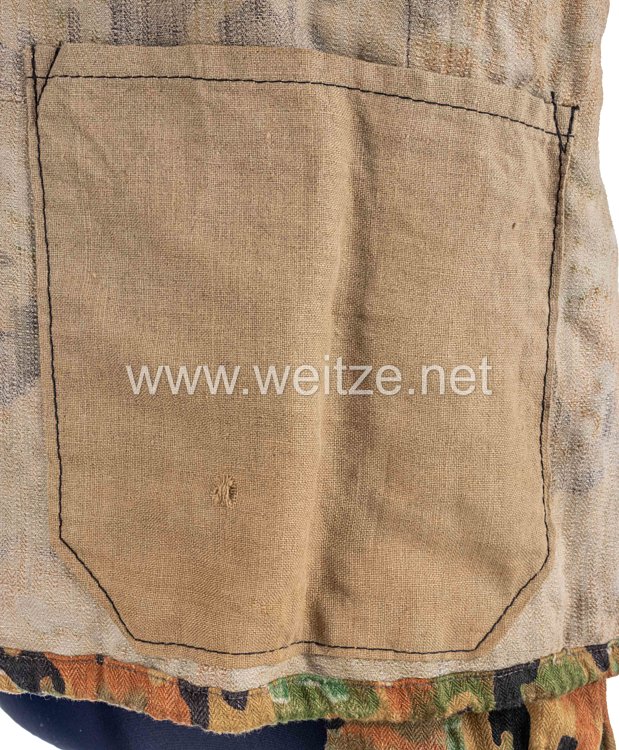
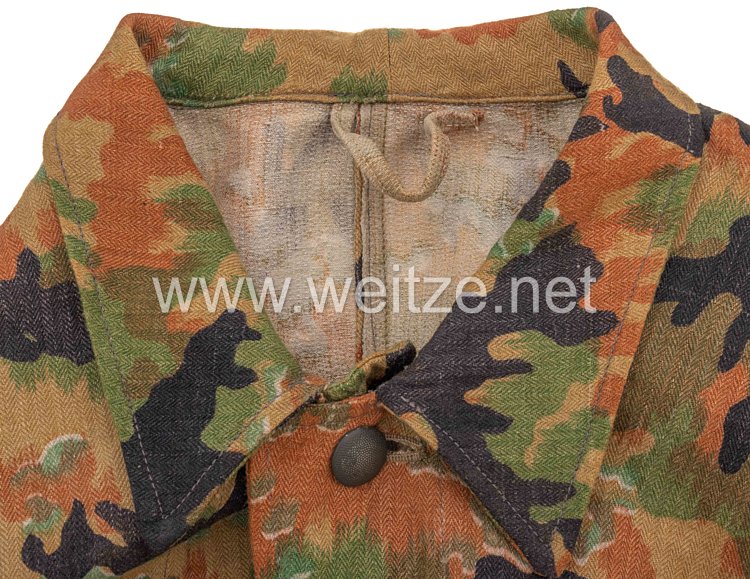
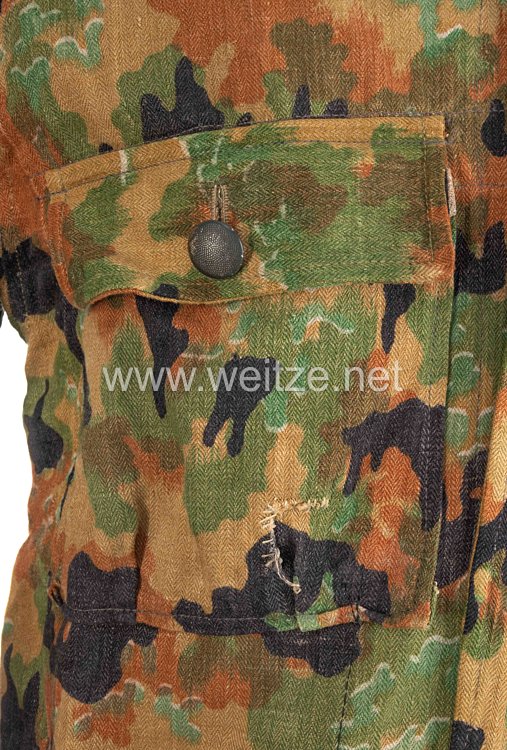
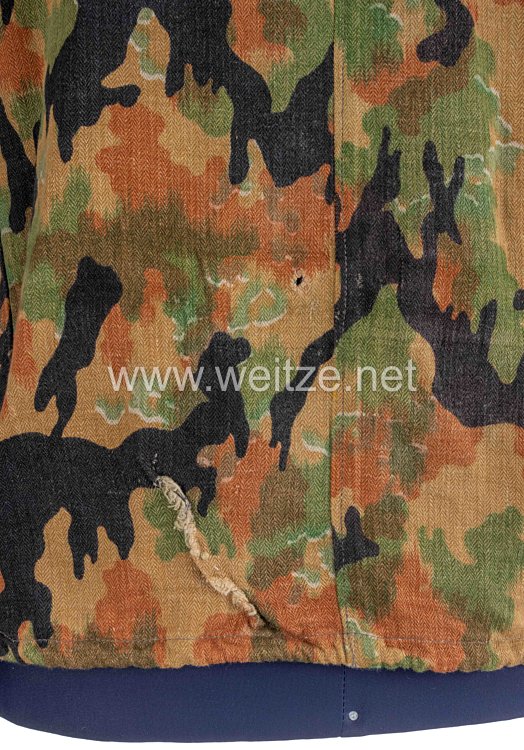
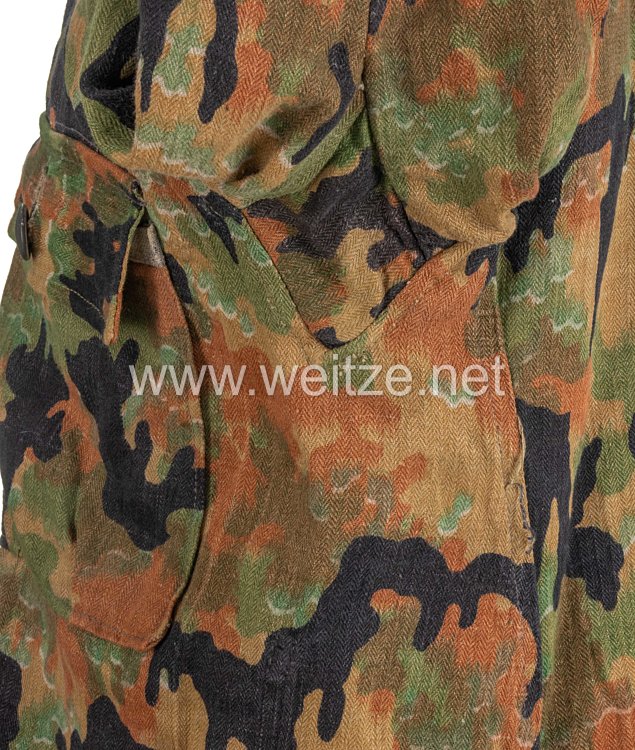
Chamber piece, circa 1945. Manufactured from single-sided printed “herringbone” twill fabric in the distinctive Leibermuster camouflage pattern. Short camouflage jacket with 2 patch breast pockets, the button placket with 5 field-gray painted metal buttons. Lower waist with drawstring cord, knotted at front. Sleeve cuffs with cardboard buttons. Interior left side with additionally attached inner pocket, hanging loop at back of collar torn off on right side, but otherwise completely intact. Chamber stamps still clearly visible at lower left interior and in inner pocket. Sleeve length 56 cm, chest circumference 98 cm, length 60 cm. Only lightly worn, one small repair patch on right breast pocket, still very color-fast, condition 2.

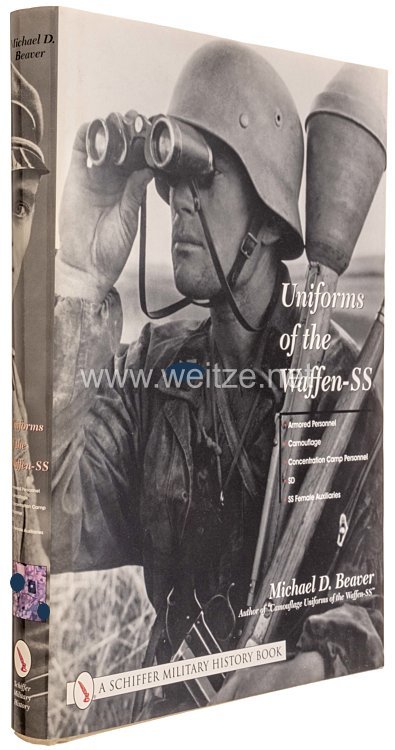
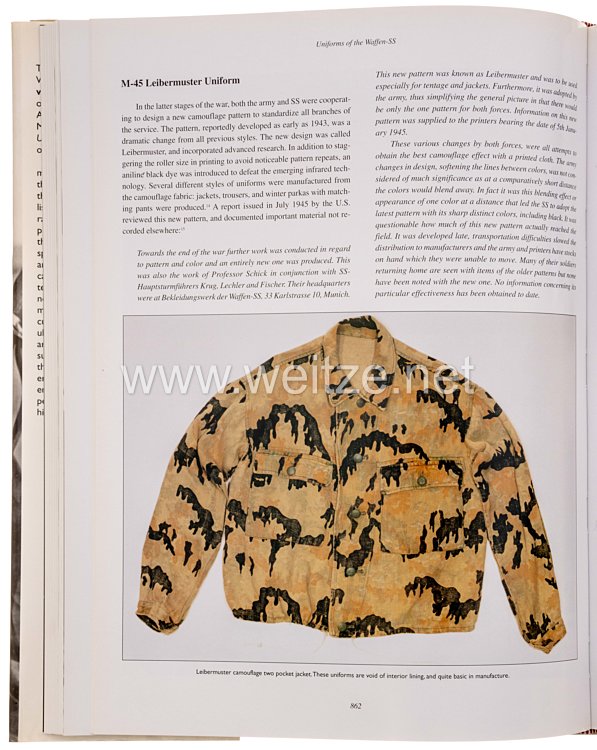
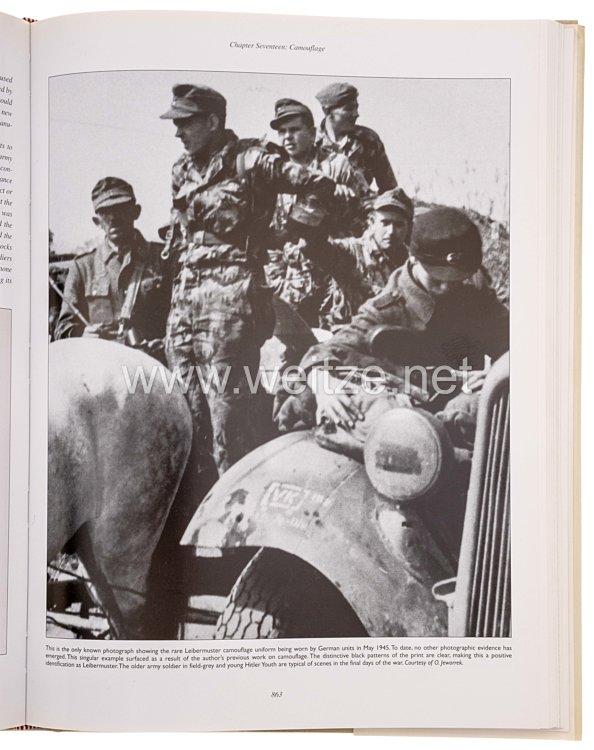
At the end of the war, the Waffen-SS together with the Wehrmacht developed a new unified camouflage pattern in collaboration with Prof. Schick and SS-Hauptsturmführers Krug, Lechler, and Fischer from the Waffen-SS clothing works in München. The distinctive feature of this newly developed camouflage pattern is its special effectiveness against UV night vision devices. The only known photograph of a Waffen-SS soldier from May 1945 is depicted in the reference work by Michael D. Beaver “Uniforms of the Waffen-SS” Vol. 3, page 863, together with another example of this camouflage model (although heavily faded).

In over 33 years of business, this is the first piece we have been able to offer. This is certainly by far the rarest camouflage field blouse of the Waffen-SS.
416730

Waffen-SS Camouflage Field Blouse M 45 in Leibermuster Pattern

The M45 Field Blouse in Leibermuster camouflage represents the final and rarest camouflage pattern of the German Wehrmacht in World War II. Developed in February 1945, this pattern was introduced far too late to be issued in any significant quantity. Printing factories did not receive information about the new pattern until January 15, 1945, and only very few German soldiers were issued these items before the war ended in May 1945.

The Leibermuster emerged from an unprecedented collaboration between the Wehrmacht and Waffen-SS, intended to replace all previous camouflage patterns used by both organizations with a unified, state-of-the-art design. Development occurred under the direction of Professor Johann Georg Otto Schick, as documented in the Richardson report from July 1945. The pattern's true innovation lay in its infrared-resistant conception: designed with aniline black dye, it was meant to counter early Allied night vision equipment coming into service at that time.

Production utilized single-sided printed herringbone twill drill cloth with complex multicolor printing. The pattern consisted of six colors: a buff background with white flecks, light green and medium green feathered leaf-shapes, red-brown swathes, and carbon black branches. The use of varying-size printing rollers eliminated conspicuous pattern repeats. The design was intended to maintain its disruptive qualities particularly at short distances.

The M45 uniforms were based on the M44 pattern but of lower quality due to economic restraints, lacking the waist band of the M44. The short field jacket featured two breast pockets, a five-button front closure with field-grey lacquered sheet metal buttons, and a drawstring waist. Beyond the field jackets, the Leibermuster pattern was also produced on marching trousers, reversible winter parkas, and Zeltbahn shelter quarters.

Actual issue of M45 uniforms occurred on an extremely limited basis, primarily to Wehrmacht soldiers on the Eastern Front, specifically in Czechoslovakia from February 1945. All known original photographic evidence shows Wehrmacht soldiers in the former Czechoslovakian territory. While reports exist of use by SS foreign volunteer units in the Baltic region, specifically the Riga area, these remain unverified by photographic evidence. Despite the original intention to issue the pattern to both Wehrmacht and Waffen-SS units, there are no known images of Waffen-SS members wearing Leibermuster uniforms.

All known original tunics bear the same RB.Nr. 0/0185/5043 marking, suggesting a single production run. From this extremely limited manufacturing batch, only a handful of original examples are known to exist today. Most surviving examples are extremely faded and worn, possibly because they were the only clothing available to German prisoners of war during extended detention.

After 1945, Leibermuster developed a remarkable postwar legacy. It became the basis for the Swiss Alpenflage pattern (TAZ 83), which was issued to the Swiss Army until the 1990s. In the 1950s, Belgium considered acquiring 20,000 Leibermuster uniforms for its military but never officially adopted the pattern. The Belgian company ABL nevertheless produced camouflage uniforms in this pattern, probably for export and Bundeswehr trials in the mid-1950s. The pattern also influenced the American ERDL pattern, precursor to US Woodland camouflage, as well as Czech and Swiss variants.

The pattern was also known as Buntfarbenaufdruck 45 (Colorful print 45), named for its year of introduction. The fabric construction utilized linen or rayon herringbone twill in some documented examples, with aluminum-covered sheet metal buttons finished in field-grey lacquer. Interior markings consisted of chamber stamps (Kammerstempel) typically visible on the inside lower left and in inner pockets.

Today, the M45 field blouse in Leibermuster camouflage is undisputedly considered the rarest camouflage tunic pattern of the Waffen-SS and Wehrmacht. While modern reproductions are manufactured in China and Turkey for collectors and reenactors, available through European vendors, original pieces in good condition rank among the most extraordinary rarities of German World War II militaria.

r