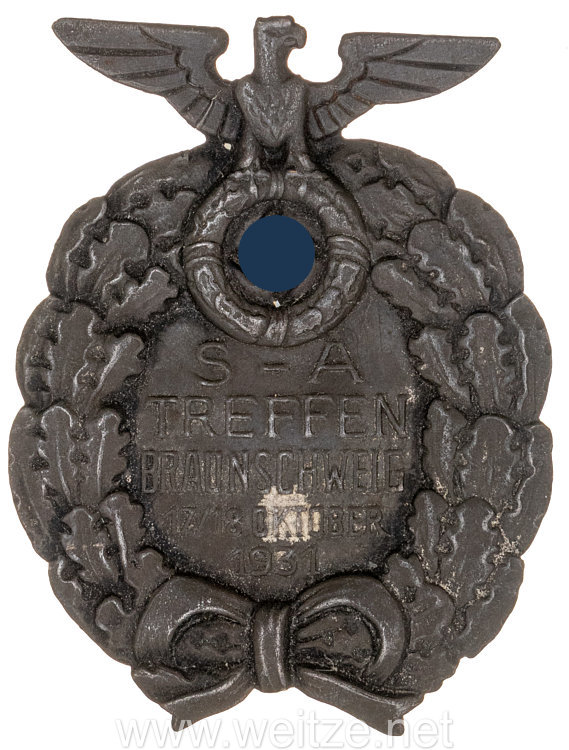
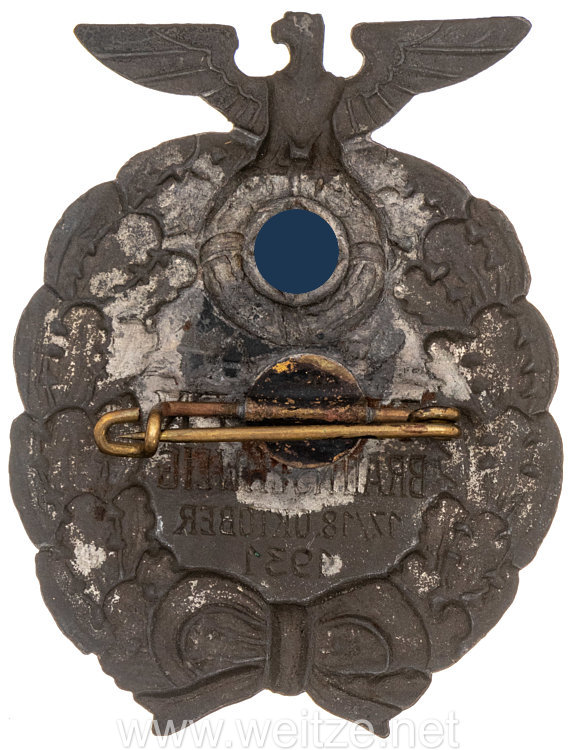
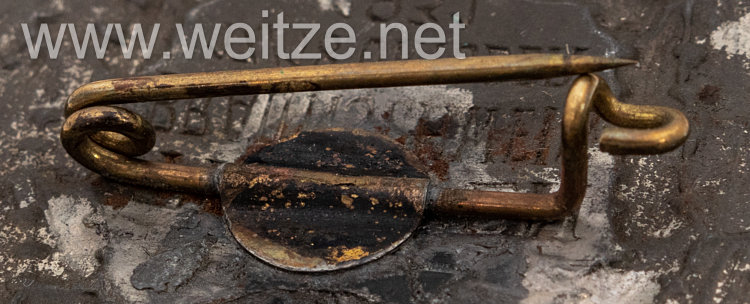
SA Rally Braunschweig 17/18 October 1931, 1st Model

Executed in sheet iron, hollow embossed, condition 2.
399730
450,00

SA Rally Braunschweig 17/18 October 1931, 1st Model

The SA Rally in Braunschweig on October 17-18, 1931 marked a decisive turning point in the history of the National Socialist movement during the Weimar Republic. This mass gathering of the Sturmabteilung (SA) represented one of the largest paramilitary demonstrations before the seizure of power in 1933 and served as an impressive show of force by the NSDAP.

The event took place at a critical juncture in German history. The Weimar Republic was experiencing a profound political and economic crisis, and the NSDAP exploited this instability to strengthen its position. Adolf Hitler and the party leadership organized the rally in Braunschweig because the city was under the leadership of Dietrich Klagges, an early NSDAP member who served as minister in the Free State of Braunschweig.

Between 80,000 and 120,000 SA men marched through the streets of Braunschweig in a carefully orchestrated demonstration of strength and discipline. This event was not merely an internal gathering but a deliberate message to the public and political opponents. The SA presented itself as a disciplined, military organization ready to challenge the political order.

The present badge, designated as the 1st Model, was manufactured to commemorate this historic event. The execution in sheet iron with hollow embossing was typical for event badges of this era. This manufacturing method allowed for cost-effective mass production while achieving a three-dimensional, appealing appearance. The designation “1st Model” suggests that multiple variants or later strikes may have existed.

Such event badges served multiple purposes within the NS movement. Primarily, they functioned as proof of participation and mementos for SA men who had attended the rally. Simultaneously, they created a sense of belonging and pride among wearers. The badges became collectible items within the movement and reinforced loyalty to the organization.

The production of event badges was widespread in the SA and later in other NS organizations. Various manufacturers produced these badges, often with slight variations in design and quality. The choice of material – in this case sheet iron – reflected both economic considerations and the paramilitary aesthetic of the SA, which sought to distinguish itself from civilian organizations.

The Braunschweig rally had significant political consequences. It demonstrated the growing power of the NSDAP and its ability to mobilize masses. The Prussian government under Otto Braun viewed the event with great concern but was unable to prevent it, as Braunschweig lay outside their jurisdiction. This revealed the weakness of republican institutions and the increasing fragmentation of state authority.

From today's perspective, such objects are important historical artifacts that document the mechanisms of NS propaganda and mobilization. They serve as reminders of a time when paramilitary organizations systematically undermined democratic order. Collectors and historians preserve these objects as testimony to a dark period in German history.

The condition of such badges varies considerably, depending on storage and use over the decades. The hollow embossing process made the badges susceptible to deformation and corrosion, especially in sheet iron versions. Well-preserved examples are rare today and of historical interest.

Scholarly engagement with such objects requires a nuanced approach. They serve historical education and research but must be understood in the context of the crimes of the NS regime. Museums and educational institutions use such artifacts to explain the mechanisms of totalitarian rule and to warn against the dangers of extremist movements.

The Braunschweig rally of 1931 represented more than just a gathering; it was a calculated political demonstration that showcased the NSDAP's organizational capabilities and its growing influence over German society. The event occurred during a period when the party was transitioning from a fringe movement to a major political force, exploiting the economic devastation of the Great Depression and the political paralysis of the Weimar system.