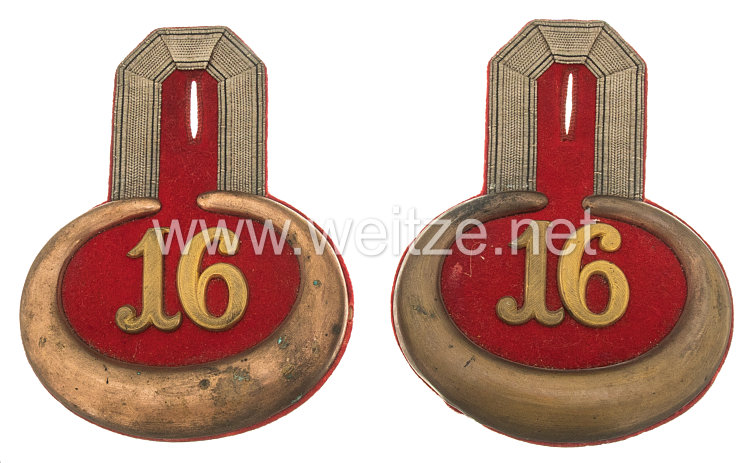
These epaulettes of a Lieutenant of the 16th Landwehr Brigade from around 1900 represent a significant testimony to the Prussian military organization in the late Imperial period. These shoulder pieces embody not only the military hierarchy but also the special role of the Landwehr in the German defense system of this era.
The 16th Landwehr Brigade belonged to the IV Army Corps, which was stationed in Magdeburg and encompassed the Prussian province of Saxony and parts of Thuringia. Four significant units were subordinated to the brigade: the 2nd Thuringian Landwehr Regiment No. 32 as well as the Landwehr battalions of Merseburg, Torgau, and Naumburg. This geographical distribution reflects the territorial organization of the Prussian Landwehr, in which local connections played an important role.
The Prussian Landwehr system was fundamentally redesigned through the military reforms under Gerhard von Scharnhorst and August Neidhardt von Gneisenau after 1807. The Landwehr formed the third pillar of Prussian defense forces after the active army and the reserve. After three years of service in active troops and four years in the reserve, soldiers served an additional five years in the Landwehr I formation, followed by further years in the Landwehr II formation. Landwehr officers were frequently reserve officers or retired active officers who continued their military careers.
The present epaulettes display characteristic features of Prussian uniform regulations from the late 19th century. The red cloth of the base is of particular significance, as the branch colors in the Prussian army designated specific types of troops. Red was the branch color of artillery, pioneers, and train troops, but was also used in certain Landwehr formations. The golden crescents (crescent-shaped metal fittings) are a traditional element of Prussian epaulettes, dating back to historical models.
Particularly interesting is the combination of silver braids with black inlays. This coloring corresponds to Prussian uniform regulations and indicates specific regional or corps-related peculiarities. The large versions of epaulettes were intended for officers of middle rank such as lieutenants and first lieutenants and differed significantly from the smaller variants for non-commissioned officers or the even more elaborate versions for higher officer ranks.
The uniform regulations for the Prussian army were revised several times in the 19th century. The Supreme Cabinet Order (Allerhöchste Kabinetts-Order, AKO) of 1843 comprehensively standardized uniforms for the first time, including epaulettes. Further significant changes occurred in 1867, in 1871 after the founding of the Reich, and finally in the 1890s. The present epaulettes from around 1900 correspond to the regulations of this late phase of the Imperial period.
The craftsmanship quality of such insignia of rank was remarkable. Specialized military equipment dealers and court suppliers manufactured these pieces with elaborate handwork. The metalwork was gilded or silver-plated, the braids carefully woven, and the cloth bases precisely cut. An officer had to procure and finance his uniform and its components himself, which caused considerable costs and underscored the elite character of the officer corps.
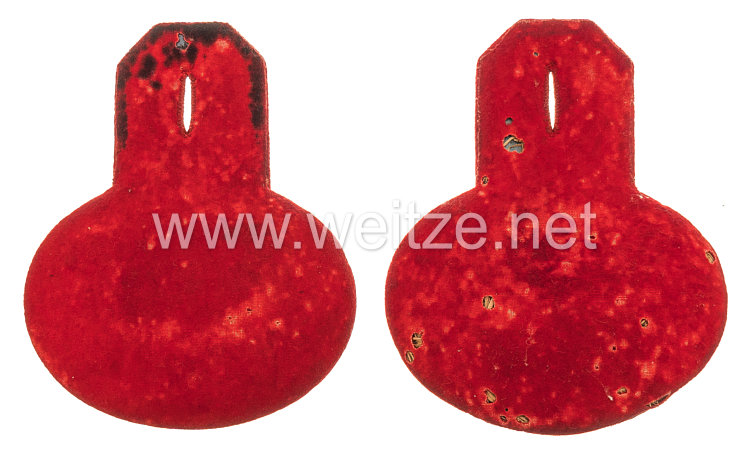
The condition with moth holes in the cloth bases is typical for textile militaria from this period. Moth damage is a common problem with historical uniform parts and testifies to the organic nature of the materials used – wool, silk, and cotton. Despite these damages, the historical and collector value of such objects remains considerable.
The Landwehr played a significant role in World War I, when mobilization activated the entire reserve system. Many Landwehr brigades and regiments were sent to the front and fought on all theaters of war. After 1918 and the end of the monarchy, the entire system of the imperial army was dissolved, and with it disappeared the traditional uniforms and insignia of rank.
Today, such epaulettes are important collector's items and objects of study for military historians. They provide insights into the social structure, material culture, and organizational principles of the Prussian-German military before 1918. Every detail – from the color of the cloth to the shape of the metal fittings – tells a story about tradition, hierarchy, and military identity in the Imperial period.