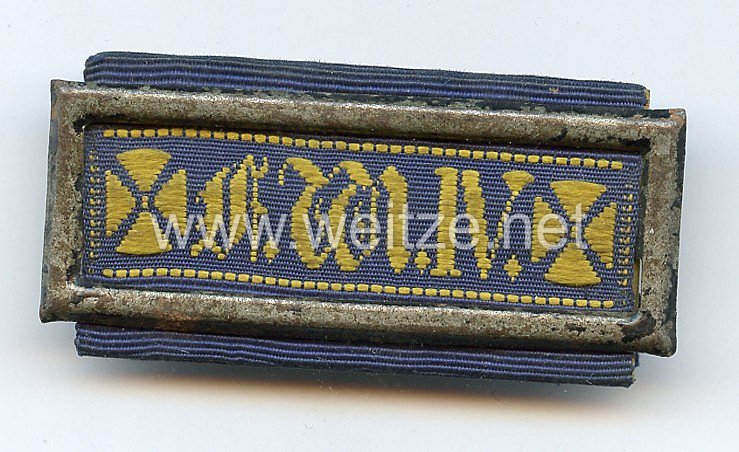
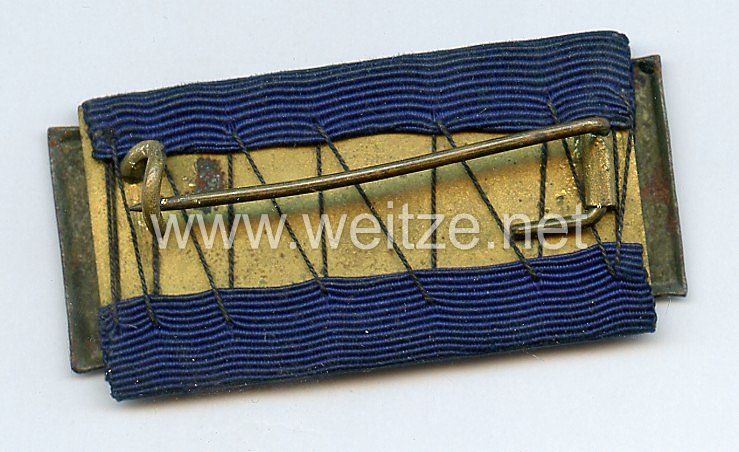
Prussia Landwehr Long Service Award 2nd Class

Clasp, condition 2-.
433830
15,00

Prussia Landwehr Long Service Award 2nd Class

The Prussian Landwehr Service Decoration Second Class represents a significant testament to the military award practices of the Kingdom of Prussia in the 19th and early 20th centuries. This clasp belongs to a system of honors that recognized the faithful service of members of the Prussian Landwehr, an institution of fundamental importance to Prussia's defense strategy.

The Landwehr was fundamentally reorganized in Prussia following the devastating defeats against Napoleon Bonaparte. As part of the military reforms from 1808 to 1814, driven significantly by figures such as Gerhard von Scharnhorst and August Neidhardt von Gneisenau, a new military system emerged. The Landwehr formed the second line after the standing army and comprised men aged 26 to 32 who had already completed their active service. This reserve formation proved indispensable during the Wars of Liberation 1813-1815 and contributed significantly to the victory over Napoleon.

The Landwehr Service Decoration was established by Royal Cabinet Order on September 14, 1825, by King Friedrich Wilhelm III. The decoration was intended to honor long and faithful service in the Landwehr and consisted of two classes. While the First Class was awarded for 20 years of service, Landwehr members received the Second Class after 15 years of faithful duty. This gradation reflected the Prussian system of seniority recognition that was applied throughout the military hierarchy.

The decoration was worn in the form of a clasp that was attached to the uniform. The design was deliberately simple to emphasize the serious and dutiful character of the Landwehr. The clasp typically consisted of metal and bore emblems referring to the Prussian state and the Landwehr. The practical execution as a clasp allowed for easy attachment to the uniform and differed from the more elaborate medals and crosses awarded for bravery in combat.

The legal foundations for the award were precisely regulated. The award regulations stipulated that not only the pure length of service counted, but also the manner of service performance. Disciplinary offenses or dishonorable conduct could lead to exclusion from the award. Applications were made through regimental commanders who reviewed service records and made recommendations. Final approval rested with the Prussian War Ministry.

In the context of Prussian military history, the Landwehr Service Decoration is part of a comprehensive system of honors. Alongside the better-known war decorations such as the Iron Cross (established 1813) or the Pour le Mérite, there existed a multitude of service decorations for various branches and ranks. The system reflected the Prussian military philosophy that honored not only martial valor but also duty fulfillment, discipline, and long-term loyalty.

The significance of the Landwehr took various forms throughout the 19th century. While initially viewed as a people's army with democratic tendencies, it increasingly developed into a firmly integrated component of the Prussian-German military system. After the founding of the German Empire in 1871, the Prussian Landwehr became the model for similar formations in other German states. The Landwehr played an important role in the Franco-Prussian War of 1870/71 and proved its operational capability.

During World War I, the Landwehr experienced massive mobilization. Landwehr divisions fought on all fronts, and many bearers of the Landwehr Service Decoration Second Class were recalled to service. The decoration documented their decades-long connection to the Prussian military establishment. After the German defeat in 1918 and the abolition of the monarchy, the decoration lost its official significance but remained for many veterans a symbol of their service time.

The condition assessment of Grade 2- in numismatic and military-historical circles indicates a well-preserved specimen with minor signs of wear. Such clasps are today both collectors' items and historical sources. They provide insights into the material culture of the Prussian military and the recognition of services beyond the battlefield. The preservation of such objects contributes to understanding the complex military history of Prussia and the German Empire.