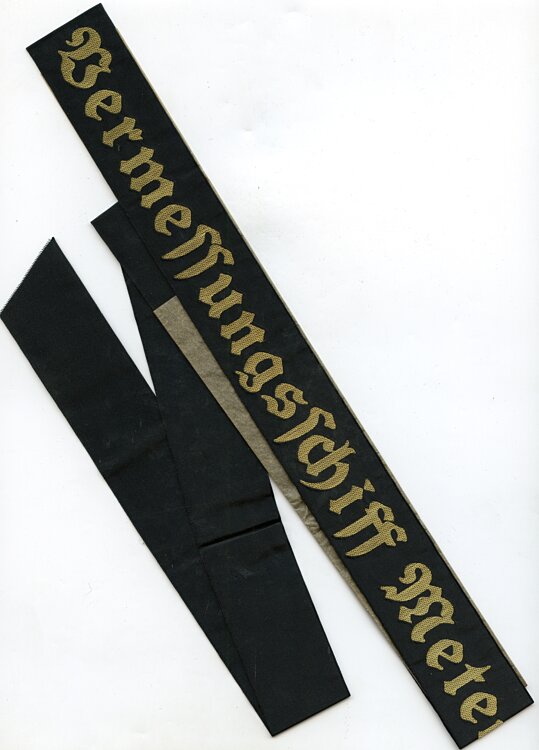
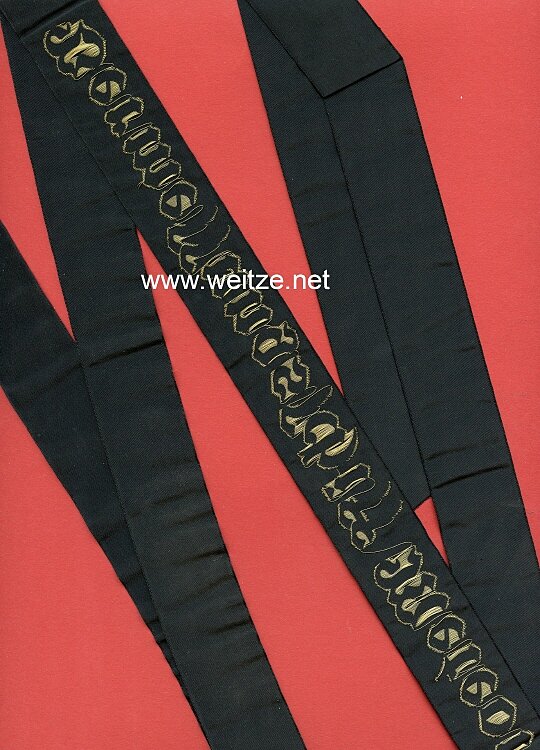
Kriegsmarine Cap Tally "Vermessungsschiff Meteor"
The Kriegsmarine cap tally bearing the inscription “Vermessungschiff Meteor” represents a significant chapter in German naval history. Cap tallies served as identification markers for enlisted personnel and petty officers of the German Navy and typically bore the name of the ship on which the wearer served.
The Meteor was a German survey ship, originally built in 1915 as an auxiliary cruiser under the name SMS Planeta. After World War I, the vessel was repurposed and converted into an oceanographic research vessel between 1924 and 1925. Under the name “Meteor,” it conducted the famous German Atlantic Expedition from 1925 to 1927, which is considered a milestone in modern oceanography.
The metal thread construction of this cap tally indicates high-quality manufacturing. During the Kriegsmarine period (1935-1945), cap tallies were produced in various quality grades. The metal thread woven variants were particularly elaborate in production and were manufactured according to the Kriegsmarine uniform regulations. These regulations were detailed in the “Anzugordnung für die Kriegsmarine” (M.Dv. Nr. 52).
The cap tally was worn on the peaked cap (also called “Tellermütze” or saucer cap), which was part of the basic uniform for all enlisted ranks. The typical design featured gold-yellow or silver-colored lettering on a black background. The inscription was usually executed in Latin letters, though Gothic script could appear on earlier examples.
The survey ships of the Kriegsmarine played an important role in navigation and nautical cartography. Besides civilian scientific work, these vessels also had military significance, as accurate nautical charts were essential for fleet operations. The Meteor continued its oceanographic work during the Kriegsmarine period, albeit in a more limited capacity.
The authenticity of such cap tallies can be verified through various characteristics. Original pieces display characteristic weaving structures where the metal threads (usually made of tinned copper or aluminum) are incorporated into the textile fabric. The letters were directly woven, not embroidered or printed. The ends of the tally were typically finished with a seam or folded over.
The condition described as “mint” is rare for historical cap tallies, as these items were worn during daily service and subject to corresponding wear. The mention of original packaging suggests this may be a never-issued or never-distributed example that originated from naval stores.
The production of cap tallies was carried out by specialized passementerie manufacturers who worked under contract to the Navy. Known manufacturers included companies such as BEVO (Barmer Bandweberei), renowned for their high-quality woven insignia and ribbons. Quality control was subject to military standards, and only approved manufacturers were permitted to produce these equipment items.
Historically, cap tallies document fleet structure and ship history. Every vessel of the Kriegsmarine, from the smallest minesweeper to the largest battleship, had its own cap tally. This makes them valuable documents for naval historical research, as they provide information about ship names, service periods, and crews.
The collection and preservation of such military-historical objects is important for documenting naval history. Museums such as the German Maritime Museum in Bremerhaven or the Military History Museum in Dresden maintain extensive collections of cap tallies and other uniform components. These objects enable the reconstruction of the everyday history of naval personnel and allow tracking of technical developments in textile manufacturing.
The Meteor itself represents the intersection of scientific exploration and military infrastructure. Survey ships were essential for both peaceful maritime commerce and naval operations, making them particularly interesting subjects of study. The cap tally thus represents not just a uniform component, but a tangible connection to Germany's maritime scientific heritage and the men who served aboard these specialized vessels.