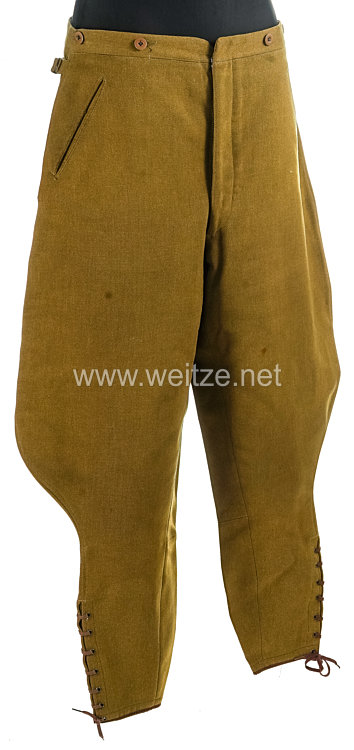
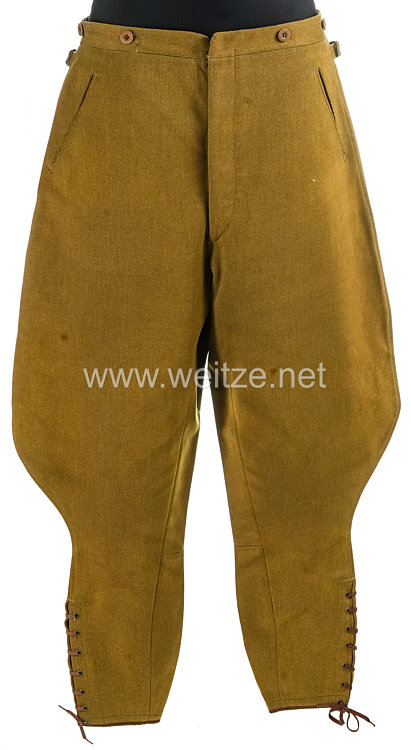
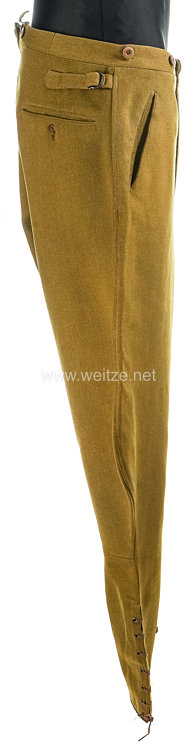
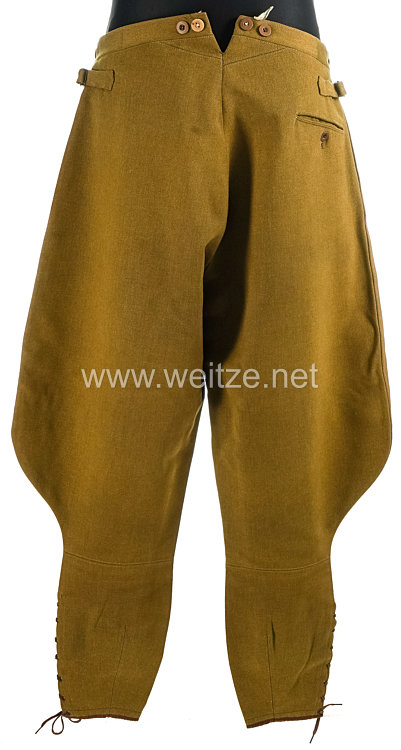
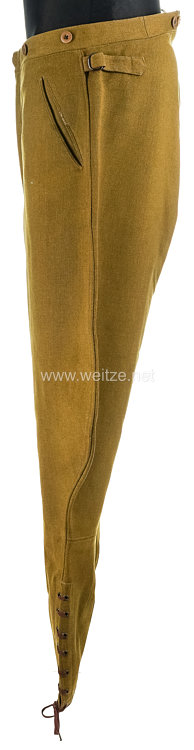
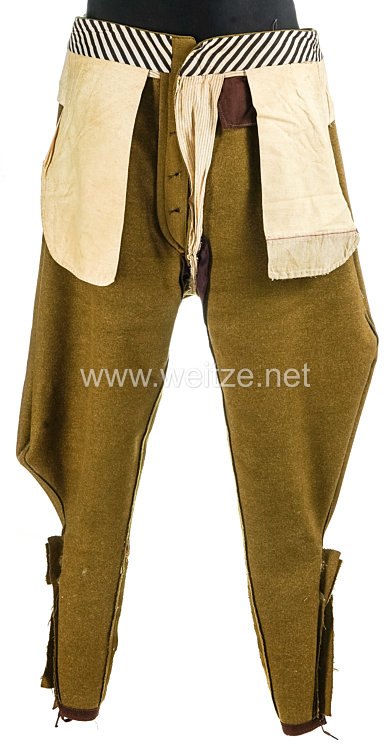
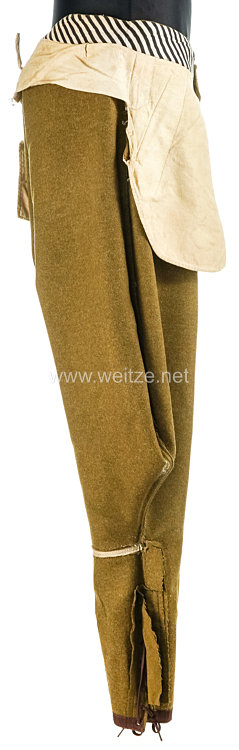
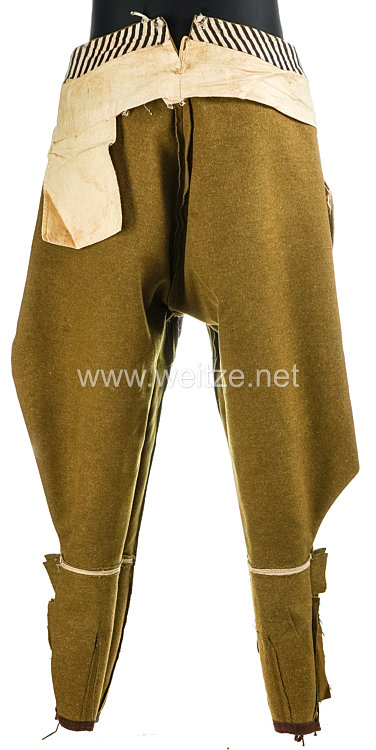
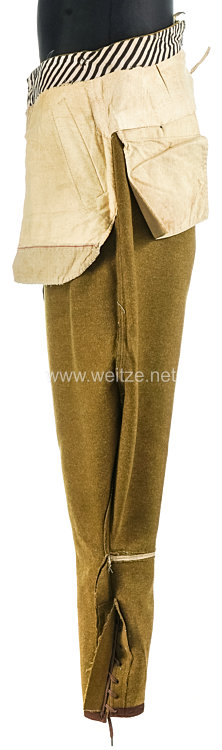
Organisation Todt (OT) Brown Breeches for Führer
Organisation Todt (OT) - Leader's Brown Breeches: Context and Historical Significance
This Organisation Todt leader's breeches represents a significant equipment piece from one of the Third Reich's most important paramilitary construction organizations. The Organisation Todt (OT), named after its founder Fritz Todt, played a central role in realizing large-scale construction projects in Nazi Germany and occupied territories between 1938 and 1945.
The Organisation Todt: Origins and Development
Fritz Todt, a civil engineer with a doctorate and NSDAP member since 1922, was appointed Inspector General for German Roadways in 1933. Under his leadership, an organization initially formed to build the Reichsautobahn highway system. In 1938, this structure was transformed and expanded into the Organisation Todt. The OT was formally a civilian organization but operated according to military principles and reported directly to the Reich government.
The organization executed monumental construction projects, including the Westwall (1938-1940), the Atlantic Wall along the French coast, U-boat bunkers, underground production facilities, and military infrastructure in occupied eastern territories. After Todt's death in an airplane crash on February 8, 1942, Albert Speer assumed leadership of the organization.
Hierarchy and Uniforming
The OT developed a sophisticated rank system oriented toward military structures. The hierarchy ranged from simple workers through various leadership levels to the highest service grades. The position of a Führer (leader) in the OT hierarchy designated a middle to higher rank with leadership responsibility over work columns, construction sites, or administrative units.
OT uniforming followed precise guidelines that were adjusted several times over the years. While simple workers were often marked only with armbands, leaders and higher ranks wore complete uniforms. The brown or olive color of the uniforms corresponded to the paramilitary character of the organization and was oriented toward the color schemes of other NS organizations.
The Breeches: Function and Design
These breeches (also called riding breeches) constituted an important component of the OT leader uniform. Manufacturing from gabardine, a tightly woven, durable cotton or wool fabric, met the practical requirements for construction site and field service deployments. Gabardine offered weather protection, was relatively robust, and simultaneously representative enough for a leadership uniform.
The characteristic features of this type of trousers - the lace-up lower legs worn with boots - enabled practical adjustment and prevented the intrusion of dirt and moisture. The two diagonal front pockets and the rear pocket corresponded to standard designs of military and paramilitary clothing of that era. The white inner lining indicates a higher-quality execution typical for leadership personnel.
Production and Procurement
OT uniforms were obtained through various procurement channels. On one hand, contracts existed with civilian clothing firms; on the other hand, uniform parts were also procured through military supply offices. Quality and execution varied depending on production timing and available resources. Toward the end of the war, increasing material shortages led to simplified designs and substitute materials.
Deployment Areas and Historical Context
OT leaders wearing such uniforms were deployed throughout Europe. From Norway through France to Russia, they directed construction projects under often extreme conditions. At its peak, the organization employed approximately 1.4 million workers, including many forced laborers and prisoners of war. OT leaders had not only technical but also disciplinary and administrative functions.
Particularly significant were OT deployments in constructing the Atlantic Wall from 1942 onward, in erecting V-weapon installations, and in repair work on war-critical infrastructure. The organization was also involved in building underground production facilities like the Mittelwerk in the Harz Mountains, where V2 rockets were manufactured under inhumane conditions.
Post-War Significance and Collector Value
After the war's end, the Organisation Todt was dissolved. Uniform parts and equipment items from the OT are today sought-after military-historical collector objects. They document an important aspect of Nazi war economy and occupation policy. For historical research, such objects offer important material testimony about the organization, logistics, and hierarchies of this unique paramilitary construction organization.
Preserved OT uniforms allow conclusions about manufacturing techniques, material availability, and the practical requirements of service. They are part of the material legacy of an organization that on one hand accomplished remarkable engineering achievements, while on the other hand was deeply entangled in the criminal system of National Socialism, particularly through the massive use of forced laborers.