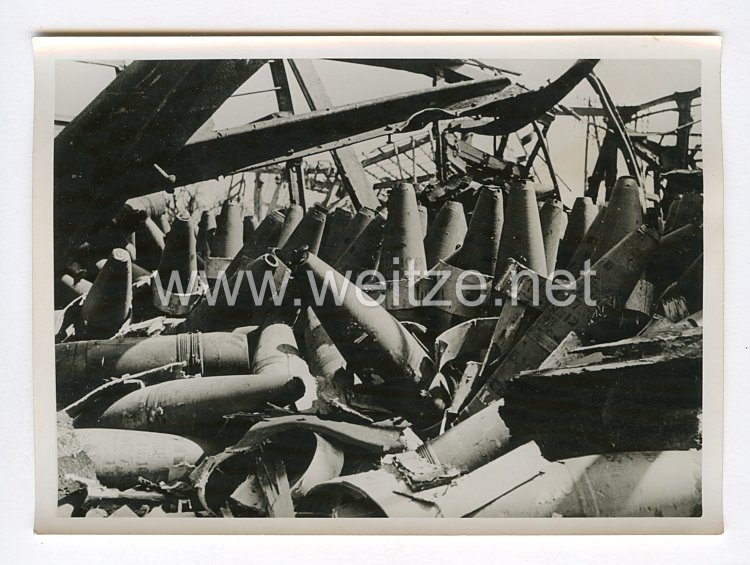
Third Reich Press Photo. Rendered Harmless. French Artillery Shells that will no longer be used against Germany. June 30, 1940.

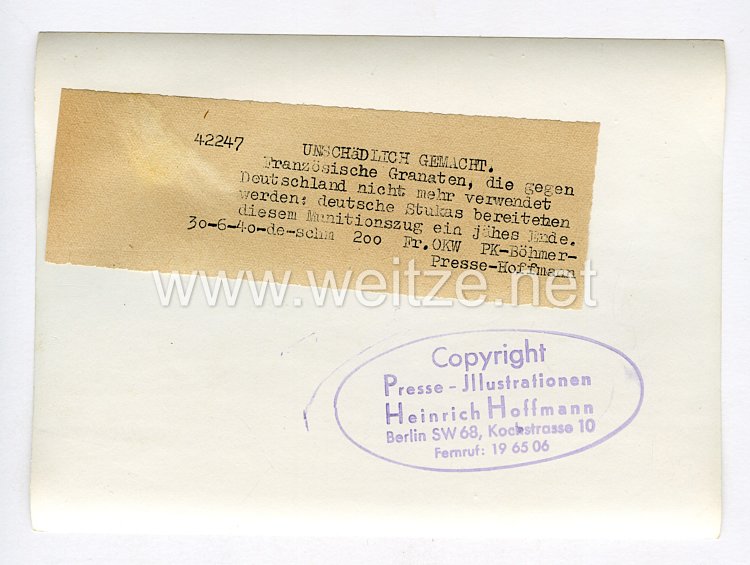
Dimensions approx. 13 x 18 cm, description on reverse, Heinrich Hoffmann, used condition. 
314229
15,00

Third Reich Press Photo. Rendered Harmless. French Artillery Shells that will no longer be used against Germany. June 30, 1940.

This object is a press photograph from the Third Reich, dated June 30, 1940, published by Heinrich Hoffmann. It documents French artillery shells that were captured and rendered harmless following the German conquest of France. This photograph represents an important aspect of the National Socialist propaganda machinery during World War II.

Heinrich Hoffmann (1885-1957) was Adolf Hitler's personal photographer and one of the most influential image producers of the Nazi regime. His agency, Hoffmann & Cie, supplied German and international newspapers with official photographs of the regime. Hoffmann held a monopoly on Hitler photographs and earned considerable sums from this privilege. His press photos were carefully staged and served systematic propaganda purposes.

The Western Campaign against France began on May 10, 1940, with the German attack on the Benelux countries and France. Through innovative Blitzkrieg tactics, in which armored units operated in coordinated cooperation with the air force, the Wehrmacht succeeded in breaking through Allied defensive lines. On June 22, 1940, the Armistice of Compiègne was signed in the Forest of Compiègne, sealing France's military defeat.

The photograph's date, June 30, 1940, falls just eight days after the armistice signing. This was a period of intense German propaganda activity aimed at glorifying the military triumph over the “hereditary enemy” France. Press photographs like this were systematically produced to demonstrate the military superiority of the German Reich.

The depicted French shells were likely ammunition for artillery pieces of various calibers used by the French Army. French artillery in 1940 included various systems, including the proven 75mm field gun Modèle 1897, as well as heavier calibers such as 105mm and 155mm howitzers. After the capitulation, enormous quantities of weapons and ammunition fell into German hands.

The rendering harmless or demilitarization of ammunition was an important process following conquest. Captured ammunition was either used for German purposes if compatible with German weapon systems, or it was destroyed. The procedure of ammunition disposal was dangerous and required specialized personnel. Often explosives were detonated in controlled conditions or their fuses were removed.

The propaganda dimension of such photographs cannot be underestimated. The Reich Ministry of Public Enlightenment and Propaganda under Joseph Goebbels strictly controlled all public images and news. Press photos had to be approved and often bore stamps and inscriptions on the reverse regulating their use. The caption “Rendered Harmless” conveyed a double message: the physical neutralization of weapons and symbolically the elimination of the French threat.

Such photographs were used in newspapers, magazines like the Illustrierter Beobachter, and in newsreels. They served to strengthen the morale of the German population and legitimize military successes. At the same time, they were intended to demonstrate the power of the German Reich internationally.

From today's perspective, these press photographs are important historical sources that provide insight into the propaganda methods of the Nazi regime. They document not only military events but also the manner in which these events were presented to the public. Collectors and historians value such materials for researching the visual culture of the Third Reich.

The preservation of such documents is significant for historical science, even though the content is propagandistic in nature. They help us understand how totalitarian regimes manipulated images and information to achieve their political goals. This press photograph thus serves as testimony to a dark period of European history and reminds us of the dangers of instrumentalizing media for political purposes.