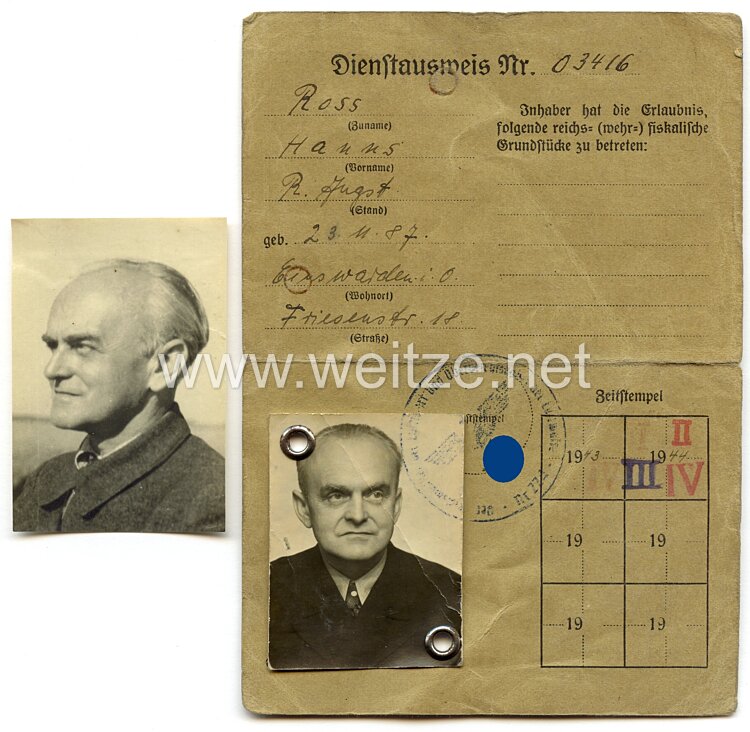
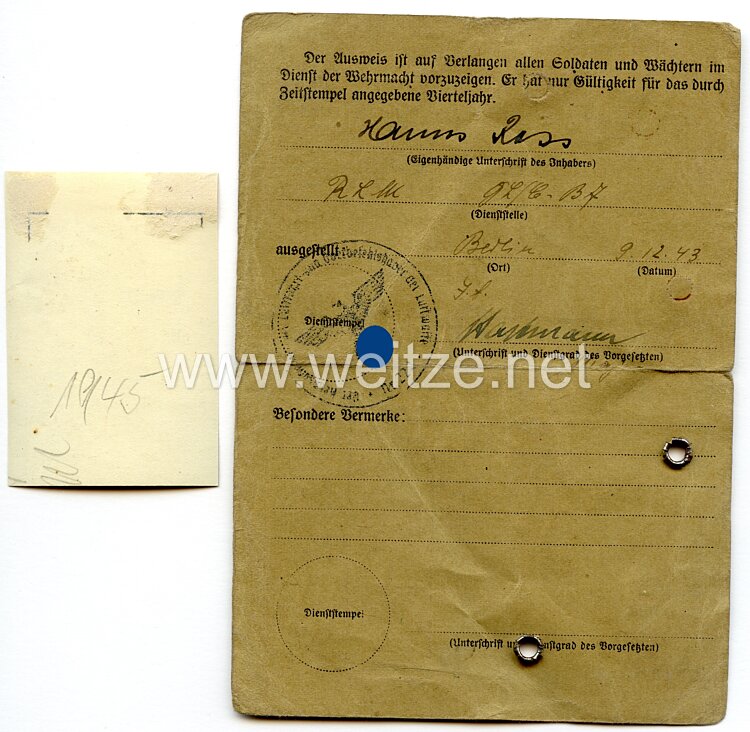
Service Identity Card for an Employee of the Reich Aviation Ministry

issued in Berlin on December 9, 1943, with photograph, validity for 1943-1944 stamped, folded used condition and an additional passport photograph from 1945 included.
273129
100,00

Service Identity Card for an Employee of the Reich Aviation Ministry

This service identification card (Dienstausweis) for an employee of the Reich Aviation Ministry (Reichsluftfahrtministerium or RLM) represents an authentic artifact of National Socialist administrative bureaucracy during World War II. Issued on December 9, 1943, in Berlin, this document authenticated the identity and authorization of a civilian employee within one of the most powerful institutions of the Third Reich.

The Reich Aviation Ministry was established in 1933 under Hermann Göring and quickly evolved into one of the most influential ministries of the Nazi state. It was responsible not only for the military Luftwaffe but also controlled all civil aviation, the aircraft industry, and vast sectors of armaments production. The imposing ministry building in Berlin's Wilhelmstrasse complex housed thousands of officials and employees engaged in the administration, planning, and coordination of German air forces.

By late 1943, when this identification card was issued, the war situation had deteriorated dramatically for Germany. The Battle of Stalingrad was lost, Allied bomber formations increasingly attacked German cities, and the material superiority of the opponents became ever more apparent. During this critical phase, the RLM faced enormous challenges: coordinating air defense, increasing aircraft production despite raw material shortages, and organizing civilian air raid protection.

Such service identification cards were more than simple identification documents. They served as authorization for access to highly sensitive areas and granted their holders special privileges during a time of increasing scarcity. RLM employees had access to secret military information and were involved in strategically important projects. The card typically contained a photograph, personal data, rank or position, as well as stamps and signatures from the issuing authority.

The validity for the years 1943-1944 reflects the customary administrative practice of renewing such documents annually or semi-annually. This served security purposes and enabled regular vetting of employees. The additional passport photograph from 1945 suggests that the holder attempted to extend or update the card as the Third Reich was already in its final throes.

The year 1945 marked the complete collapse of German administrative structures. In April 1945, Berlin was encircled by the Red Army, and the RLM building suffered severe bomb damage. Many files were destroyed, employees fled or were evacuated. In this chaos, such service cards lost their official function but possibly retained some practical value for their holders, such as during flight or when dealing with various authorities during the collapse phase.

From a historical perspective, such documents are today of inestimable value for researching the Nazi administration. They provide insights into personnel policies, the structure of ministries, and the daily life of civilian employees during wartime. The used condition and fold marks testify to the document's actual use and lend it particular authenticity.

The preservation of such identification cards is often due to chance. Many were destroyed by their holders after the war to obscure connections to the Nazi regime. Others were lost in the turmoil of the post-war period. Surviving examples are now found in archives, museums, and private collections, serving as important primary sources for historical research.

The Reich Aviation Ministry employed several tens of thousands of people during the war, including officials, engineers, secretaries, technical staff, and administrative employees. Their work ranged from strategic planning and technical development to everyday office work. This service identification card represents the millions of individual fates connected to the Nazi state and its war apparatus.

For collectors and historians, such documents provide tangible connections to a dark chapter of history. They remind us of the bureaucratic machinery that sustained the Nazi war effort and the countless individuals who participated in it, whether through conviction, coercion, or simple necessity. Each such document tells a story of survival, complicity, and the mundane reality of working within a totalitarian regime during its most destructive period.

r