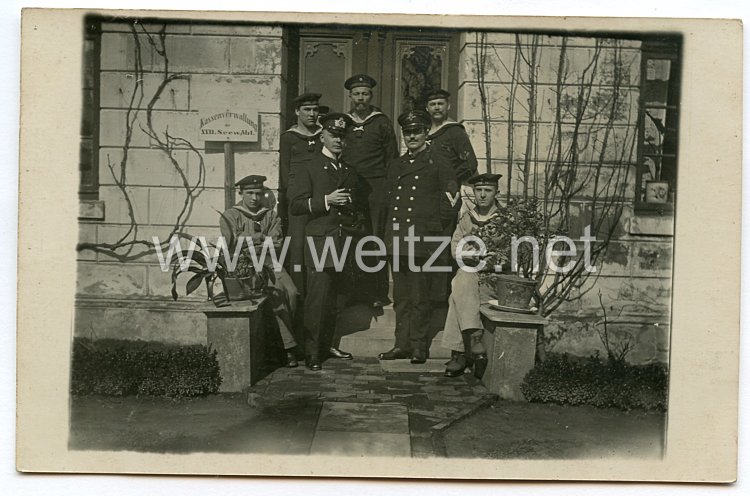
World War I Imperial German Navy Photograph, Barracks Administration XVII. Seeabteilung
This object is a postcard-sized photograph from the First World War era, associated with the barracks administration of the XVII. Seeabteilung (XVII. Naval Division) of the Imperial German Navy (Kaiserliche Marine). Such photographic documents are significant historical sources that provide insight into the organization, structure, and daily life of German naval forces during the Great War.
The Kaiserliche Marine was the navy of the German Empire from 1871 to 1918. Under the aegis of Grand Admiral Alfred von Tirpitz, it underwent massive expansion from the 1890s onward in what became known as Tirpitz's naval policy. This expansive naval policy aimed to develop Germany into a first-rate naval power and caused considerable tensions with the British Empire, leading to the so-called Anglo-German naval arms race.
The organizational structure of the Imperial Navy was complex and included various divisions and departments. The Seeabteilungen (naval divisions) were special units within the navy that fulfilled various functions. The numbering extending to the XVII. Seeabteilung indicates the extensive organization of the navy during World War I. These divisions could have different tasks, ranging from direct combat operations to training functions and administrative and logistical duties.
The barracks administration (Kasernenverwaltung) was an essential component of military infrastructure. It was responsible for organizing and managing barracks facilities where naval personnel were housed, trained, and supplied. Its duties included quartermaster services, catering, building maintenance, healthcare, and general administration. Managing a barracks required extensive bureaucratic activities and well-organized infrastructure.
Postcard-sized photographs were widespread during World War I. Photographic technology had developed to such an extent by 1914 that photographic prints could be produced relatively inexpensively and in large numbers. Soldiers frequently used such photos to preserve memories or send them to their families. Official military photographs also served documentary purposes, propaganda, or internal administration.
During the war, the Imperial Navy maintained numerous naval bases and barracks facilities along the German coasts, particularly on the North Sea and Baltic Sea. Important locations included Wilhelmshaven, Kiel, Cuxhaven, and Flensburg. These bases served as home ports for the High Seas Fleet and other naval units. They featured extensive infrastructure, including shipyards, arsenals, training facilities, and, of course, barracks.
Daily life in a naval barracks during World War I was characterized by strict military routines. Sailors and officers underwent regular drills, guard duties, and technical training. Discipline was strict, and hierarchy was rigorously maintained. At the same time, administrations had to provide for thousands of men, which was an enormous logistical challenge.
During the war, the Imperial Navy played a significant, though strategically controversial, role. The High Seas Fleet remained largely in its ports, as a direct confrontation with the superior British Royal Navy was considered too risky. The most significant naval battle was the Battle of Jutland (Skagerrakschlacht) from May 31 to June 1, 1916, the largest naval battle of the war. Although it can be considered a tactical draw, it did nothing to change British naval supremacy.
The U-boat arm proved to be the most effective component of the Imperial Navy. The unrestricted submarine warfare, especially from 1917 onward, inflicted significant losses on Allied shipping but also contributed decisively to the United States' entry into the war, which ultimately sealed Germany's defeat.
Documents such as this photograph are valuable historical sources today. They provide insights into material culture, uniforms, infrastructure, and daily life in the Imperial Navy. For military historians and collectors, such objects are of particular interest as they make abstract history concrete and tangible.
After the end of World War I and the November Revolution of 1918, the Imperial Navy was dissolved. The provisions of the Treaty of Versailles of 1919 drastically limited the German navy. The High Seas Fleet was interned at Scapa Flow, where its crews scuttled it on June 21, 1919. The successor organization, the Reichsmarine of the Weimar Republic, was only a shadow of the former imperial naval power.