Wehrmacht - Post-War Signatures of Various Knight's Cross Recipients

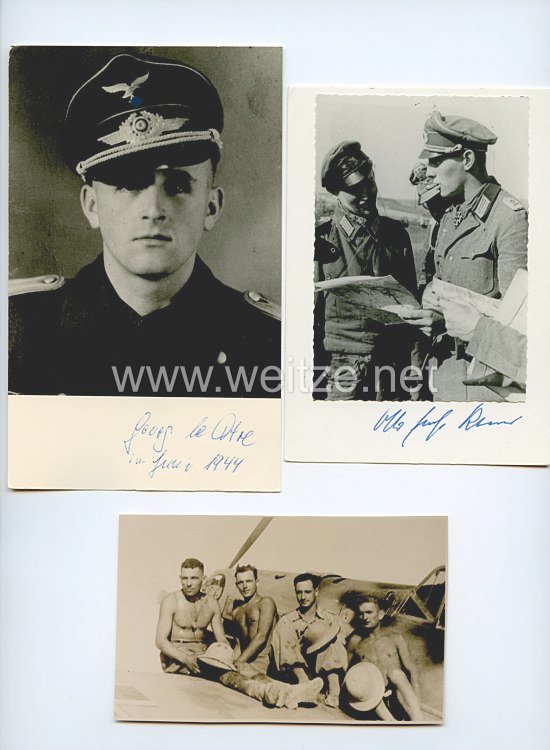
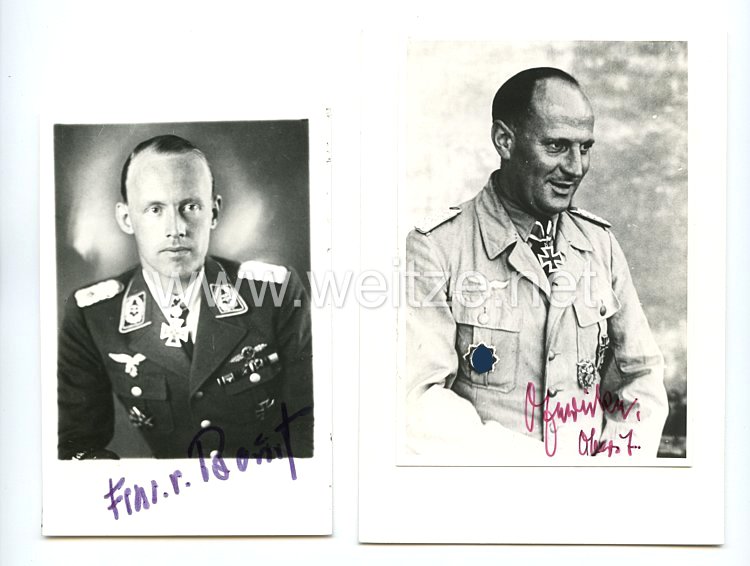
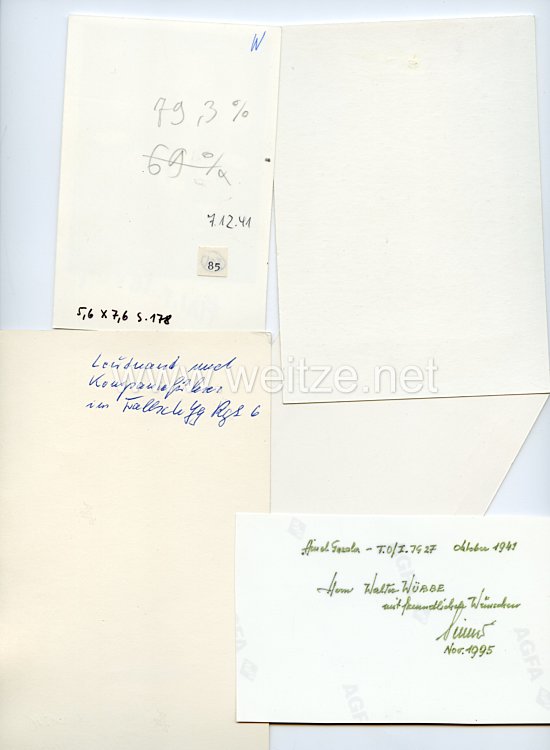
5 photographs. Various photographs with signatures of various Knight's Cross recipients. The photographs are prints made after 1945, condition 2.
413728
90,00

Wehrmacht - Post-War Signatures of Various Knight's Cross Recipients

This collection of five photographs with post-war signatures of Knight's Cross recipients represents a fascinating phenomenon in German military history after 1945. These objects document a practice that emerged in the decades following World War II and constitute a remarkable aspect of military-historical commemoration culture.

The Knight's Cross of the Iron Cross was instituted on September 1, 1939, by Adolf Hitler as the highest decoration for valor of the Wehrmacht. During the war, approximately 7,300 members of the Wehrmacht, Waffen-SS, and allied forces received this distinction. The decoration was awarded in various grades: the Knight's Cross itself, the Knight's Cross with Oak Leaves, with Oak Leaves and Swords, with Oak Leaves, Swords and Diamonds, and the Knight's Cross with Golden Oak Leaves, Swords and Diamonds.

After the war's end in 1945, a lively scene of collector circles and veteran organizations developed in the Federal Republic of Germany. Many former Knight's Cross recipients became sought-after personalities in these circles. The practice of signing photographs with personal autographs arose from various motivations: some veterans sought recognition of their military achievements separate from political evaluations, others responded to collector demand, and still others attempted to supplement their income through the sale of such autographs.

The post-war photographs differ fundamentally from contemporary wartime images. While original photos from the period between 1939 and 1945 represent historical documents capturing military reality and propaganda, post-war prints are part of a retrospective culture of remembrance. They were often signed at veteran meetings, at militaria shows, or through direct correspondence. This practice was particularly widespread during the 1960s through the 1990s.

The legal situation regarding Nazi order symbols in the Federal Republic was regulated by the Law on Titles, Orders and Decorations of 1957. This law permitted the wearing of orders from the National Socialist period in modified form, with swastikas replaced by oak leaves. This led to the creation of so-called “denazification versions” of decorations. Photographs with signatures existed within this complex legal and social framework.

From a historical perspective, the question of authenticity is of considerable significance for such collector's items. While some signatures were created under witness supervision at official meetings, others were traded through speculative channels. The provenance and documentation of the circumstances of creation are therefore essential factors in the historical evaluation of such objects.

Photographs as a medium played a special role in military commemoration culture. They served not only as memorabilia but also as means of constructing heroic narratives. In the early Federal Republic, there existed a controversial debate about the role of the Wehrmacht and the evaluation of military achievements. While some groups wanted to separate military valor from political responsibility, others emphasized the Wehrmacht's involvement in war crimes.

The collecting activity itself developed into a significant phenomenon. Specialized dealers, auction houses, and collector associations emerged that dealt with German military history. This scene was and remains not free from controversies, as it engages with a sensitive historical legacy. Academic military history research has repeatedly pointed to the necessity of distinguishing between historical documentation and uncritical heroization.

Today, such collections represent complex historical sources. They document not only the military history of World War II but also post-war history, commemoration culture, and societal engagement with the Nazi past. For historians, they are testimonies to the multifaceted processing of German military history in the second half of the 20th century.

The scholarly evaluation of such objects requires a differentiated approach that considers both military-historical facts and commemoration-cultural contexts. They are part of a history characterized by heroism and crimes, by individual fates and collective guilt, by remembrance and repression. The study of these materials contributes to understanding how societies grapple with difficult historical legacies and how memory is constructed, contested, and commercialized across generations.

r