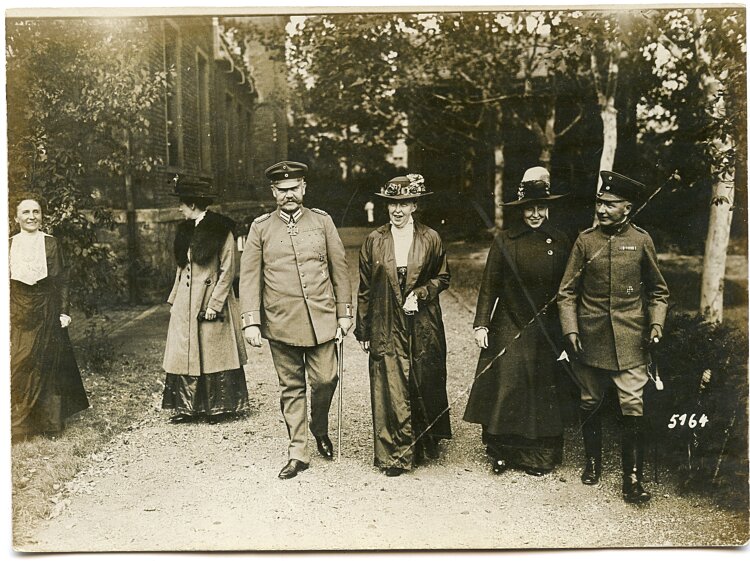
Press Photograph, Paul von Hindenburg Taking a Walk

approx. 17 x 12 cm, condition 2
184028
25,00

Press Photograph, Paul von Hindenburg Taking a Walk

This press photograph showing Paul von Hindenburg during a walk represents an important aspect of political image propaganda during the Weimar Republic and early Third Reich period. With dimensions of approximately 17 x 12 cm, it corresponds to the standard formats for press photographs that were distributed to newspaper editorial offices and archives during that era.

Paul von Hindenburg (1847-1934) was one of the most significant military and political figures in German history during the early 20th century. As a Field Marshal, he achieved legendary fame during World War I following the victories at Tannenberg (August 1914) and the Masurian Lakes (September 1914). From August 1916, together with Erich Ludendorff, he effectively assumed military and political leadership of the German Empire as part of the Third Supreme Command.

After the war, Hindenburg was elected as the second Reich President of the Weimar Republic in 1925 and re-elected in 1932. His presidency ended only with his death on August 2, 1934. The media portrayal of Hindenburg was carefully orchestrated and served various political purposes.

Press photography in the Weimar Republic developed into an important medium of political communication. The 1920s witnessed a revolution in visual media, with the proliferation of illustrated newspapers and magazines such as the Berliner Illustrirte Zeitung, which achieved circulation in the millions. Photographs of politicians were systematically distributed to editorial offices to construct and disseminate particular images.

Walking photographs like this one served a specific propagandistic purpose: they were intended to portray Hindenburg as close to the people, healthy, and vital despite his advanced age. During his presidency, Hindenburg's age was a particularly sensitive topic. Born in 1847, he was already 77 years old at his first election in 1925, and 84 at his re-election in 1932. The public and political circles were increasingly concerned about his mental and physical condition.

Photographs taken during walks, frequently shot at Neudeck (his estate in East Prussia) or later in his Berlin surroundings, were meant to convey vitality and down-to-earth character. The “Hindenburg myth” was nourished by such images - the notion of a paternal statesman above party politics, whose mere presence guaranteed stability.

The technical aspects of such press photos are noteworthy: they were typically developed on baryta paper, a photographic paper coated with barium sulfate that was standard from the 1880s well into the second half of the 20th century. The reverse sides often bore stamps from press agencies such as Scherl, Hoffmann, or Transocean GmbH, along with handwritten or stamped captions and dates.

The format of approximately 17 x 12 cm was practical for archiving and met the requirements of printing technology of that time. Such photos were distributed in special press packages or issued by government central image offices to accredited journalists.

The historical significance of such press photographs today lies primarily in their documentary and cultural-historical value. They not only show the depicted individuals but also reveal the mechanisms of political image propaganda. The seemingly harmless “private” moments were in reality carefully staged to convey specific political messages.

After Hindenburg's death in 1934, the Nazi regime continued to exploit his myth for its own purposes. The appointment of Adolf Hitler as Reich Chancellor on January 30, 1933, was Hindenburg's most fateful decision, even though he had initially hesitated. Photographs of Hindenburg, including those of seemingly apolitical walks, became part of the visual historiography of this dramatic epoch.

For collectors and historians, such press photographs offer important insights into the visual culture of the interwar period. They are testimonies to early political photography and the professionalization of press work. The preservation condition of such documents varies; the indicated “condition 2” suggests a well-preserved photograph with possibly minor signs of use.