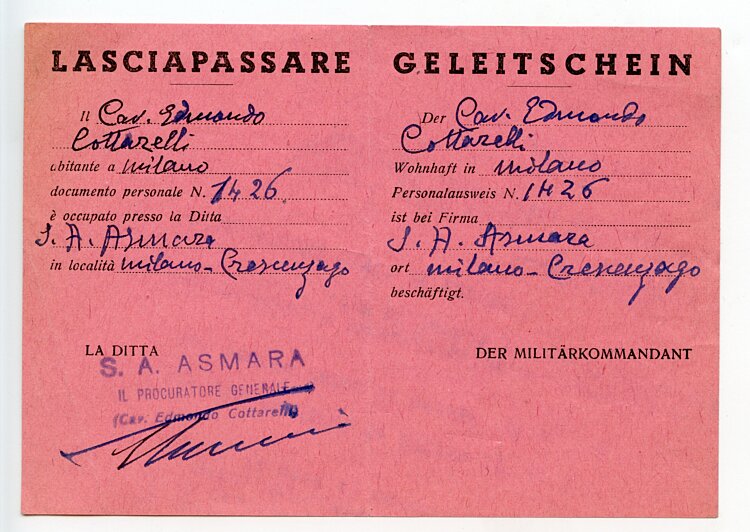
Third Reich - Military Commandant of Milano (Italy) - Safe Conduct Pass

for a man employed by the firm S.A.Asmara in Milano; bilingual printed form; used condition.
126728
40,00

Third Reich - Military Commandant of Milano (Italy) - Safe Conduct Pass

This Geleitschein (safe-conduct pass) issued by the Military Commander of Milano during the Third Reich represents a fascinating testament to the German occupation administration in Northern Italy during World War II. This bilingual document – written in German and Italian – granted its holder, an employee of the company S.A. Asmara in Milan, permission to move freely within the occupied territory.

Following the overthrow of Benito Mussolini in July 1943 and the subsequent Armistice of Cassibile on September 8, 1943, between Italy and the Allies, German troops rapidly occupied large parts of Northern and Central Italy. The Wehrmacht established a network of military commandant's offices to control and administer the conquered territories. Milan, as the economic and industrial center of Northern Italy, played a central role in this occupation structure.

The Militärkommandantur Milano (Military Commandant's Office Milano) was subordinate to Army Group C and was responsible for maintaining order, coordinating with the newly created fascist authorities of the Italian Social Republic (Repubblica Sociale Italiana, also known as the Republic of Salò), and ensuring the economic exploitation of the region for the German war economy. The commandant's office also supervised local administration, controlled civilian population movements, and combated the growing Italian resistance.

A Geleitschein or Passierschein (transit pass) was an indispensable document during the occupation period. The German military administration implemented strict controls both to ensure the security of occupation troops and to monitor the Italian population. Without proper papers, it was nearly impossible for civilians to move freely, especially between different districts or outside cities. These documents were issued only after thorough examination and were often restricted to specific routes, time periods, or purposes.

The bilingual nature of the document is characteristic of administrative practice in occupied Italian territories. Unlike in other occupied countries where German administration often communicated exclusively in German, in Italy the continuing Italian government structures of the Mussolini regime in Salò were acknowledged. This parallel administrative structure required bilingual documents to communicate with both German agencies and Italian authorities and the local population.

The mention of the firm S.A. Asmara sheds light on the economic dimension of the occupation. Milan was the industrial heart of Northern Italy, with significant production facilities for textiles, machinery, and other war-essential goods. The German occupation forces depended on utilizing these industrial capacities for their own war effort. Workers and employees in such enterprises frequently received special permits to reach their workplaces, particularly when these were outside regular movement zones or when curfews were in effect.

The designation “S.A.” stands for Società Anonima, the Italian form of joint-stock company. The name “Asmara” might indicate connections to the former Italian colony of Eritrea, whose capital was Asmara, possibly engaged in trade or import-export business. This would illustrate the context of continuing Italian economic relations even under German occupation.

The “used condition” of the document underscores its authentic use during the war years. Such papers were shown daily at checkpoints, folded, carried in pockets, and exposed to weather conditions. Many of these ephemeral documents were destroyed or lost after the war, making surviving examples valuable historical witnesses today.

The occupation period in Northern Italy from September 1943 to April 1945 was characterized by increasing harshness. The German Wehrmacht and the SS responded to partisan attacks with brutal reprisals. Simultaneously, persecution of the Jewish population intensified, along with deportations to extermination camps and forced recruitment of Italian workers for Germany. In this context, safe-conduct passes also served as instruments of control and surveillance.

Today, such documents are important sources for researching German occupation rule in Italy, the daily living conditions of the civilian population, and the bureaucratic mechanisms of totalitarian control. They complement official military and administrative records with personal documents that make individual fates and the practical implementation of occupation policy tangible.