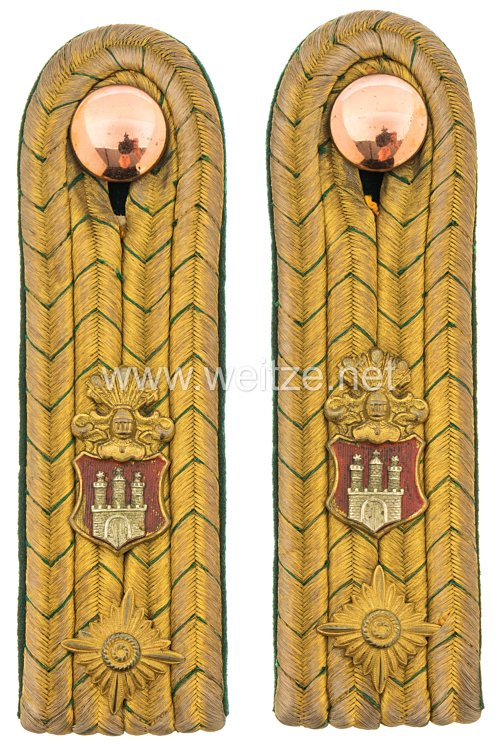
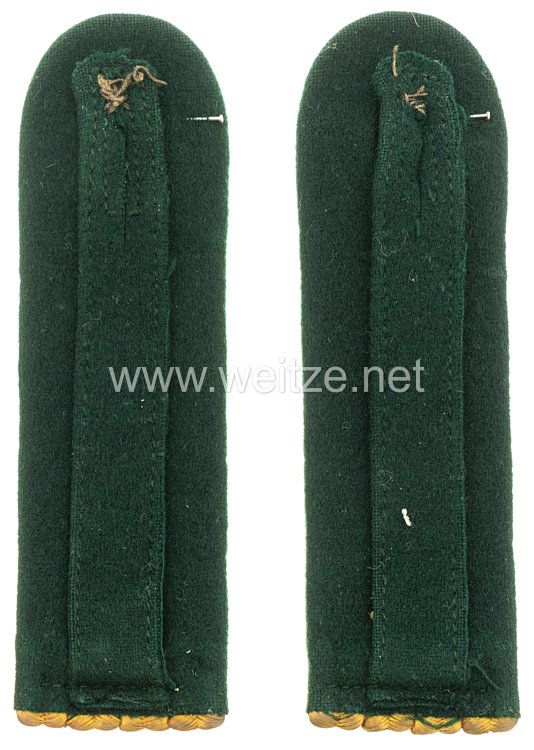
Hamburg Customs Pair of Shoulder Boards for a Senior Customs Inspector

Circa 1910. Condition 2.
414128
180,00

Hamburg Customs Pair of Shoulder Boards for a Senior Customs Inspector

These shoulder boards for a Senior Customs Inspector from Hamburg, dating to around 1910, represent a fascinating chapter in German administrative history during the Imperial era. These rank insignia document the strict hierarchical organization of customs administration in the German Hanseatic cities, particularly in Hamburg, which held a special position within the German Empire as a major trading port.

The German Empire (1871-1918) maintained a highly organized customs administration responsible for collecting import and export duties and monitoring the flow of goods. After the founding of the Reich, Hamburg initially retained its status as a Free Port, which required special administrative arrangements. It was not until 1888 that Hamburg was fully integrated into the German customs territory, further emphasizing the importance of a professional customs administration.

The ranking system within the customs administration was clearly defined and made visible through external markers such as uniforms and shoulder boards. The Senior Customs Inspector (Ober-Zoll-Inspektor) represented a higher civil service rank associated with considerable responsibility. These officials supervised multiple customs stations, managed larger offices, and were responsible for the correct application of complex customs regulations.

The shoulder boards, also called epaulettes or shoulder pieces, were worn in pairs on both shoulders of the uniform. They served to immediately identify rank and followed precise regulations regarding material, color, and design. Green base colors were typically characteristic of the customs administration, combined with silver or gold braiding and stars indicating respective rank.

The Hamburg Customs Administration around 1910 was undergoing a phase of intensive modernization. The port was continuously expanding, and new storage facilities such as the famous Speicherstadt (warehouse district) required adapted control mechanisms. Customs officials had to inspect not only traditional goods but also deal with new forms of trade and international agreements.

The uniforming of customs officials followed regulations valid throughout the Reich, while allowing for regional peculiarities. Hamburg, as a city-state with its own administrative traditions, maintained certain distinctive features in the design of its officials' uniforms. The shoulder boards were not merely decorative elements but fulfilled practical functions: they reinforced the shoulder area of the uniform and provided attachment points for equipment straps.

The period around 1910 marked a peak phase of international trade before World War I. Hamburg was one of Europe's most important commercial ports after London, and the customs administration had to process thousands of consignments daily. Senior Customs Inspectors bore special responsibility for smooth operations and compliance with regulations.

The hierarchical structure of the customs administration comprised various ranks from simple customs assistants through customs secretaries and customs inspectors to senior customs inspectors and higher administrative officials. Each rank had specific duties and powers regulated by corresponding service regulations.

The preservation of such shoulder boards today holds cultural-historical value. They document not only administrative history but also craft traditions of uniform production. Their manufacture required specialized knowledge in metalworking, textile processing, and often embroidery. Specialized manufactories produced these rank insignia according to precise specifications.

With the end of World War I and the transition to the Weimar Republic, the uniform regulations of the customs administration also changed. The imperial rank insignia were replaced by republican forms, making these pieces witnesses to a bygone era.

These artifacts provide insight into the professionalization and bureaucratization of state administration in the late German Empire, reflecting both the importance of customs revenue for state finances and the social prestige associated with civil service positions in Imperial Germany.