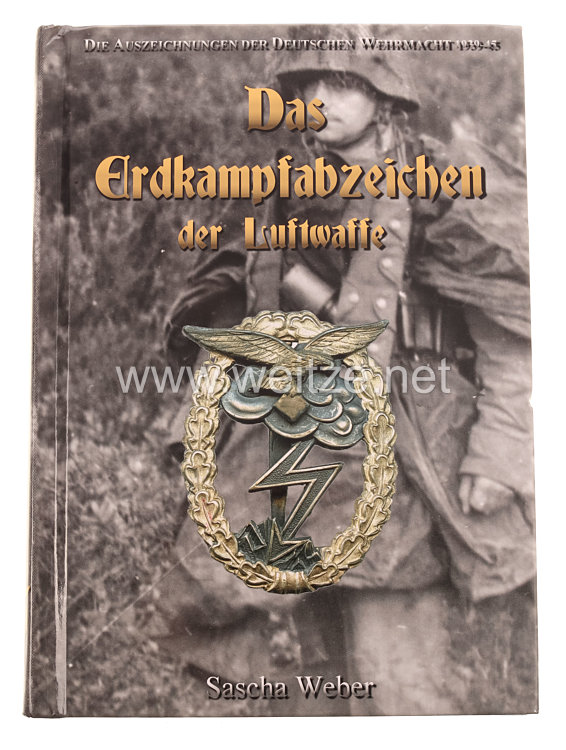
Sascha Weber - The Ground Combat Badge of the Luftwaffe 1939-1945 Volume 5
The Ground Combat Badge of the Luftwaffe (Erdkampfabzeichen der Luftwaffe) represents one of the most significant and interesting decorations of the German Wehrmacht during World War II. This award was specifically created for members of the Luftwaffe who participated in ground combat – a situation that became increasingly common in the later war years, as Luftwaffe units were progressively deployed in terrestrial combat operations.
The Ground Combat Badge was instituted on March 31, 1942, by decree of the Commander-in-Chief of the Luftwaffe, Reichsmarschall Hermann Göring. The creation of this decoration was a direct response to the increased deployment of Luftwaffe forces in ground combat, particularly on the Eastern Front. During the Russian campaign, Luftwaffe Field Divisions were established, which, in addition to their original duties, were also employed in conventional infantry combat.
The badge itself features an oval design with a stylized eagle clutching a swastika in its talons, surrounded by an oak leaf wreath. Lightning bolts are depicted in the lower section, symbolizing affiliation with the Luftwaffe. The design was created by the Berlin artist and designer Wilhelm Ernst Peekhaus, who was also responsible for other Wehrmacht decorations.
The award criteria were clearly defined: the badge could be awarded to members of the Luftwaffe who had participated in ground combat on at least three different days or were wounded in such combat. Alternatively, it could be awarded for exceptional bravery in ground combat. Documentation was made through entries in Soldbücher (pay books) and the issuance of award certificates (Besitzzeugnisse), which today represent important historical documents for collectors and researchers.
The manufacture of the Ground Combat Badge was carried out by various companies throughout the German Reich. Among the most significant manufacturers were companies such as Juncker of Berlin, Assmann & Söhne of Lüdenscheid, and Friedrich Linden of Lüdenscheid. Each manufacturer had its own characteristic features in execution, which today serves for the identification and classification of different variants. The badges were primarily made of zinc die-cast and subsequently silver-plated.
As the war progressed and materials became scarce, production methods and materials also changed. Later versions frequently show simplified manufacturing and lower material quality. This development reflects the general economic situation of the German Reich in the final war years.
In addition to regular badges, miniature versions were also produced, which could be worn on civilian clothing. These miniatures are particularly rare today and highly sought after by collectors. They were often privately commissioned from jewelers and show a variety of individual executions.
The historical significance of the Ground Combat Badge lies not only in its military function but also in documenting the changed role of the Luftwaffe during the course of the war. The increasing deployment of Luftwaffe personnel in ground combat was a sign of Germany's desperate military situation, especially after 1943, when Allied air superiority became increasingly evident.
The work by Sascha Weber represents a comprehensive scholarly examination of this subject. Following successful first editions between 2005 and 2008, a completely revised and expanded new edition was published, reflecting the current state of research. With nearly 1,000 color illustrations across 152 pages, the book offers a detailed overview of all known manufacturer variants, award practices, and associated documents.
For collectors of military historical objects, correct identification and evaluation of Ground Combat Badges is of great importance. The market is unfortunately also affected by counterfeits, making well-founded specialist literature indispensable. The present work provides both beginners and experienced collectors with the necessary tools for authenticating and classifying these historical artifacts.
Today, such decorations serve as important historical sources for military history research. They provide insights into the organization, hierarchy, and recognition practices of the Wehrmacht. At the same time, they are testimonies to individual destinies and the dramatic events of World War II.