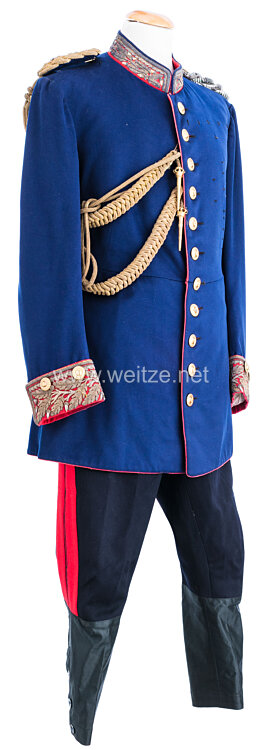
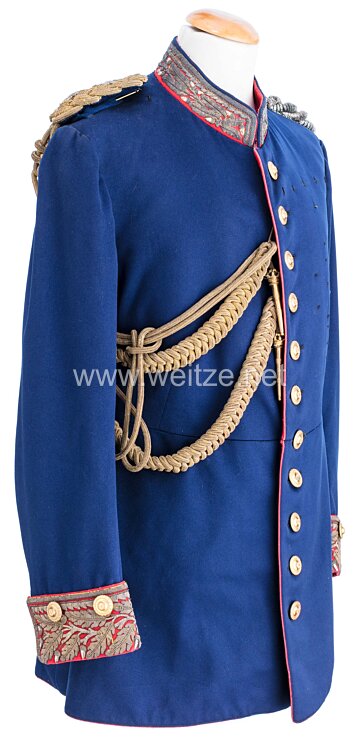
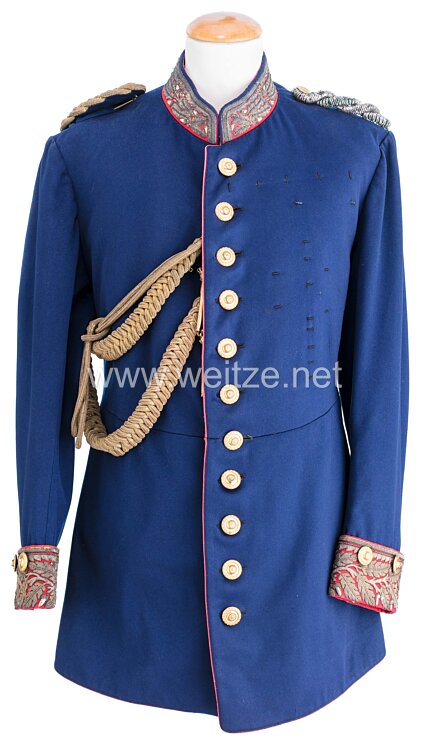
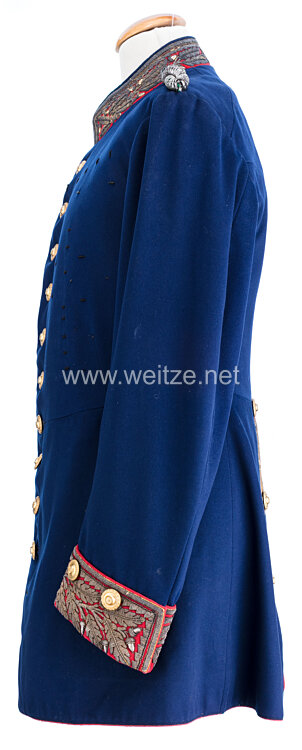
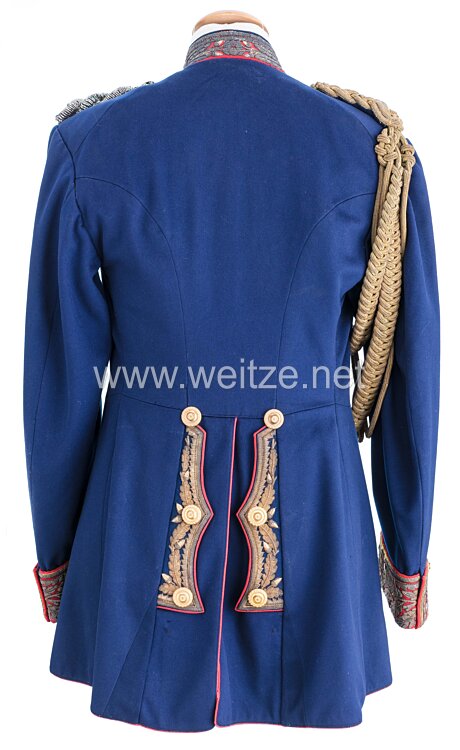
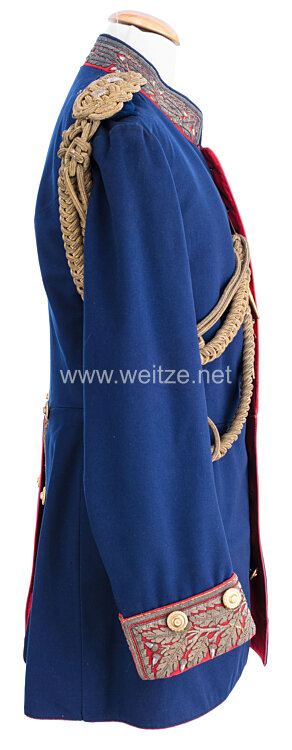
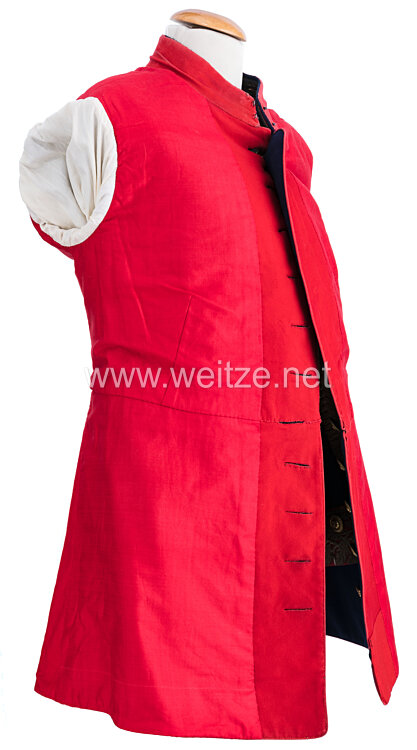
Saxon Parade Tunic from the Property of Duke Ernst I of Sachsen-Altenburg as General of Infantry

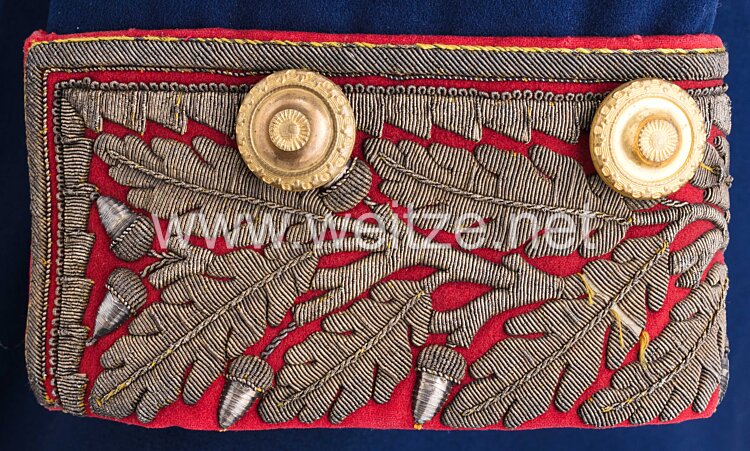
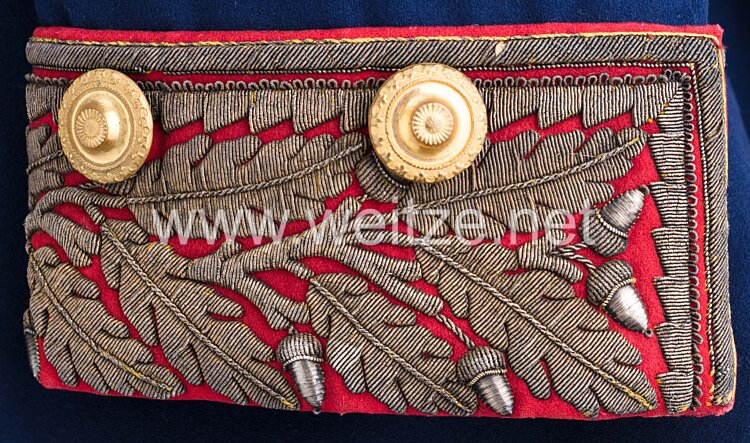
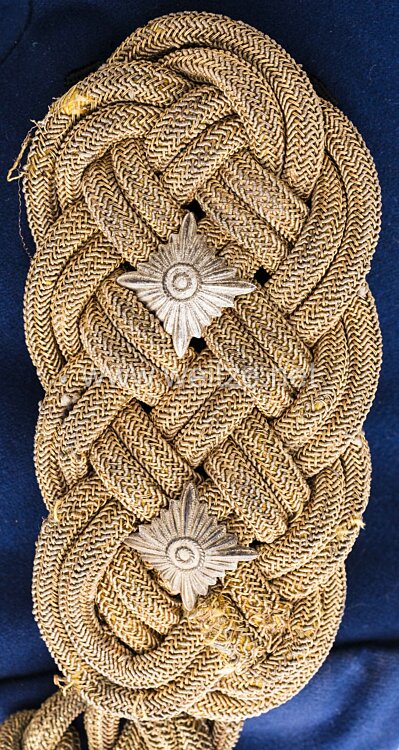
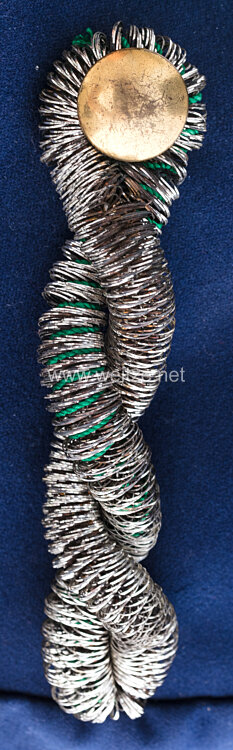
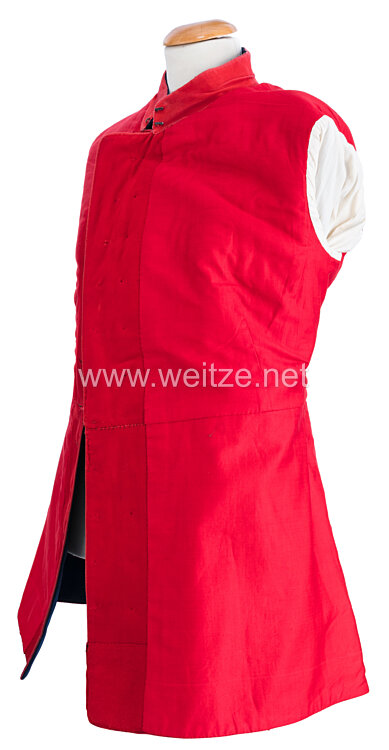
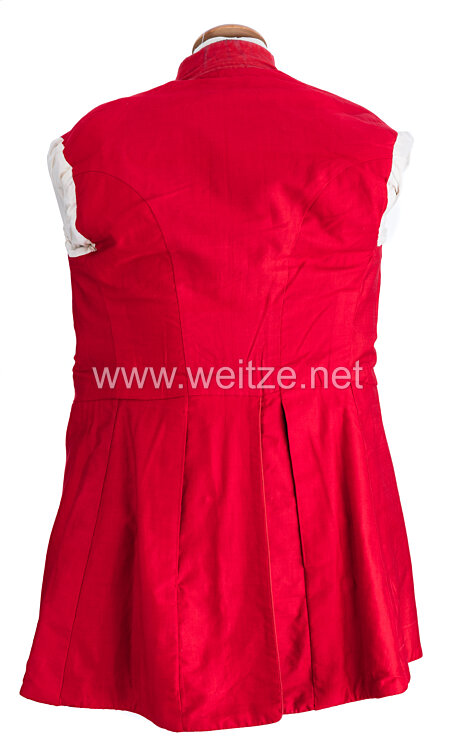
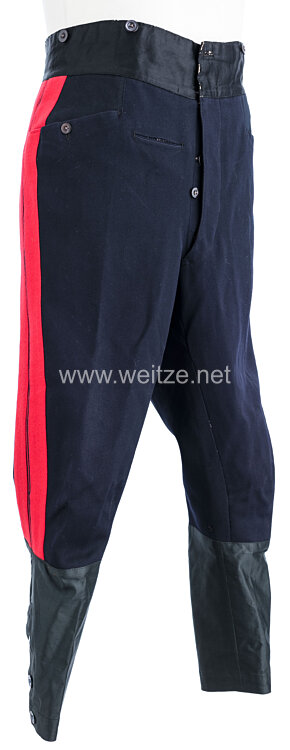
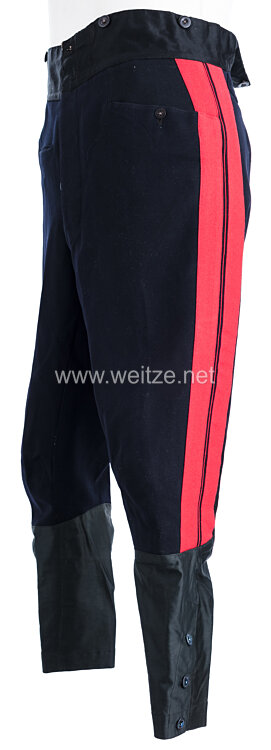
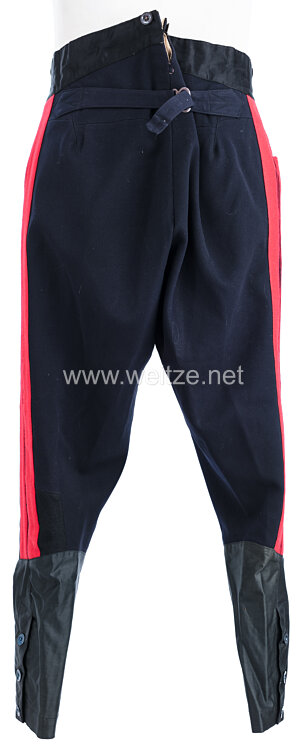
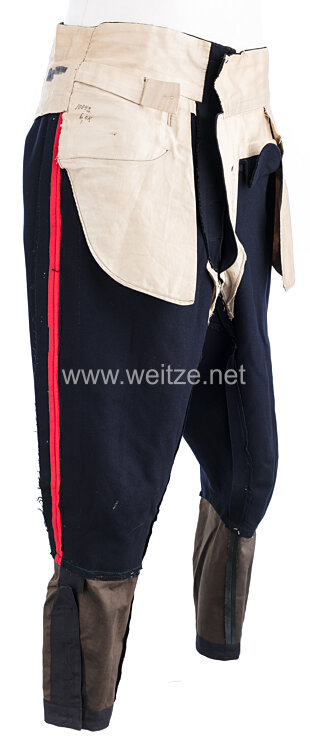
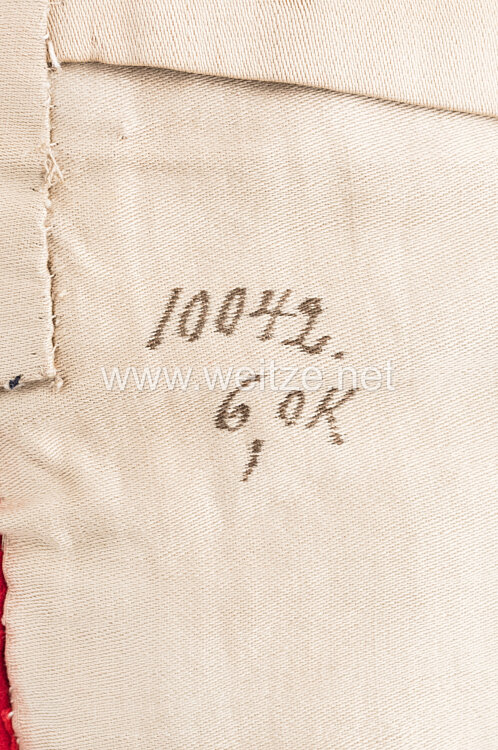
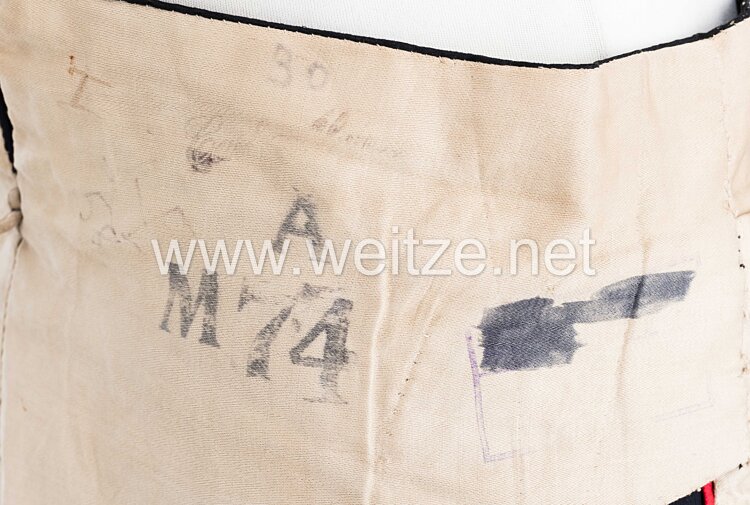
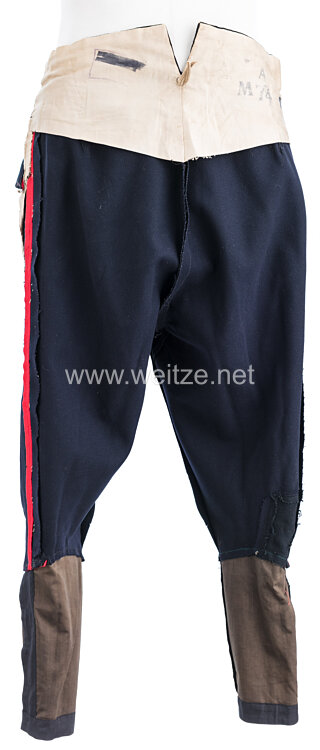
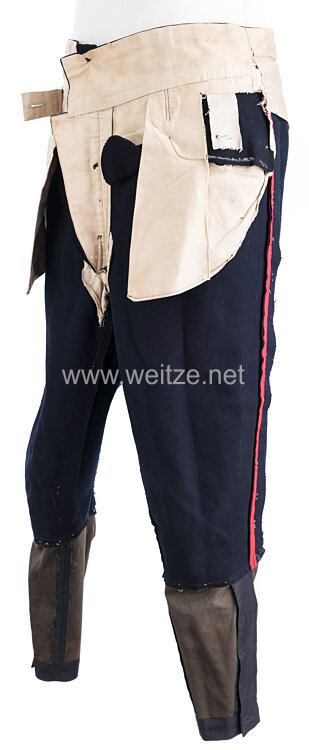
Elegant property piece, circa 1905. The tunic of fine dark blue cloth. On the red standing collar and cuff flaps the special gold embroidery of the Saxon generals. The button panel piped in red, the Saxon general's buttons gilt. On the right shoulder the heavy gold general's braid with attached parade dress cord and gilt crowns, on the shoulder board 2 large silvered rank stars. On the left shoulder the silver general's lozenge with green slashes. On the chest loops for the large medal bar as well as 6 (!) breast stars. The complete inner lining in red. Together with matching black booted trousers for wide red general's stripes. Only lightly worn, in particularly fine condition.
Ernst I. Friedrich Paul Georg Nikolaus von Sachsen-Altenburg (born September 16, 1826 in Hildburghausen; died February 7, 1908 in Altenburg) was Duke of Sachsen-Altenburg from 1853 to 1908.
290227

Saxon Parade Tunic from the Property of Duke Ernst I of Sachsen-Altenburg as General of Infantry

This magnificent Saxon parade Waffenrock of a General of Infantry from the estate of Duke Ernst I of Saxe-Altenburg represents the apex of German military ceremonial dress in the late Imperial period. Produced around 1905, this uniform embodies the independent military tradition of the Kingdom of Saxony, which maintained its own distinctive uniform regulations for generals despite the establishment of the German Empire in 1871.

The Waffenrock was introduced in the Prussian Army by Cabinet Order on 23 October 1842 and became the standard parade dress tunic across German states. When Bavaria adopted the Waffenrock in 1849, it retained lighter blue cloth; Saxony maintained dark blue for infantry but used dark green for Artillery, Pioneers, and Schützen units. By 1871, with the establishment of the German Empire, the Waffenrock had matured as the national dress uniform for the Imperial German Army. However, the Kingdoms of Bavaria and Saxony, whose army contingents remained under the command of their sovereigns in peacetime, retained their own distinctive general's uniform traditions with traditional embroidery on collar and cuffs rather than adopting the Prussian Larisch-Stickerei pattern introduced in 1900.

This tunic displays features specific to Saxon generals: golden embroidery on red collar and cuffs, special Saxon general's buttons, and two rank stars on the right shoulder indicating the rank of General of Infantry. The right shoulder bears the heavy golden general's braid with attached parade dress cord and gilded crowns. The left shoulder features the silver general's diamond-pattern braid with green threads. The chest provides loops for a large medal bar and six breast stars. The complete interior lining is in red, and the matching black riding breeches display broad red general's stripes.

Duke Ernst Friedrich Paul Georg Nikolaus of Saxe-Altenburg was born on 16 September 1826 in Hildburghausen and reigned as Duke of Saxe-Altenburg from 1853 until his death on 7 February 1908 – a remarkable reign of 55 years. His military career began in 1845 in the Saxon-Altenburg line battalion, and in 1847 he became an officer in the Prussian Army. He progressed through all ranks to Major (1853), Generalmajor à la suite (1855), and Generalleutnant (1859). During the Franco-Prussian War of 1870-71, he participated in the Siege of Paris and battles at the Loire, and witnessed the Kaiser Proclamation at Versailles on 18 January 1871.

On 28 September 1907, Kaiser Wilhelm II promoted him to the extraordinary rank of Generaloberst with the rank of Generalfeldmarschall – one of the highest honors in the Imperial German military establishment. Ernst I also held the position of Saxon Generaloberst and was Chef of Jäger-Bataillone Nr. 6 and 12. Russian Tsar Alexander II appointed him Chef of the 50th Infantry Regiment “Bialystok” in 1873. Upon his death, Kaiser Wilhelm II stated: “I and my house lose in the departed a true, sincere friend, his subjects a caring father, the Reich a loyal, proven prince who always placed his long, richly blessed life in the service of the Fatherland.”

This uniform from around 1905 was worn during the Duke's final years and represents the era of Kaiser Wilhelm II, when Ernst I held the highest military honors. The Waffenrock was the highest form of dress uniform in the Imperial German military establishment and was worn on formal occasions, parades, state receptions, military ceremonies, and court functions, always with decorations, medals, sash, and aiguillettes.

After Duke Ernst I's death on 7 February 1908, his nephew Ernst II of Saxe-Altenburg succeeded him, reigning from 1908 to 1918. Ernst II abdicated on 13 November 1918 following the German Revolution, and the Duchy of Saxe-Altenburg became the Free State of Saxe-Altenburg, which merged into the newly formed state of Thuringia in 1920. The Waffenrock as a dress uniform was largely discontinued with the end of the German Empire in 1918. The Reichswehr (1919-1935) simplified uniforming considerably. The Wehrmacht reintroduced a parade tunic also called Waffenrock in 1935 for officers, but with significant design changes. This particular uniform appears to have been preserved as a historical artifact, eventually entering the militaria collection market.

r