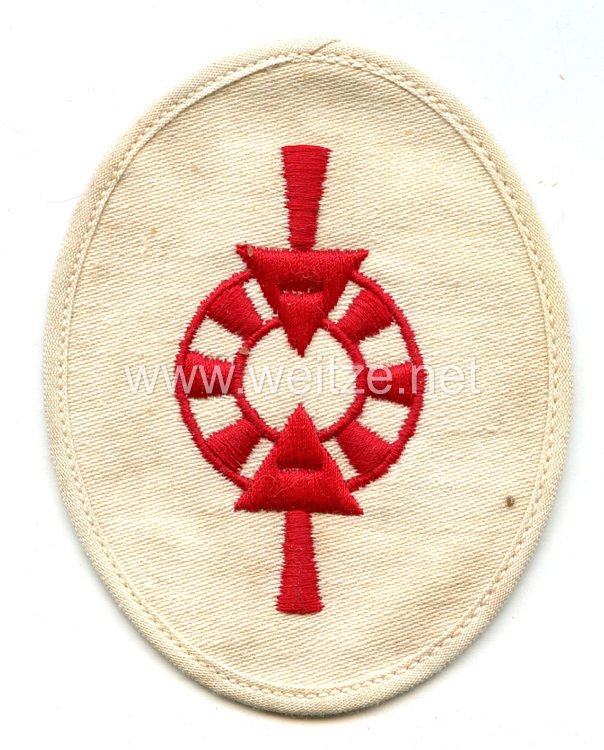
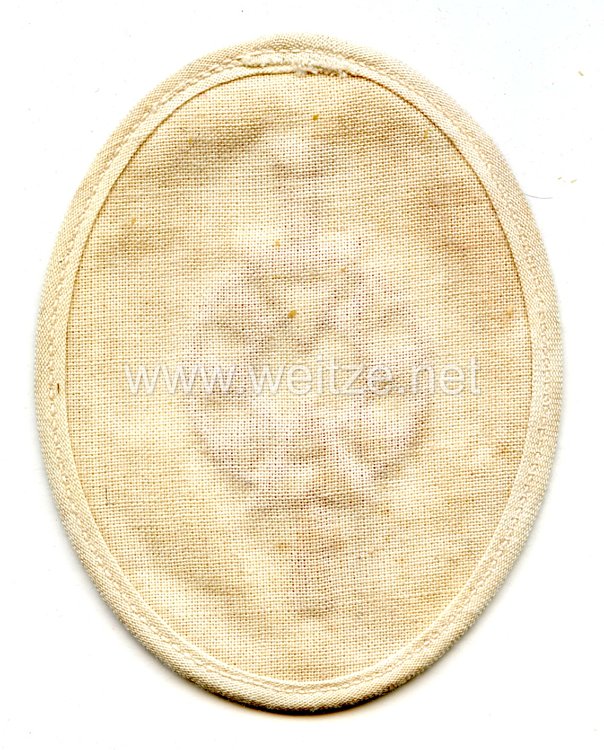
Kriegsmarine Sleeve Insignia Special Training Fire Control Petty Officer (Troop Training)
The Kriegsmarine Sleeve Badge for Special Training as Weapons Control Petty Officer represents an important aspect of the training system of the German Kriegsmarine during World War II. These special badges were introduced to identify qualified non-commissioned officers and enlisted men who had completed specialized technical training in weapons control.
Weapons control (Waffenleitung) was a highly specialized field within the Kriegsmarine, dealing with fire control and target acquisition for naval artillery. With the increasing mechanization of naval warfare in the 1930s and 1940s, precise coordination of weapons systems became increasingly important. Weapons control systems included complex optical and later electronic systems, rangefinders, and calculating devices for computing firing parameters.
The present badge was designed for the white uniform (summer uniform) and was worn on the upper arm. The Kriegsmarine strictly distinguished between different uniform variants, with the white blouse worn primarily in warmer climates or during summer months. Sleeve badges had to be adapted to match the respective uniform color.
The introduction of special training badges occurred within the framework of Kriegsmarine service regulations, which mandated clear identification of specialists. The rank of Vormann (literally “leading man”) represented a promotion level within the non-commissioned officer career path and was awarded to sailors who had distinguished themselves through exceptional performance and expertise. A Weapons Control Vormann was thus a non-commissioned officer specialized in weapons control systems.
Troop training for weapons control personnel took place at specialized naval schools, where crews were instructed in theoretical and practical aspects of fire control. This included operating optical devices, performing ballistic calculations, and coordinating between different combat stations aboard ship. The training was demanding and required mathematical understanding as well as technical skill.
The manufacture of such badges was carried out by various authorized manufacturers working according to prescribed specifications. The badges were typically hand-embroidered or machine-embroidered, using special threads and backing materials that met military requirements. For white uniforms, dark blue or black embroidery on white or light-colored backing was frequently used to create clear contrast.
In operational deployment, weapons control specialists played a crucial role in naval engagements. Their skills could mean the difference between hit and miss, especially at long ranges or in difficult sea conditions. On major warships such as battleships and cruisers, multiple weapons control specialists were stationed to coordinate various artillery systems.
The historical significance of such training badges lies in their documentation of the Kriegsmarine's highly specialized personnel system. They demonstrate how the navy attempted to ensure efficient organization through clear rank insignia and specialization markings. After 1945, all badges and symbols of the Wehrmacht and Kriegsmarine were prohibited by the Allied occupation powers.
Today, such sleeve badges are important military-historical objects that provide insight into the organization, training, and hierarchical structures of the Kriegsmarine. They are preserved by collectors and museums and serve historical research and examination of this period of German naval history.