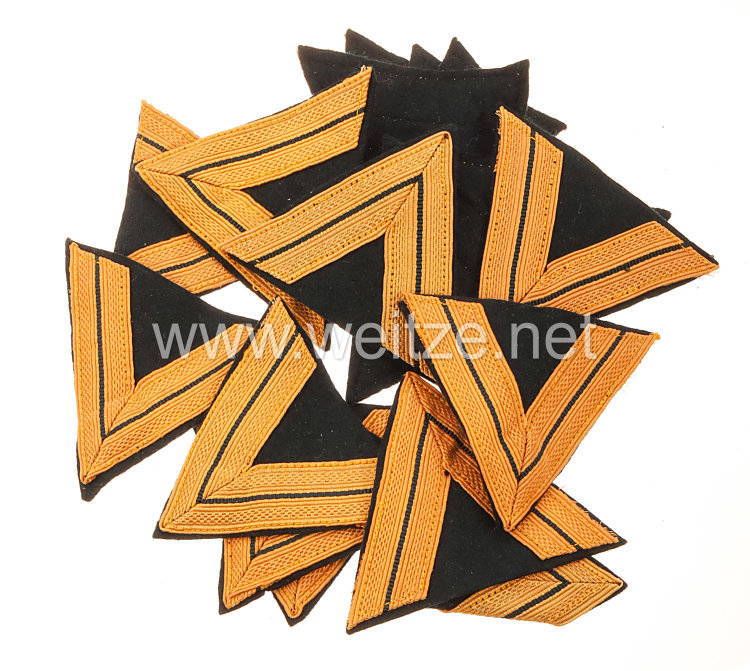
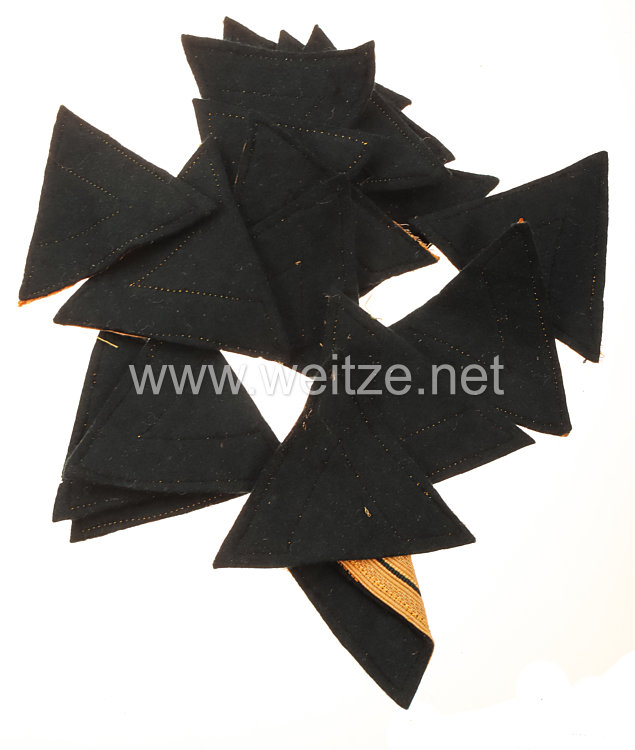
Kriegsmarine Sleeve Insignia Senior Lance Corporal (Obergefreiter) for Field Gray Uniform
Condition may vary
PRICE PER PIECE.
The Kriegsmarine sleeve insignia for Obergefreiter represents an authentic example of the uniform regulations of the German Kriegsmarine during World War II. This specific badge was worn on the field-grey uniform, a special uniform variant used by the Kriegsmarine under certain circumstances.
The Kriegsmarine, as the naval force of the German Reich from 1935 to 1945, developed a complex system of rank insignia and uniform regulations. The rank of Obergefreiter (literally “Senior Private”) was a lower enlisted rank, positioned between the simple Gefreiter (Private) and the Stabsgefreiter (Staff Private). In the Kriegsmarine hierarchy, this rank represented the third grade in the enlisted career path.
The use of dark green cloth as the base for this sleeve insignia is particularly noteworthy. While the Kriegsmarine typically wore dark blue uniforms, field-grey uniform variants existed for special operational areas. These were particularly worn by naval personnel serving in land-based units, deployed in coastal defense tasks, or working in certain administrative functions.
The dress regulations of the Kriegsmarine were governed by the Anzugsordnung für die Kriegsmarine (A.O.K.), which was updated several times. These regulations precisely specified which insignia had to be worn on which uniform parts and in what form. Sleeve insignia for enlisted ranks were usually worn on the left upper arm and indicated the respective rank through their design and number of stripes or chevrons.
The sleeve insignia of an Obergefreiter typically consisted of a specific arrangement of chevrons or stripes applied in contrasting color to the background. For field-grey uniforms, dark green cloth was frequently used as a base, onto which the rank insignia were applied. These badges were either sewn on or, in higher-quality versions, manufactured as separate pieces on cloth backing.
The production of such insignia was carried out by various manufacturers throughout the German Reich. There were both state-owned and private manufacturers producing for the Wehrmacht and its branches. Quality could vary depending on the manufacturer and production period. Towards the end of the war, when material shortages prevailed, quality was often reduced and simplified versions came into use.
The historical context of these insignia is inseparably linked to the history of the Kriegsmarine. After Germany's rearmament from 1935 onwards, the Reichsmarine was renamed Kriegsmarine. Grand Admiral Erich Raeder and later Karl Dönitz led this branch through World War II. The Kriegsmarine was active in various operations, from submarine warfare in the Atlantic to coastal defense tasks and naval infantry deployments.
Naval personnel with the rank of Obergefreiter served in diverse functions: as crew members on warships, in submarines, at coastal batteries, in naval bases, or in land-based naval units. Particularly in the latter functions, the field-grey uniform was frequently used, as it was better suited for land operations than the traditional dark blue naval uniform.
Collecting military-historical objects such as this sleeve insignia serves today's historical education and documentation. Such artifacts enable understanding of the material culture and organizational structure of historical armed forces. They are important sources for uniform studies (uniformology) and military history research.
Preservation in unworn condition makes this insignia a particularly valuable study object, as it shows the original manufacturing quality and intended colors without the patina of use. Such pieces are of special value in military-historical research, as they can serve as reference objects for comparative studies.
The dark green backing cloth, the construction method, and the overall design characteristics provide insights into the manufacturing standards and regulations of the period. For researchers and collectors alike, such insignia represent tangible connections to the organizational structure and daily life of the Kriegsmarine during one of the most significant periods in modern history.