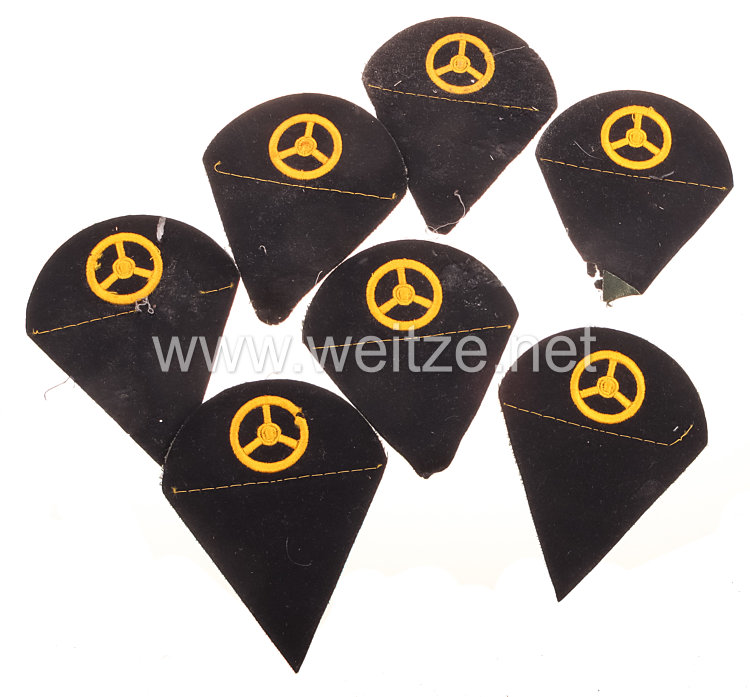
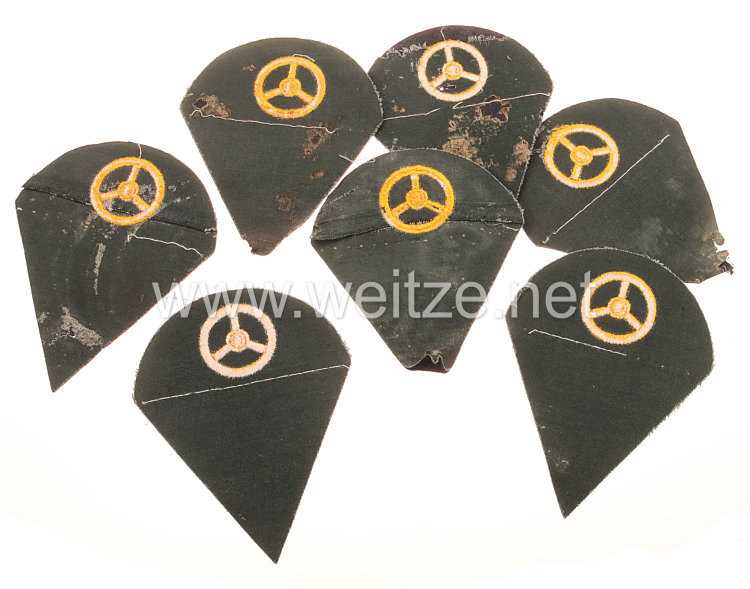
Kriegsmarine Enlisted Men's Sleeve Insignia Motor Vehicle Personnel Career Track

7 pieces, design for blue collar uniform, all partially damaged, condition 3-.


440827
35,00

Kriegsmarine Enlisted Men's Sleeve Insignia Motor Vehicle Personnel Career Track

The Kriegsmarine sleeve badges for enlisted personnel in the motor vehicle career path represent a specialized aspect of German naval uniforming during World War II. These badges belonged to a comprehensive system of career insignia that identified the various technical and administrative specializations within the Kriegsmarine.

The Kriegsmarine, as the official navy of the German Reich from 1935 to 1945, developed a complex system for identifying different ranks and specializations. The introduction of special career badges occurred within the framework of the Anzugordnung für die Kriegsmarine (Uniform Regulations for the Navy), which was revised several times to meet the growing complexity and organizational requirements of the navy.

The Kraftfahrerlaufbahn (motor vehicle career path) was one of the technical career paths that included personnel responsible for operating, maintaining, and administering motor vehicles. Although the Kriegsmarine was primarily a seafaring force, it required extensive land-based infrastructure, including naval bases, shipyards, supply facilities, and administrative centers. The transport of personnel, materials, and equipment required qualified drivers and mechanics.

The execution for the Kollani (Colani) refers to how these badges were worn on the dark blue work and service uniform of enlisted personnel. These badges were typically worn on the left upper arm and consisted of embroidery on a dark blue background that matched the uniform fabric. The design followed the precise specifications of naval clothing regulations.

The typical design of a motor vehicle career path badge usually showed a stylized cogwheel or winged wheel, symbolizing the technical nature of the specialization. The embroidery was usually executed in yellow or gold color, corresponding to the color scheme for technical career paths. The quality of production varied depending on the manufacturer and time of production, with earlier war years tending to have higher quality standards.

The enlisted ranks of the Kriegsmarine included all ranks from sailor to senior seaman and chief seaman. These ranks formed the backbone of the navy and carried out the daily tasks required for operating the fleet and its support facilities. Career badges served not only for identification but also to promote professionalism and specialization within the ranks.

The production of these badges was carried out by various authorized manufacturers throughout the German Reich. Production was subject to strict quality controls, especially in the early war years. However, as the war progressed and material shortages increased, quality often deteriorated, and simplified manufacturing processes were employed.

Collectors and military historians today value these badges as important witnesses to the organizational structure and daily life in the Kriegsmarine. The state of preservation varies greatly, as these badges were exposed to considerable wear as items of daily use. Damage such as thread loss, discoloration, and fabric wear are commonly found on original pieces and testify to their actual use.

The historical significance of these objects lies in their ability to provide insight into the less well-known aspects of naval service. While U-boats and battleships are often the focus of historical attention, it was specialists such as motor vehicle personnel who maintained the logistical infrastructure without which the fleet could not have functioned.

Today, such sleeve badges serve as study objects for understanding uniform history, organizational structure, and the material culture of the Kriegsmarine. They document the efforts of the Nazi regime to build a highly organized and specialized military establishment and are thus part of the broader history of World War II.