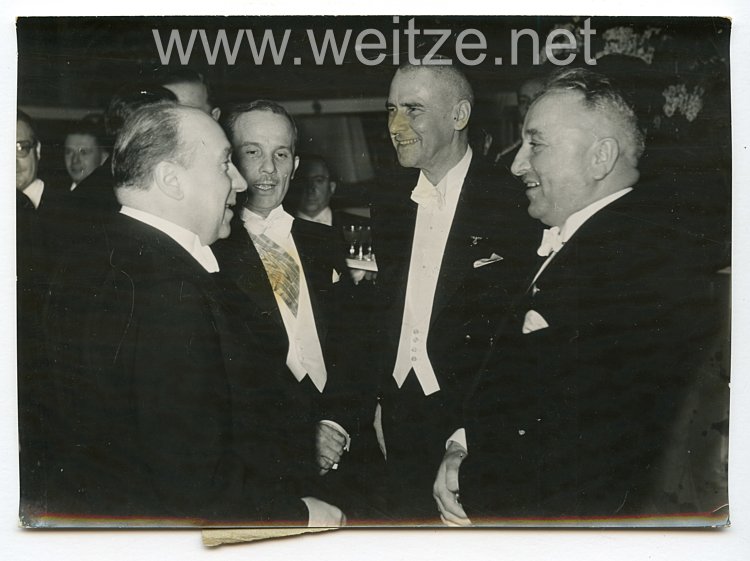
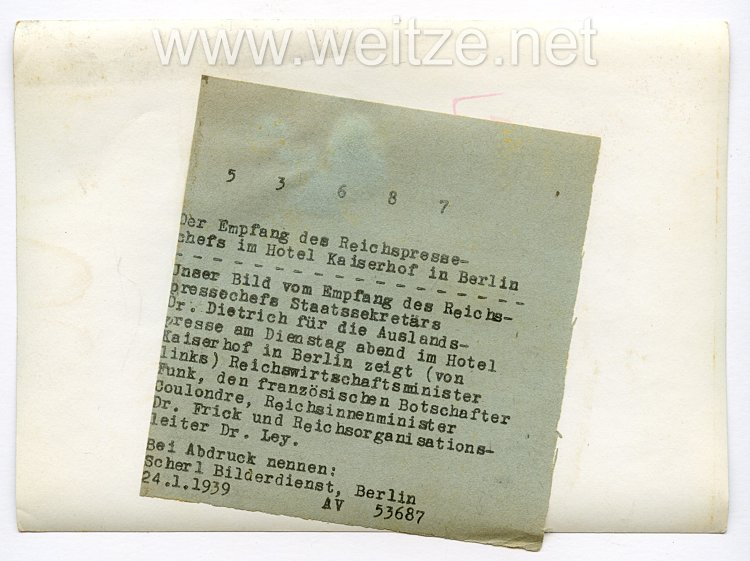
Third Reich Press Photo. 53687 Reception of the Reich Press Chief at Hotel Kaiserhof in Berlin.

Dimensions approx. 13 x 18 cm, with description on reverse, stained, used condition.
303927
20,00

Third Reich Press Photo. 53687 Reception of the Reich Press Chief at Hotel Kaiserhof in Berlin.

This press photograph from the Third Reich documents a reception hosted by the Reich Press Chief at the legendary Hotel Kaiserhof in Berlin. This historical document offers a fascinating glimpse into the propaganda machinery of the National Socialist regime and the central role that press work and photographic coverage played in exercising power.

The Hotel Kaiserhof, located on Wilhelmstraße near the government quarter, was one of Berlin's most distinguished hotels and played a significant role in the history of National Socialism. Even before the seizure of power in 1933, Adolf Hitler used the hotel as his preferred accommodation during Berlin visits. After 1933, it became an important venue for official receptions, press conferences, and meetings of the Nazi elite.

The position of Reich Press Chief was a key function in the Nazi state. This office was held by Otto Dietrich from 1937 to 1945, who simultaneously served as press chief of the NSDAP and State Secretary in the Reich Ministry for Public Enlightenment and Propaganda under Joseph Goebbels. Before Dietrich, Walther Funk held this position. The Reich Press Chief was responsible for coordinating all press policy measures and controlling reporting throughout the Reich.

Press photography in National Socialism was a strictly regulated instrument of state propaganda. Photographs were taken by authorized photographers and distributed through central offices such as the Presse-Hoffmann archive, Scherl Bilderdienst, or directly through the Propaganda Ministry. Each photo carried an official description on the reverse and often a number, such as the “53687” mentioned here, which served archival and control purposes.

The daily press conferences of the Reich government initially took place in the Propaganda Ministry, later also in other representative venues such as the Hotel Kaiserhof. There, journalists received detailed instructions on which topics to cover and how, which formulations to use, and which photographs could be published. This strict control turned the German press into a mere mouthpiece for the regime.

The Reich press conferences were mandatory events for all capital journalists. The “language regulations” issued there had to be followed by all newspapers. Violations could lead to withdrawal of accreditation or closure of the newspaper in question. The Editor's Law of 1933 had transformed editors into “Schriftleiter” (writing directors), who were obligated as state functionaries to follow the propaganda line.

Photographs like this one served several purposes: they documented the supposed normality and order of the regime, staged the rulers in dignified settings, and suggested an open press culture while total control actually prevailed. The careful preservation and labeling of these images demonstrates their importance as historical documents of Nazi propaganda.

The format of approximately 13 x 18 cm corresponds to a common press image format of that era. The description on the reverse was standard for all official press photos and typically contained information about location, date, persons depicted, and the event. The mentioned stains and signs of use are characteristic of working copies that were actually used in editorial offices.

After the war, many of these press photographs became part of archives and collections, where they now serve as important sources for researching Nazi propaganda. They provide insights into the regime's self-representation and the mechanisms of opinion manipulation. The Hotel Kaiserhof itself was severely damaged in the 1945 Battle of Berlin and was not rebuilt in the post-war period.

Such documents are now significant contemporary witnesses that document both the technical aspects of historical photography and the political structures of totalitarian rule. They belong to our cultural heritage and serve the purpose of historical education about the mechanisms of National Socialist propaganda.

r