Army - Award Document Iron Cross 2nd Class
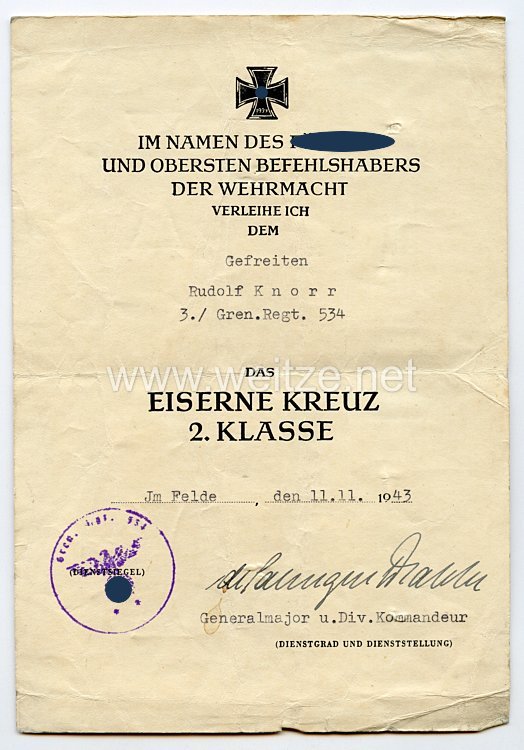
The award document for the Iron Cross 2nd Class represents a significant artifact of German military history during World War II. This particular example was issued on November 11, 1943 to a Gefreiter (lance corporal) of the 3rd Company / Grenadier Regiment 534 and bears the signature of Generalmajor Hans de Salengre-Drabbe, who served as division commander at that time.
The Iron Cross was originally established in 1813 during the Wars of Liberation against Napoleon by King Friedrich Wilhelm III of Prussia. Adolf Hitler reinstated the decoration on September 1, 1939, the day of the German invasion of Poland, through the “Law for the Renewal of the Iron Cross.” The award was issued in two classes, with the Iron Cross 2nd Class being the lower grade and typically awarded before the Iron Cross 1st Class.
The award criteria for the Iron Cross 2nd Class were clearly defined during World War II. It was bestowed for bravery in the face of the enemy or special merit in troop leadership. The decoration could be awarded to soldiers of all ranks, from common enlisted men to general staff officers. By the end of the war, several million Iron Crosses 2nd Class had been awarded, underscoring the widespread distribution of this decoration.
Grenadier Regiment 534 was part of the German army units on the Eastern Front. In November 1943, the date of this award document, the Wehrmacht found itself in an increasingly defensive position. Following the devastating defeat at Stalingrad in February 1943 and the failed offensive at Kursk in the summer of that year, strategic initiative had definitively passed to the Soviet Union.
Generalmajor Hans de Salengre-Drabbe was himself a highly decorated officer who had been awarded the Knight's Cross of the Iron Cross on February 22, 1942. The Knight's Cross represented a substantially higher decoration and was awarded only for exceptional leadership achievements or extraordinary bravery. As division commander, de Salengre-Drabbe had the authority to award the Iron Cross 2nd Class to members of his division.
The formal design of such award documents followed strict guidelines. Typically, they were printed on high-quality paper, often with pre-printed text and handwritten individual details such as name, rank, unit, and award date. The certificates usually bore the state emblem of the Third Reich as well as the signature and official seal of the awarding commander. The described example shows a center fold, which was typical for storage in military pay books or personal document folders.
The condition rating of 2- indicates a very well-preserved certificate with only minimal signs of use. This is remarkable, as many such documents did not survive the chaos of the war's end, flight, captivity, or deliberate destruction. The preservation of such documents enables historians and collectors today to study the military recognition culture and administrative practices of the Wehrmacht.
The historical significance of such award documents lies not only in their function as military certificates but also in their value as contemporary historical sources. They document the deployment of individual soldiers and units, the hierarchies within the Wehrmacht, and the geographical and temporal distribution of military operations. For research on the military history of World War II, they represent indispensable primary sources.
The year 1943 marked a turning point in World War II. While German propaganda still spoke of “final victory,” the military reality was characterized by increasing losses, retreats, and an overwhelming material superiority of the Allies. The awarding of decorations such as the Iron Cross also served to maintain morale and was intended to strengthen the combat readiness of the troops.
Today, such documents are collected and researched as military-historical objects. They serve as material witnesses to a dark epoch of German history and remind us of the need for remembrance and critical examination of the past.