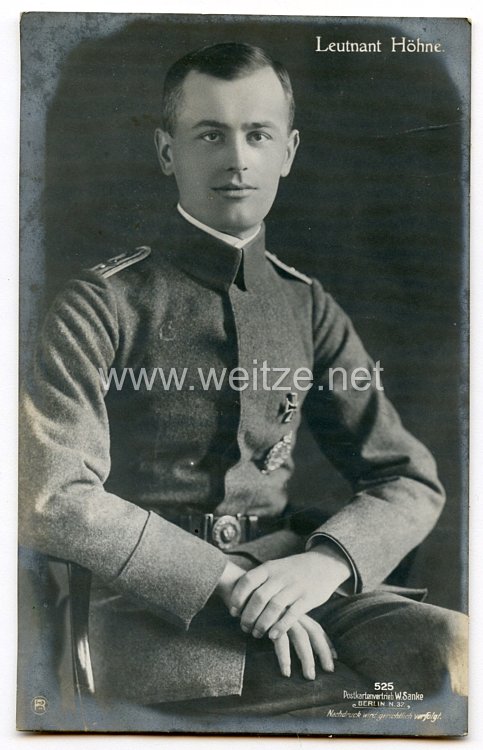
World War I Aviation - German Flying Ace “Leutnant Höhne”

on Sanke postcard No. 525, unmailed, condition 2.
416727
35,00

World War I Aviation - German Flying Ace “Leutnant Höhne”

This Sanke postcard No. 525 documents a German aviator officer of World War I and belongs to the significant series of aviation cards published by Gustav Liersch & Co. in Berlin, known as Sanke cards. These postcards represented an important part of German propaganda work and hero worship during the First World War.

The Gustav Liersch publishing house, later continued under photographer Hermann Sanke, produced over 1,000 different motifs of military personnel between 1914 and 1918, with aviators occupying a particularly prominent share. The cards were printed in high volumes and served both home front morale and as collectibles. The systematic numbering enables precise cataloging of these historical documents today.

The Imperial German Air Service evolved during World War I from an experimental reconnaissance unit to an independent branch of the armed forces. At the outbreak of war in 1914, Germany possessed approximately 230 aircraft; by war's end in 1918, there were several thousand. Aviators were quickly stylized as heroes, as aerial combat was portrayed as a modern, chivalrous form of warfare – in contrast to the anonymous mass death in the trenches.

The depiction of Lieutenant Höhne on this card falls in line with the portraiture of numerous German fighter and combat pilots. While names like Manfred von Richthofen, Oswald Boelcke, or Max Immelmann gained worldwide fame, Sanke cards also documented less prominent officers who nevertheless made important contributions to aerial warfare. The photographs typically show the officers in uniform with medals and decorations, often in front of or inside their aircraft.

The condition grade 2 according to collector classification designates very good preservation with possibly minimal signs of use. The fact that the card is unmailed – never used postally – significantly increases its collector value, as there are no stamps, inscriptions, or transport damage present.

The military organization of the German air forces was complexly structured. Fighter squadrons (Jagdstaffeln or Jastas), bomber squadrons, and reconnaissance units formed the backbone of the air service. Officers like Lieutenant Höhne underwent intensive training that included theoretical instruction, flight training, and tactical schooling. The average life expectancy of a fighter pilot on the Western Front was sometimes only a few weeks, which further enhanced the heroic status of these men in public perception.

The iconography of these postcards followed certain conventions: the portraits were meant to convey courage, determination, and Prussian virtues. The uniforms with the characteristic Pour le Mérite (colloquially "Blue Max"), the Iron Cross, and other decorations were central visual elements. These representations had a lasting impact on the image of the "flying hero" in German society.

From today's historical perspective, these Sanke cards are valuable sources for research on propaganda, hero worship, and visual culture of World War I. They document not only individual military personnel but also the manner in which the war was presented to the civilian population. The mass distribution of such images contributed to the popularization of aviation and profoundly influenced the postwar generation.

Collectors and museums today particularly value unmailed specimens in good condition, as they preserve the original print quality and coloring. Sanke cards are an integral part of military history collections worldwide and are cataloged and scientifically evaluated in standard works on German military history of World War I.

r