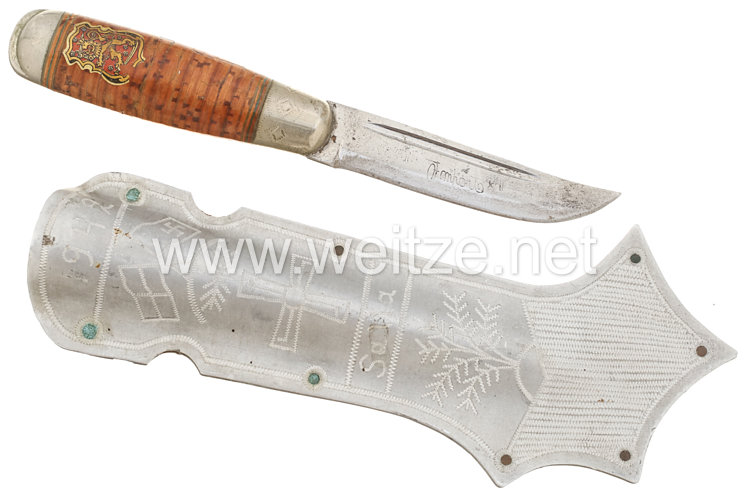
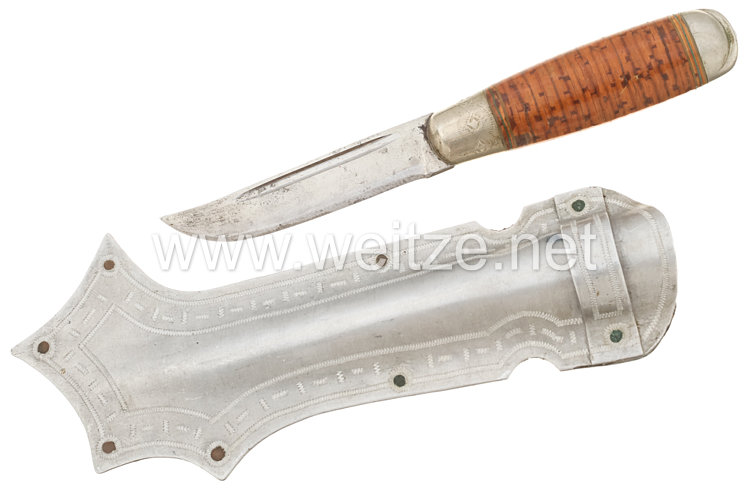
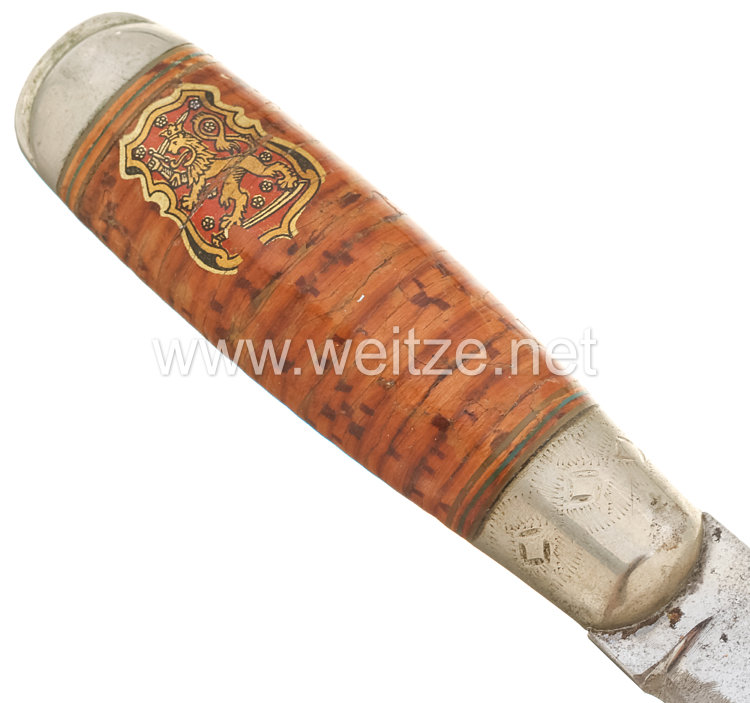
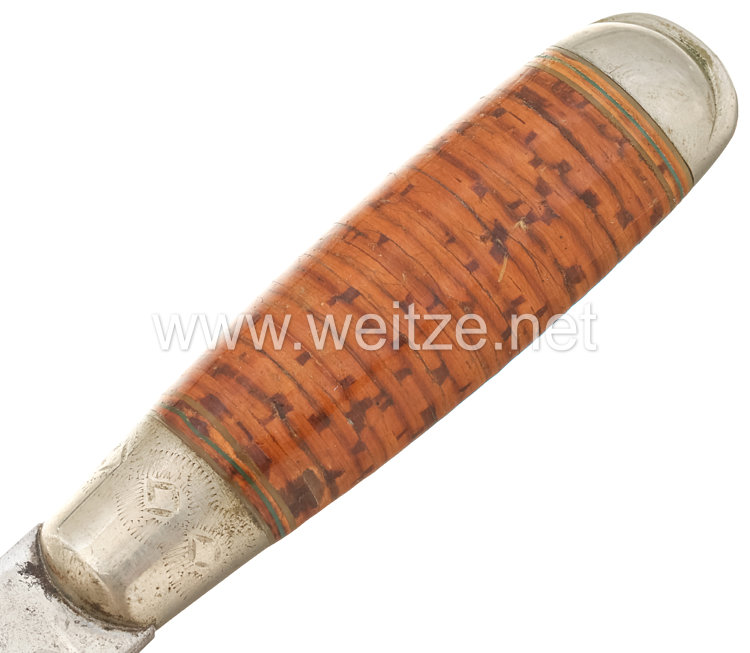
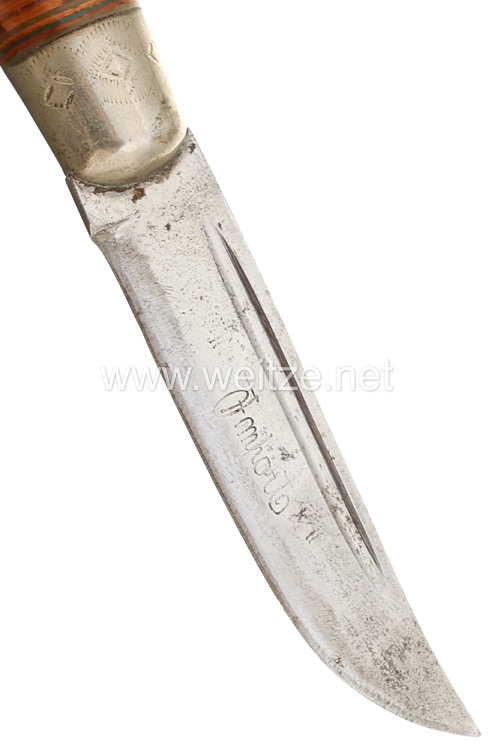
Finland Traditional Knife, so-called “Puukko”
Typical souvenir of a Wehrmacht member who was deployed on the Northern Front.
The Finnish puukko (Finnish: puukko, plural puukot) represents one of the most characteristic elements of Finnish culture and craftsmanship tradition. As a traditional utility knife, it has held a firm place in the daily life of the Finnish population for centuries and became an important symbol of Finnish identity and resilience during World War II.
The described specimen dates from 1942, a period of intense fighting on the Finnish-Soviet front. The engraving “Salla” refers to a strategically important region in Lapland that was fiercely contested during both the Winter War (1939-1940) and the Continuation War (1941-1944). Salla was occupied by Soviet troops during the Winter War and recaptured by Finnish units in July 1941.
The construction of this knife displays several period-typical features. The laminated wood grip was a characteristic material of wartime, when traditional materials became scarce. However, the lacquered laminated wood offered good durability and provided a secure grip. The single-edged blade with fuller corresponds to the classic puukko form that had proven itself over centuries. The fuller reduced weight and increased the blade's flexibility.
Particularly noteworthy is the sheath made from aircraft aluminum. During the war, materials from shot-down or damaged aircraft were frequently used to manufacture everyday items and souvenirs. The wings of Soviet or even Finnish machines provided high-quality aluminum that was easy to work with. The elaborate decorations on the sheath – Finnish flag, swastika, Baltic cross, and year – document Finland's complex political situation during the war.
The swastika on this sheath refers to multiple contexts: On one hand, the Finnish Air Force had used a blue swastika as a national symbol since 1918, completely independent of German National Socialism. On the other hand, it symbolizes the “brotherhood-in-arms” between Finnish troops and the German Wehrmacht during the Continuation War. German soldiers were stationed in large numbers in northern Finland from 1941 onwards, particularly as part of Operation Silver Fox.
The Baltic Cross (also known as the Freedom Cross) was the national marking of the Finnish armed forces and appears on vehicles, aircraft, and military equipment. Its presence on this knife underscores the military context of the piece.
Such souvenir knives were frequently manufactured by Finnish soldiers or civilians and sold or traded to German soldiers. They served as mementos of the common struggle and were highly sought after by German members of the mountain troops and other units deployed on the Northern Front. The German 20th Mountain Army under General Eduard Dietl was the Wehrmacht's main force in Finland and operated in the region around Salla, Murmansk, and Petsamo.
After the Moscow Armistice in September 1944, Finland was forced to expel German troops from its territory, leading to the Lapland War (1944-1945). Many German soldiers took their Finnish souvenirs home, where they became historical witnesses to a complex and often contradictory brotherhood-in-arms.
The puukko itself remains an important symbol of Finnish culture to this day. Traditionally passed from fathers to sons, it belongs to Finnish national costume. The specimens manufactured during the war with their specific symbolism are now important historical artifacts documenting the dramatic years when Finland defended its independence against the Soviet Union.