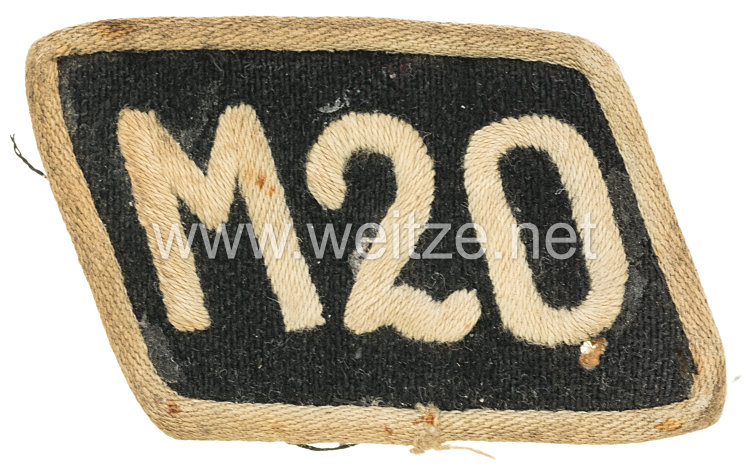
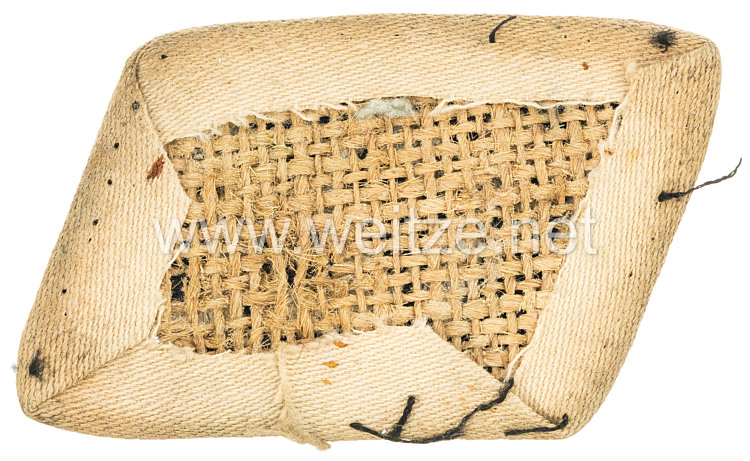
Allgemeine-SS Single Collar Tab for Members of Motorsturm 20

Early pattern, pre-1933. Hand-embroidered “M 20” with white piping. Clearly worn, condition 2-. Very rare.
433427
650,00

Allgemeine-SS Single Collar Tab for Members of Motorsturm 20

This single collar tab of the Allgemeine SS for members of Motorsturm 20 represents a significant artifact from the early phase of the National Socialist organization before 1933. This hand-embroidered version bearing the designation “M 20” with white edging documents the development of SS uniforming during a period of transition and formation.

The Schutzstaffel (SS) was founded in 1925 as a small bodyguard unit for Adolf Hitler and developed under the leadership of Heinrich Himmler from 1929 into one of the most powerful organizations of the Nazi regime. In the early years, particularly before the seizure of power in 1933, the SS was still a relatively small formation within the NSDAP, whose members wore special insignia to document their affiliation to specific units.

The Motorstürme (motorized storm units) represented a specialized formation within the early SS. These units were equipped with motorized vehicles and undertook important logistical and operational tasks. Motorsturm 20 was one of these early motorized units, whose precise geographical assignment and area of responsibility emerged from the decentralized organizational structure of the SS during the “Time of Struggle” (Kampfzeit).

The collar tabs (Kragenspiegel) developed into a central element of SS uniforming. Before 1933, these insignia were not yet fully standardized, and various forms of execution existed. The hand-embroidered manufacture, as present in this example, was characteristic of the early period when industrial mass production had not yet been established. Each piece was individually crafted, often by local artisans or specialized embroidery workshops.

The white edging and the inscription “M 20” served for clear identification of unit affiliation. In the early phase of the SS, as the organization was still expanding rapidly and new formations were being created, clear identification was essential. The Motorstürme used special markings that distinguished them from regular foot formations.

The manufacture of such collar tabs followed certain guidelines, which however were not yet as strictly regulated before 1933 as in later years. The black base color of the collar tab corresponded to the characteristic SS uniform, which deliberately distinguished itself from the brown SA uniforms. The embroidery in white on black ground created a clear contrast and enabled good readability of the unit designation.

The condition showing clear signs of wear indicates actual use during the Kampfzeit. This significantly increases the historical value of the object, as many early SS uniform items did not survive the turbulent years or were later destroyed. Worn pieces from the period before 1933 are therefore extraordinarily rare today and of particular interest to collectors and historians.

After the seizure of power in 1933, SS uniforming became increasingly standardized and unified. The SS clothing regulations were formulated more precisely, and production was centralized. The early, individually manufactured pieces were gradually replaced by standardized factory goods. This makes specimens from the pre-period important documents of the organizational development of the SS.

The Motorsturm units were integrated into the larger SS structure over time and lost their independent identification. The special collar tabs with unit designations were replaced by the standardized system with rank insignia and uniform runes, which became part of the characteristic appearance of the SS from the mid-1930s onward.

From a military-historical perspective, such early uniform items document the development of paramilitary organizations in the Weimar Republic and their transition to state instruments of power after 1933. They are testimonies of a time of political radicalization and organizational formation, the study of which is essential for understanding this historical epoch.

r