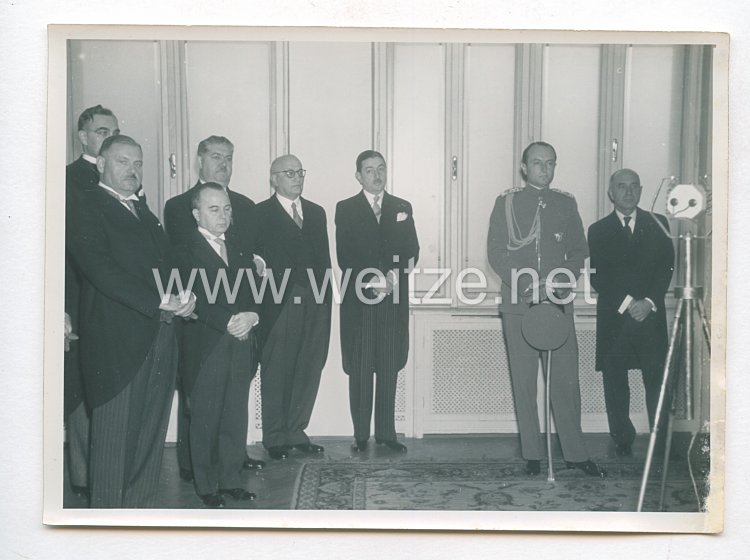
Third Reich Press Photo: Ceremonial Opening of the Exhibition of the German Book at the Museum of Prince Paul 1939 in Belgrade

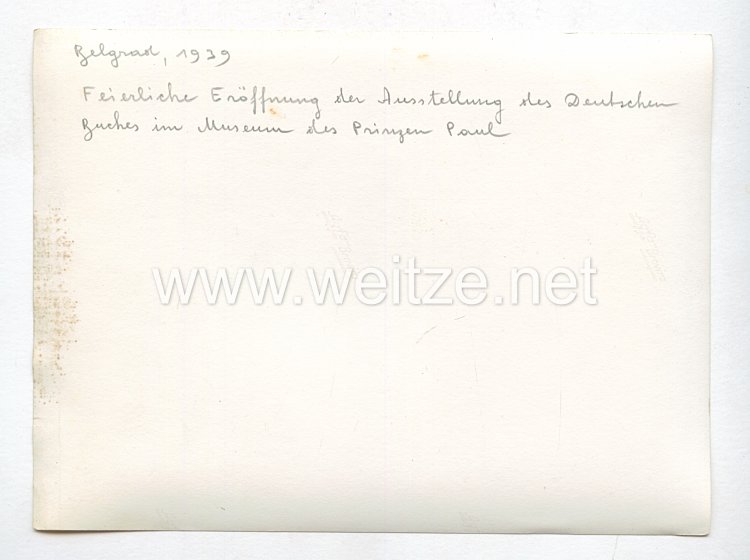
Dimensions approx. 13 x 18 cm, inscribed on reverse, used condition.
343727
15,00

Third Reich Press Photo: Ceremonial Opening of the Exhibition of the German Book at the Museum of Prince Paul 1939 in Belgrade

Historical Context: Press Photograph of the Opening of the German Book Exhibition in Belgrade 1939

This press photograph documents the ceremonial opening of the Exhibition of the German Book at the Museum of Prince Paul in Belgrade in 1939. It represents a typical example of National Socialist cultural propaganda abroad during the immediate pre-war period.

The Third Reich and Cultural Propaganda

The National Socialists recognized early on the importance of cultural policy as an instrument of foreign policy. The Reich Ministry of Public Enlightenment and Propaganda under Joseph Goebbels systematically coordinated the dissemination of German culture abroad. Book exhibitions were a central element in presenting Nazi Germany as a nation of culture while simultaneously conveying ideological content.

These exhibitions presented not only literary works but served to spread National Socialist ideology under the guise of cultural events. They were part of a comprehensive strategy to influence public opinion in friendly countries or those considered strategically important.

German-Yugoslav Relations in 1939

In 1939, Yugoslavia found itself in a complex foreign policy situation. The Kingdom attempted to maintain its neutrality while navigating between the interests of the Axis powers and the Western Allies. Prince Paul Karađorđević, who served as regent for the underage King Peter II, pursued a cautious foreign policy.

Germany intensified its cultural and economic relations with Yugoslavia during this period. The exhibition at the Museum of Prince Paul was part of these efforts to consolidate German influence in the Balkans. The choice of venue – a museum named after the regent – underscores the official sanctioning of this cultural event by the Yugoslav government.

Press Photography in the Third Reich

Press photographs were strictly controlled media products in the Third Reich. The Reich Ministry of Public Enlightenment and Propaganda exercised control over photographic reporting through various mechanisms. Photographers had to be members of the Reich Press Chamber, and all publications were subject to censorship.

Photos of official events were centrally distributed with standardized captions. The reverse inscriptions on such photos typically contained information about the event, date, and often instructions for use. These images were distributed to newspaper editors at home and abroad to ensure uniform reporting.

The Significance of Book Exhibitions

Book exhibitions abroad had been an established instrument of German cultural policy since the 1920s. After 1933, however, they became increasingly ideologized. The exhibitions showed a curated selection of German literature that reflected or at least did not contradict the National Socialist worldview.

At the same time, works by Jewish authors, pacifist literature, and other books labeled as “degenerate” were systematically excluded. The exhibitions were meant to create the impression that Germany possessed a flourishing cultural landscape, while domestically the book burnings had already taken place since 1933 and freedom of expression was massively restricted.

The Balkans in NS Foreign Policy

The Balkans held considerable strategic importance for the Third Reich. The region was economically important as a supplier of raw materials and politically as a buffer zone against Soviet interests. Cultural events such as the documented book exhibition served to win sympathies and strengthen German influence.

This intensive cultural penetration was part of the preparation for the coming war. When Germany attacked Yugoslavia in April 1941, it had already spent years working to gain influence in the region.

Collector Value and Historical Significance

Such press photographs are important historical documents today. They provide insight into the propaganda machinery of the Third Reich and document cultural policy activities abroad. The reverse inscription is often as revealing as the image itself, as it discloses the intended interpretation of the event.

For collectors and historians, these photographs are valuable because they document the everyday reality of NS cultural policy. They show how systematically the regime attempted to shape its image abroad and pursue political goals through cultural means.

The present photograph, with its dimensions of approximately 13 x 18 cm, corresponds to the standard format for press photos of this period and confirms through its inscription the typical use as press material for contemporary reporting.