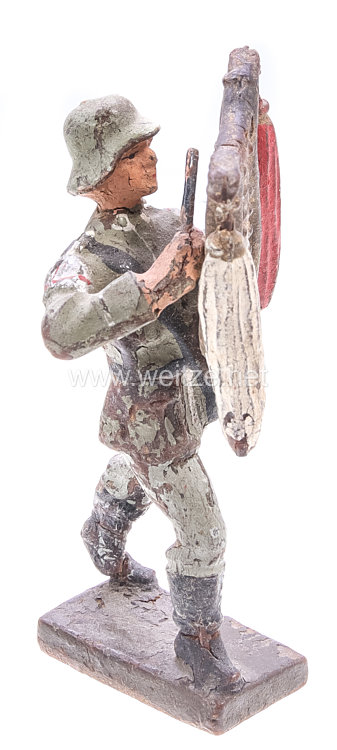
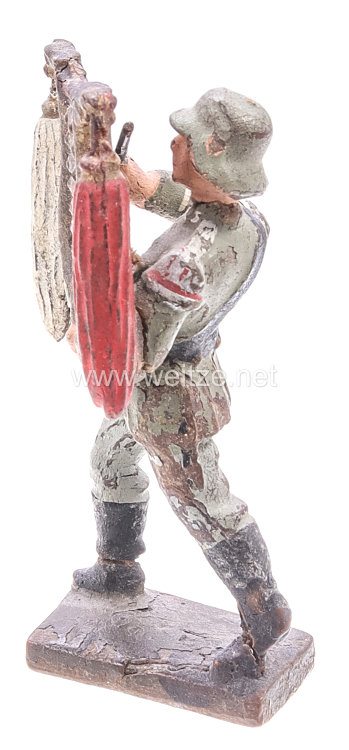
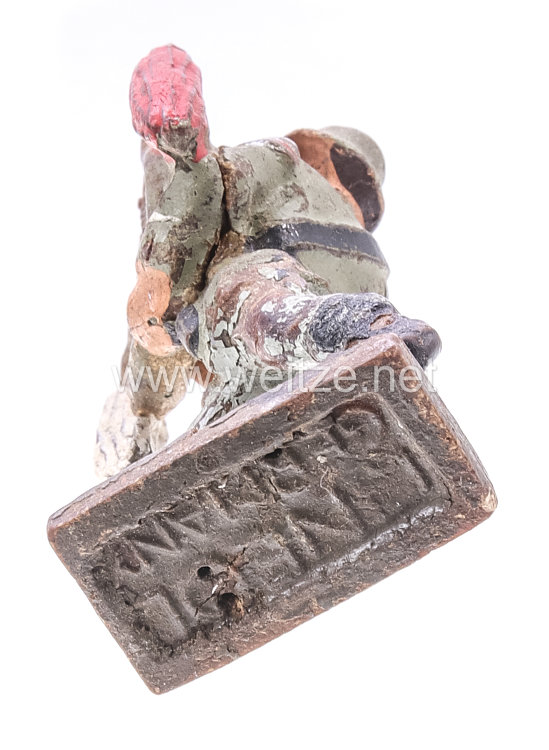
Lineol - Army Lyre Bearer Marching

7 cm, condition 2/2-.
406026
25,00

Lineol - Army Lyre Bearer Marching

The Lineol figure of a marching lyre bearer of the Wehrmacht represents a fascinating chapter in German toy history and military tradition. Standing 7 cm tall, this figure belongs to the classic Elastolin and Lineol composition figures manufactured in Germany between the 1930s and 1940s.

The Lineol company was founded in 1906 by Oskar Wiederhholz in Brandenburg an der Havel and developed into one of the leading German manufacturers of composition figures. The name “Lineol” was derived from the words “Linie” (line) and “Elastolin,” the latter referring to the material used. The figures were made from a composition material consisting primarily of sawdust, casein, chalk, and other binding agents, formed around a wire armature.

The lyre bearer was an important component of German military bands and music corps. The lyre, also known as a bell lyre or jingling johnny, is a traditional marching instrument that originated in Turkish Janissary music. During the 18th and 19th centuries, this instrument was adopted by European military bands and evolved into a symbol of military pageantry and ceremony.

In the Wehrmacht, music corps played a significant role in military ceremonies, parades, and boosting troop morale. The Army music corps were organized according to the “Heeresmusikinstruktion” (Army Music Instruction) of 1926 and subsequent regulations. Each regiment had its own music corps, whose uniforms were distinguished by special insignia and decorations. Lyre bearers carried their instruments in an upright position during marches at ceremonial occasions.

Lineol figures from this era are today sought-after collector's items that are significant not only from a toy history perspective but also culturally and historically. They document the representation of military units in popular culture and children's toys of the 1930s. The detailed execution of these figures, from uniforms to body posture, demonstrates the craftsmanship quality of toy production at that time.

Lineol's production technique was highly developed for its time. After forming the composition material around the wire armature, the figures were dried, primed, and hand-painted. The painting was executed with great attention to detail, with uniform colors, rank insignia, and equipment items reproduced true to life. The quality of painting and the state of preservation are today essential criteria for evaluating such figures.

The condition rating of 2/2- for this figure indicates very good preservation, which is remarkable for composition figures from this period. These figures were designed as children's toys and consequently subject to heavy use. Many examples showed damage, paint wear, or breaks over the decades.

After World War II, Lineol production was initially discontinued but later resumed on a reduced scale. However, the original molds and quality of the pre-war period were never again achieved. The company finally ceased production permanently in 1983.

Today, Lineol figures are important testimonies of German toy history and are valued by collectors worldwide. They document not only the military equipment and uniforms of their time but also the societal role of the military in Germany during the interwar period and World War II. Museums and private collections preserve these objects as cultural-historical documents of a complex epoch in German history.

r