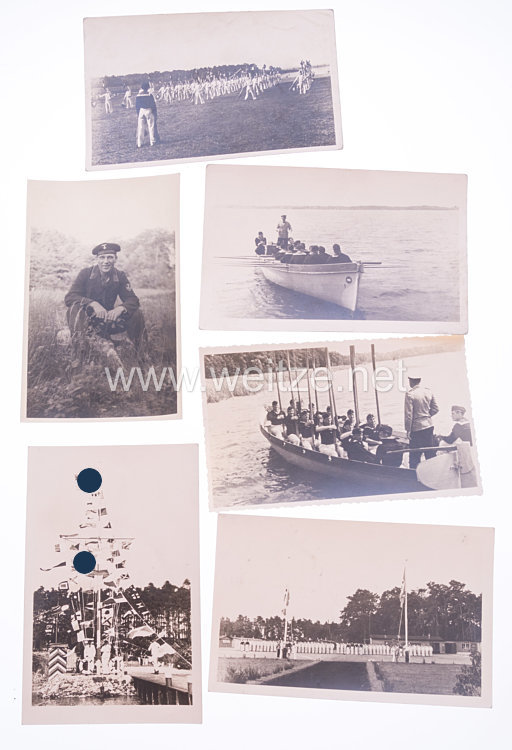
Kriegsmarine Photographs of a Sailor During Training

6 photographs, Condition 2- 
317726
25,00

Kriegsmarine Photographs of a Sailor During Training

These photographs of a Kriegsmarine member during training represent an authentic testament to military training practices in the German Kriegsmarine during World War II. Such personal photographic documents offer a unique insight into the daily life of young sailors who served in Germany's rebuilt naval force between 1935 and 1945.

The Kriegsmarine was officially founded on May 21, 1935, when Nazi Germany signed the Anglo-German Naval Agreement, openly violating the provisions of the Treaty of Versailles. Under the leadership of Grand Admiral Erich Raeder and later Karl Dönitz, the Kriegsmarine developed into a significant naval force that at its peak comprised over 810,000 men.

Sailor training in the Kriegsmarine followed a strictly regulated system. New recruits first underwent basic training, which typically took place at one of numerous training facilities along the North and Baltic Sea coasts. Major training locations included Stralsund, Wilhelmshaven, Kiel, and Flensburg-Mürwik, home to the renowned Naval Academy Mürwik.

Training generally lasted several months and included both theoretical and practical elements. Recruits learned navigation, seamanship, weapons training, communications, and the operation of various technical equipment. Physical conditioning was particularly important, as was ideological education in National Socialist doctrine. The training was rigorous and demanded absolute discipline.

Photography played an important role in military and personal life during this period. Despite partially existing photography bans in sensitive areas, soldiers were permitted in many training situations to take private photographs. These photos served not only as personal mementos but were often sent to family members to inform them of the soldier's well-being. Many young men were proud to be part of the Kriegsmarine and wanted to document this through photographs.

Typical subjects of such training photographs showed recruits in various situations: during drill exercises, weapons training, practical exercises on training ships, or during leisure time in the barracks. Group photographs were often taken to document the spirit of camaraderie. Individual portraits in uniform were also very popular, as they expressed pride in one's military career.

The naval uniform visible in such photographs followed traditional maritime design principles. The characteristic dark blue uniform with the sailor collar, sailor cap with cap ribbon, and corresponding rank insignia was internationally recognizable as German naval attire. The cap ribbon bore different inscriptions depending on assignment, such as the name of the ship or unit.

From a historical perspective, such private photographic documents possess significant source value. They supplement official military records and propaganda photographs with a personal dimension. While official photos were often staged for propaganda purposes, private photographs frequently show more authentic insights into military daily life. They document the faces of young men who were often barely of legal age when they began their military service.

The condition of such historical photographs varies greatly. Classification as “Condition 2” indicates good to very good preservation, where the images are still clearly recognizable but may show slight signs of age or use. This is quite remarkable for photographs that are over 75 years old and were often stored under difficult conditions.

For collectors and military historians, such photographic documents are of particular interest. They enable the study of Kriegsmarine uniforms, equipment, and training methods. Additionally, they provide starting points for researching individual fates and the social history of the military. The Kriegsmarine suffered substantial losses during World War II, particularly in the U-boat service, where the loss rate exceeded 75 percent.

Today, such photographs serve as both a reminder and historical testimony. They commemorate a time when young men were sent into a devastating war while simultaneously documenting the military culture and organization of a bygone era. Their preservation and scholarly analysis contribute to understanding this complex historical period.